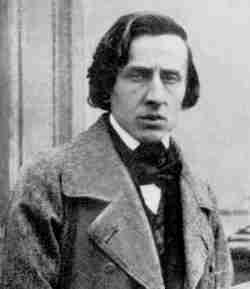
Frédéric Chopin was a Polish composer and famous virtuoso pianist. Most of his writings were for solo piano although he did compose two concertos. He is regarded worldwide as a major exponent of the art of piano. He was born on 1st March 1810 in Zelazowa, Poland and died on 17th October 1849 in Paris aged 39.
Major Works
Two piano concertos
“Fantaisie-Impromptu” (1834)
“Andante Spianato et Grande Polonaise Brillante” (1834)
“24 Preludes” (1839)
Polonaise in A flat major “The Heroic Polonaise” (1842)
Sonata for Cello in G minor (1846)
“Minute’ Waltz in D flat major” (1847)
Biography Timeline
1810: Frédéric Chopin is often quoted as being born on 22nd February in Zelazowa Wola near Warsaw but scholars now believe it was 1st March.His father, Nicolas Chopin was a Frenchman who had emigrated to Poland in 1787 and played the flute and the violin. His mother was Justyna Krzyanowska who played the piano and gave lessons to boys in the Chopin’s boarding house. The Chopin Family moves to Warsaw on 1st October when his father got a job teaching French at the Warsaw Lyceum.
1816: He starts piano lessons with Wojciech Zywny
1817: He composes two polonaises, in G minor and B-flat Majorandbegins giving public concerts in Warsaw.
1823: He begins lessons at the Warsaw Lyceum and has organ lessons from Wilhelm Wurfel. On 24th February he plays the Concerto by Ferdinand Ries at a concert of the Charity Society, organized by Józef Jawurek.
1824: He composes “Variations in E major on a theme of a Swiss Song” and the Polonaise in G sharp minor as well as mazurkas, valses and marches.
1825: His Rondo, opus 1 is published in June. On 30th October 1825 heattends a performance of Rossini’s “Il Barbiere di Siviglia” and in November he becomes the Lyceum organist in the Church of the Visitant Nuns.
1826: He completes his studies at the Lyceum with distinction and begins a three-year course under composer Josef Eisner at the Warsaw Conservatory. On 13th July he attends the Premiere of “Der Freischütz” by Carl Maria von Weber. In December he writes the Rondo à la Mazur, Opus5
1827: On 10th April Chopin’s sister Emilia, dies of tuberculosis. He passes his examination in composition and is described as an amazing talent by his tutor. The family move from the Warsaw University building, adjacent to new lodgings across the street.
1828: He writes his first piano sonata. In September he visits Berlin with zoologist Feliks Jarocki and in December he completes the Rondo à la Krakowiak, opus 14.
1829: In April he meets and falls in love with Konstancja Gladkowska at a concert given by pupils of Carl Soliva and in May he attends a series of concerts by Niccolò Paganini and Karol Lipinski. Chopin graduates from the Warsaw Conservatory in July and is described as a musical genius. On 11th August Chopin makes his debut in Vienna playing his Variations opus 2 and improvisations on the theme of Chmiel and the pieces. In October hestarts composing études besides his work on the Piano Concerto in F minor. His portrait is painted by Eliza Radziwill and writes the Polonaise opus 3 for Prince Antoni Radziwill.
1830: On 17th March Chopin plays the Piano Concerto No.2 in F minor, for family and friends in Warsaw. Most of his concerts in later years would be to friends or at Soirees in the houses of the nobility rather than in large concert halls. On 2nd November Chopin departs for Vienna.
1831: He writes his Étude Opus 10, No. 12, which has become known as the “Revolutionary” Study in July and then moves on to Paris in September. In November he meets Delfina Potocka and in December he meets Rossini, Cherubini and Liszt. On 7th December Robert Schumann reviews the Opus 2 Variations in the “Allgemeine musikalische Zeitung” and declares “Hats off, gentlemen! A genius.”
1832: He gives his debut very successful Paris concert at the Salle Pleyel on 26th February where he meets Franz Liszt. Later in the year he is introduced to the Rothschild family who open the doors for him to visit other private salons.
1833: On 23rd March Chopin, Liszt and Hiller perform a concerto by Johann Sebastian Bach for three keyboards and on 2nd April he plays at benefit concert for Hector Berlioz’s bankrupt Shakespearean actress wife Harriet Smithson. In May he writes Variations opus. 12 on the theme of the rondo from the opera “Ludovic” Ferdinand Hérold and Fromental Halévy. Whilst in Paris Chopin meets the Polish poet Adam Mickiewicz who is principal of the Polish Literary Society and uses some of his verses as songs.
1834: In the spring he attends the Lower Rhenish Music Festival in Aix-la-Chapelle with Hiller and meets Felix Mendelssohn. They move on to Dusseldorf where Mendelssohn has been appointed as musical director.
1835: On 26th April he gives a performance of the Polonaise in E flat major, opus 22 in the Conservatory in Paris. In September he is in Decin in Czechia and dedicates the Valse in A flat major, op. 34 to Countess J. Thun-Hohenstein. InOctober he finally reaches Leipzig, where he meets Robert Schumann and Clara Schumannand Felix Mendelssohn who are all impressed by his playing. On 20th October he returns to Paris.
1836: On 8th September he is in Dresden and asks for the hand in marriage of the 17 year-old Maria Wodzinska the following day. He is accepted provided that he takes care of his health and that the engagement is kept secret. He writes he two first Etudes, opus 25. Chopin and Robert Schumann meet again in Leipzig and on 24th October back in Paris he meets the writer George Sand for the first time in the Salon of countess Marie d’Agoult and Liszt. He was not initially impressed with her.
1837: He visits London incognito during July with the piano manufacturer Camille Pleyel and plays at a musical soirée at James Broadwood’s house. Back in Paris his engagement is ended.
1838: On 25th February Chopin gives a concert in the Tuilleries, Paris at the court of King Louis Philippe the First and on 3rd March he take part in an arrangement for eight hands of two movements of Beethoven’s 7th Symphony. On 25th April he meets George Sand again at a soiree held by Charlotte Marliani and in June they become lovers. On 1st July Eugène Delacroix makes sketches for a joint portrait of Chopin and Sand. On 1st November Chopin and Sand sail on “Le Phénicien” to Barcelona and then move on to Majorca with her two children. In Mallorca he writes his 24 Preludes. In bad health he complains about the poor doctors in the region. He also had problems having his Pleyel piano delivered to him and eventually sells it to a couple on the island.
1839: In February they leave Majorca and travel to Marseille via Barcelona. Once there they move to George Sand’s estate at Nohant to spend the summer.
1840: On 26th July Chopin and Sand are present at the dress rehearsal of Berlioz’s “Grande Symphonie Funèbre et Triomphale”, composed to commemorate the tenth anniversary of the July Revolution, although Chopin is not impressed with the piece.
1842: In June Eugène Delacroix visits him and George Sand.
1844: In March the periodical “La France Musicale” tells readers about Chopin’s grave illness.
1846: On 28th November he acts as a witness in Paris at the wedding of his pupil Rosengardt with Bohdan Zaleski.
1847: In May he is seriously ill again but recovers. He goes to the house of Albrecht in Ville d’Avray to recuperate. George Sand reads aloud her novel “Lucrezia Floriani” to Chopin and Delacroix. Later in the year their relationship ends following an angry series of letters.
1848: On 16th February he gives his last Paris Concert, with cellist Auguste Franchomme, which includes three movements of the Cello Sonata Opus 65. Chopin then tours England and Scotland during April to escape the 1848 Revolution in Paris. On 12th May he has dinner with the Swedish soprano Jenny Lind in London. On 15th May at Stafford House he plays in front of Queen Victoria and Prince Albert. He then moves on to Manchester, Glasgow and Edinburgh. On 30th October he writes his will at the house of the Polish physician Adam Kyszczyński in Edinburgh. On the 16th November back in London he gives his last concert appearance at the Guildhall and returns to Paris on the 24th.
1849: On 22nd April he attends a premiere of the opera “Le Prophète” by Giacomo Meyerbeer. He spends the summer out of the city in Chaillot and meets Jenny Lind there again. In June his sister Ludwika comes to Paris with her husband and daughter to look after him supported by a loan from Jane Stirling of Edinburgh. On 10th October he asks that all his unpublished works are burnt.
Frédéric Chopin died on 17th October 1849 in Paris of tuberculosis. The funeral was held at the Church of the Madeleine on 30th October with entrance by ticket only. However over 3,000 people arrived without invitations, from as far away as London, Berlin and Vienna and couldn’t get in. Eugene Delacroix was one of the pallbearers. Chopin was interred in Pere Lachaise Cemetery in Paris. Ludwika took his heart preserved in alcohol back to Poland in 1850.
Influences
Chopin was heavily influenced by the work of Johann Sebastian Bach and often made his students practice his pieces as part of their exercises. Other contemporaries claimed he was obsessed by his preludes and fugues. He also used the Italian composer Muzio Clementi’s piano method with his students. Other influences were Wolfgang Amadeus Mozart, Franz Schubert, Johann Nepomuk Hummel, particularly his piano concertos, Carl Maria von Weber and Friederich Kalkbrenner (1785-1849). He also had a respect for the work of Ludwig van Beethoven even though he did not copy him directly, although Chopin’s famous funeral march owes a great deal to Beethoven’s Piano Sonata No.12. He is also known to have played Beethoven’s Piano Sonata No. 26 in at least concert. Other clear influences are Polish folk tunes and Italian opera.
Chopin developed the new nocturne, invented by the Irish composer John Field and was the first to compose ballades and scherzi as individual pieces. He took the preludes to new heights and developed the concert etude more than most other composers including Franz Liszt. He also introduced the mazurka to larger European audiences. Publishers in Paris were quick to publish his work and many of the wealthy or aristocratic paid handsomely for lessons. All this added to his reputation.
Robert Schumann is reported to have said “Hats off gentlemen. A genius!” when he attended a recital and later named a part of his “Carnaval” suite in his honour. Chopin reciprocated by dedicating his Ballade No 2 to Schumann. Franz Liszt was often influenced and transcribed for piano six of Chopin’s Polish songs even though the two composers were seen as competitors. Immediately after Chopin’s death in 1849, Liszt wrote a book about him. The poet and influential critic Heinrich Heine who had damned many a career called him the “Pianoforte-Bard”.
Not all were so enthusiastic and the musicologist Erinn Knyt wrote: “In the nineteenth century Chopin and his music were commonly viewed as effeminate, androgynous, childish, sickly, and ethnically other”. Many of his pieces were played in soirees by female pianists which might have helped give rise to this notion. Pyotr Tchaikovsky was never enthusiastic for Chopin’s music and he is stated as stating he “found in him a certain sickliness of expression, as well as an excess of subjective sensibility”.
Many later composers were however influenced by him including Sergei Rachmaninoff who called him the “King of the Piano”, Alexander Scriabin, whose Study in D sharp minor owes a debt to Chopin’s “Revolutionary” Etude, Claude Debussy who dedicated his Twelve Studies “to the Memory of Frédéric Chopin” and Sergei Prokofiev who said that the Scherzo of his Third Symphony was directly inspired by the Finale of Chopin’s B flat minor Piano Sonata. Other pianists and composers who were influenced by his style were the American Louis Moreau Gottschalk, Edvard Grieg, Antonin Dvorak and the Polish men Moritz Moszkowski and Karol Szymanowski.
In the twentieth century Bohuslav Martinu, Darius Milhaud, Igor Stravinsky and Heitor Villa-Lobos were notable admirers and Michel Fokine used Chopin’s music in his 1909 ballet “Chopiniana”. Sergei Diaghilev commissioned additional orchestrations from Stravinsky for later productions entitled “Les Sylphides”.
The International Chopin Piano Competition, founded in 1927 is still held every five years in Warsaw and there are over eighty societies dedicated to the composer worldwide.
Further Information
List of compositions by Chopin by genre.