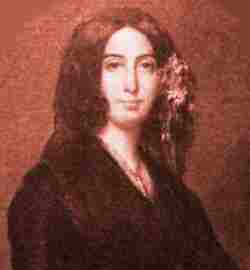
George Sand (pseudonym of Amantine Lucile Aurore Dupin de Francueil) was a French novelist, memoirist and journalist. She was born in Paris, France on 1st July 1804 and died in Nohant-Vic, France on 8th June 1876 aged 71.
Major Works
“Indiana” (1831)
“Lélia” (1833)
“Un Hiver à Majorque” (1841)
“La Mare au Diable” (1846)
“François le Champi” (1848)
“La Petite Fadette” (1849)
Biography Timeline
1804: George Sand was born as Armandine Aurore Lucille Dupin on 1st July in Meslay Street, Paris, France. Her father was Maurice Dupin de Francueil, a soldier, who was related to ancient French Kings and the Marshal of France, Maurice de Saxe. Her mother, Sophie-Victoire Delaborde was from a humble family who were master birders.
1808: Her father dies and Aurore, her mother, and her grandmother move from Paris to Nohant, France where her grandmother, Marie-Aurore de Saxe, is mainly responsible for raising her.
1818: At the age of fourteen she is sent to the convent of the Dames Augustines Anglaises in Paris but she is a rebel and returns to her Grandmother. Here she studies nature and philosophy and reads widely. She also helps the local working people by practicing medicine on them. Her tutor encourages her to wear men’s clothing whilst out riding which she also adopts later in life. A law of 1800 required all women to have a licence to wear men’s clothing but many ignored it.
1821: Her grandmother dies and she inherits the house in Nohant and it becomes the setting for many of her novels.
1822: She has an intense but, it is thought, platonic affair with Aurelian de Seze a lawyer. She then marries Francois Casimir Dudevant on 10th December at the age of eighteen. He is the bastard son of Baron Jean-François Dudevant. He is loving but she finds him coarse.
1823: Her son Maurice is born.
1828: Her daughter Solange is born.
1831: At the age of twenty-seven she moves to Paris leaving her husband and children behind and begins writing to earn a living. She is mentored by Henri de Latouche and the historian Charles Sainte-Beuve and she chooses the pseudonym George Sand for the first time. “Sand” is a diminutive of “Sandeau” as her current lover is Jules Sandeau, a writer. This choice is to help her get published in a male dominated world. In Paris she is seen as scandalous, not only for wearing men’s clothes but for smoking in public which is not yet acceptable for women in society. Her first published novel is “Rose et Blanche” which she writes with Sandeau.
1832: Joint articles with Sandeau are signed “J. Sand.” Her first independent novel is “Indiana”. She meets the poet Alfred de Musset and they have an affair when things cool with Sandeau. She works hard on her writing completing twenty pages from midnight until daybreak each day. Her next published novel is “Valentine” about an unhappily married upper-class woman. From February she has another affair, this time with the Polish Prince Norbert Przanowski, which lasts until the following year. She is also romantically acquainted with the writer Prosper Merimee.
1833: From the summer onwards she has a relationship with the dramatist Alfred de Musset and then later with the actress Marie Dorval whom she had already met in January after seeing her perform on the stage. Dorval appears in the novel “Lélia” which is her next published novel.
1835: She legally divorces and she takes custody of her daughter Solange and her ex-husband takes Maurice.
1836: By now her work is very popular and in such demand that a twenty-four-volume compendium of her recent writings is published.
1837: She meets the composer Frédéric Chopin for the first time. She publishes her next novel “Mauprat”.
1838: She spends the winter with Chopin in Mallorca at the old Carthusian monastery of Valldemossa. He is already suffering from tuberculosis and the cold damp conditions do not help him.
1839: Chopin spends the summer (and many afterwards) at Sand’s house in Nohant
1840: She publishes “Le Compagnon du Tour de France” and Marie Dorval plays the lead in her play “Cosima”. The play is not a success and is cancelled after seven performances, although she and Sand remain on good terms for the rest of their lives.
1841: She publishes “Un Hiver à Majorque” (A Winter in Majorca) about her trip with Chopin. She now becomes interested in politics and many republicans consult her for her advice.
1843: “Consuelo” is completed.
1845: “Le Meunier d’Angibault” is published.
1846: She writes the pastoral novel “La Mare au Diable”.
1847: Chopin and Sand separate. She completes “Le Péché de Monsieur Antoine” about the difficulties of farming life.
1848: The 1848 Revolution begins in Paris. Sand starts a newspaper for a worker’s co-operative and completes the novel “François le Champi”. She becomes a member of the provisional government as an ardent republican.
1849: She completes “La Petite Fadette”. Fredéric Chopin dies and she is notably absent from his funeral in Paris and then burns most of their letters, saving only four. In December her son Maurice invites the engraver Alexandre Manceau to celebrate Christmas with them in Nohant and Sand promptly falls in love with him. He is a willing lover and becomes her secretary and they stay together for fifteen years until his death.
1851: Louis-Napoléon Bonaparte’s stages a coup d’état and whilst many republicans are imprisoned or go into exile Sand remains in France and even manages to negotiate pardons or reduced sentences for some of her friends.
1852: She publishes “Les Maîtres Sonneur”s.
1854: Her next novel “Lélia” is about a beautiful woman loved by a young poet who can only show him the affection of a mother. She spends much of her time in Nohant where life is more peaceful and there she entertains her grandchildren.
1855: She writes “Histoire de Ma Vie” (History of My Life) and “Elle et Lui”.
1857: She publishes “Les Beaux Messieus de Bois-Dore” in serial form in “Le Progres Illustre”.
1859: She writes “Elle et Lui ” about her affair with Musset.
1864: She moves to live in Palaiseau, a suburb of Paris, with Alexandre Manceau where she looks after him in his last months.
1871: During the short-lived Paris Commune of 1871 she speaks to the Versailles Assembly against the Communards and urges them to take violent action against people she sees as thugish rebels.
George Sand (Armandine Aurore Lucille Dupin) died in her house in Nohant on 9th June 1876. She was buried in the private graveyard behind the chapel at Nohant-Vic. (in 2003 plans that her remains should be moved to the Pantheon in Paris caused a major in controversy).
Influences
George Sand was a major figure in the nineteenth century literary world and she was published throughout Europe. Her father was distantly related to the King of Poland and she had comfortable upbringing at her grandfather’s estate in the country which she described as a refuge and inspiration.
She would go on to write seventy novels, plays, critical essays and works on travel and by the age of twenty-seven she was Europe’s most popular writer of either sex. Most of her work was influenced by her own experiences as a child and later as an adult. She was on good terms with a good many cultural giants of the time such as Honoré de Balzac, Franz Liszt, Eugène Delacroix, Gustave Flaubert and the critic Charles Augustin Sainte-Beuve. Although most known for her affair with Frédéric Chopin she also had liaisons with the dramatist Alfred de Musset, the novelist Jules Sandeu, the Polish-Russian Prince Norbert Przanowski, the writer Prosper Mérimée, the actress Marie Doval, the engraver Alexandre Manceau and several others including politicians. She would dress in men’s clothing, scandalously smoke tobacco in public and delighted in flouting French laws. Her divorce from her husband Baron Jean-François Dudevant was unusual in that she was granted custody of her two children and she paid for their upkeep through her writing.
Her first literary works were collaborations with the Jules Sandeu, published under the name Jules Sand and it is assumed that this is why she chose her pen name but it is no surprise that she chose a man’s name in the male dominated literary society of the day. In her novel “Lucrezia Floriani” Chopin is reputed to be the model for Karol, the sickly European prince, however their relationship eventually deteriorated and she even accused him of being in love with her daughter Solange and didn’t attend his funeral.
From the late 1830s she was influenced by the socialists Félicité de Lamennais and Pierre Leroux and she remained interested in humanitarian socialism for the rest of her life as can be seen reflected in works such as “Spiridion” in 1839. She was an ardent Republican during the 1848 Revolution and started a newspaper, published by a workers’ co-operative. She was a member of the provisional government of 1848 and published a series of manifestos. She remained in France after Louis-Napoléon Bonaparte’s coup d’état in December 1851 and negotiated pardons and reduced sentences for many of her friends. She took a stance with the Versailles Assembly against the Communards of 1871 as she was appalled by their violence. Although she has been seen as a feminist her record has been marred by her reluctance to become too closely involved with the women engaged in their struggle for civil and political rights.
In England in the 1830s and 1840s she was immensely popular and by 1836 the first of several compendia of her works was published in twenty-four volumes. Four editions of her “Complete Works” were published during her lifetime and in 1880 her children sold her literary rights for 125,000 Francs (1.3 million US dollars equivalent today). For a time after her death her reputation rested on works such as “La Mare au Diable” (The Enchanted Lake), “La Petite Fadette” (Little Fadette) and “Le Compagnon du Tour de France” but since then she has become wider known.
She is less known for her drawings and even at one time considered becoming a portraitist before publication of her first novel in 1830. She described her late watercolour paintings, at Nohant, many painted from her imagination, as dendrites, a term derived from natural history due to her technique of pressing another sheet of paper onto the pigment to create abstract forms.
Alfred de Vigny described her as Sappho and Victor Hugo said she was an idea with a unique place in the age. Not all contemporaries however were so complimentary. Charles Baudelaire described her as “stupid, heavy and garrulous”.
She has influenced many other writers. Fyodor Dostoevsky read many of her novels and translated “La Dernière Aldini” into Russian in 1844 and mentions her in his “Notes from Undergound”. Elizabeth Barrett Browning wrote two poems about her. “To George Sand: A Desire” and “To George Sand: A Recognition”. Walt Whitman refenced her novel “Consuelo” as a personal favourite. Marcel Proust mentions her work in “In Search of Lost Time” and Jules Verne was an admirer. In more recent times A.S. Byatt refers to her in his play “Possession” as does Tom Stoppard in “The Coast of Utopia” trilogy of 2002. Her writing and political stance has also influenced numerous authors in Spain and Latin America.
Further Information
List of seventy books by George Sand.