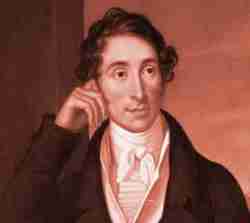
Carl Maria von Weber was a German composer, conductor, virtuoso pianist, guitarist, and critic who was one of the first major composers of the Romantic era. He is best known today for his operas. He was born in November 1786 in Eutin, Germany and died in London on 5th June 1826 aged 39.
Major Works
“Silvana” (1810)
“Abu Hassan” (1811)
“Der Freischütz” (1821)
“Die drei Pintos” (1820–21)
“Euryanthe” (1823)
“Oberon” (1826)
Biography Timeline
1786: Carl Maria von Weber was born on 18th November in Eutin, Holstein in Germany. His father was Franz Anton a musician and soldier of fortune who tacked on the noble term von to his name which he had no right to. His mother, Genovefa was a singer from Vienna and most of his extended family were involved in music or the theatre. Weber was not a strong child and suffered from a diseased hip and he was the eldest of three children. He was baptised Carl Friedrich Ernst and the Maria was added later.
1779: In April his father is appointed director of the Prince-Bishop’s orchestra in Eutin. Franz Anton’s half-brother, Franz Fridolin had four daughters including Constanze, who married Wolfgang Amadeus Mozart, and he had hopes that the young Weber would become a prodigy just like Mozart.
1781: His father’s orchestra is disbanded due to spending cuts.
1787: His father had become Eutin’s municipal music director but resigns and moves the family to Hamburg to try and start a theatre company but with little success. Instead he joins Johann Friedrich Toscani and Peter Carl Santorini, who take their performances to several German cities.
1796: He continues his musical education in Hildburghausen in Thuringia where his teacher is the oboist Johann Peter Heuschkel.
1797: He moves to Salzburg, Austria in the autumn.
1798: His father enlists Michael Haydn (younger brother of the composer Joseph) to teach his son who does not charge a fee. Weber writes his first major piece “Sechs Fughetten” (Six Fugues). His mother Genovefa dies of tuberculosis on 13th March and Weber is looked after by his Aunt Adelaide and moves to Munich in the autumn to study singing under Johann Evangelist Wallishauser and composing with Johann Nepomuk Kalcher. Weber writes his first opera “Die Macht der Liebe und des Weins” (The Power of Love and Wine). His one-year-old sister Antonetta dies on 29th December 1798 in Munich.
1799: His father hoped to set up a printing business to print his son’s music and Weber studies lithography under Alois Senefelder, its inventor, and he prints a set of his “Variations for the Pianoforte” himself.
1800: He composes the opera, “Das Stumme Waldmädchen” (The Silent Forest Maiden). It is staged at Freiberg where the family have moved but is a failure there although it is given later in St Petersburg, Russia in 1804, Vienna in 1805 and Prague in 1806.
1801: He publishes the first of many of his music criticisms in the newspaper “Leipziger Neue Zeitung”. The family return to Salzburg, where Weber continues his studies with Michael Haydn. He composes his third opera “Peter Schmoll und Seine Nachbarn” (Peter Schmoll and His Neighbours).
1803: Completed in Salzburg “Peter Schmoll” is premiered in Augsburg but is again a failure. Weber moves to Vienna to study with Abbe Vogler.
1804: He resumes his studies under Abbé Vogler and is appointed musical director at Breslau. He instigates a number of reforms of the orchestra and chorus and tackles an ambitious repertoire all of which are not universally popular. He also accidentally ingests some engraving acid which permanently harms his voice.
1806: He does not extend his contract at Breslau by mutual consent and becomes Director of Music to Duke Eugen of Wurttemberg in Silesia. He writes two symphonies for the orchestra.
1807: He moves to Stuttgart to become private secretary to Duke Ludwig, the brother of King Frederick the First of Wurttemberg. His excessive lifestyle means he accrues large debts. He is also imprisoned for a short time after being involved with the Duke’s sale of confirmations of ducal service and being personally accused of embezzlement. He and his father are then both banished from the Kingdom and move to Mannheim. His first song with guitar accompaniment, “Liebeszauber”, is printed.
1808: He composes “Er an Sie” (He to Her).
1809: To earn a living he writes a great amount of reviews of other people’s music as well as some of his own poetry. He writes the song “Was Zieht zu Deinem Zauberkreise” (What Draws Me to your Magic Circle).
1810: He composes the Romantic opera “Silvana” as well as several songs and pieces for piano and visits a number of cities throughout Germany.
1811: He moves to Darmstadt and meets Vogler again and the German composer Giacomo Meyerbeer, who was also taught by Vogler. The two become close friends. He composes the “Grand Concerto No. 1 in C Major” and the one-act opera “Abu Hassan”. As he is unable to obtain a post in Darmstadt he moves on to Munich where he writes “Concertino” and two clarinet concerti. From December he tours with the Munich Court clarinettist Heinrich Baermann and they perform the new works to great enthusiasm.
1812: He puts on a performance of “Silvana” in Berlin.
1813: He is appointed conductor of the opera at Prague.
1816: Again, he meets opposition to his reforms and is forced to resign and he moves to Berlin. He composes the “Duet Op. 38” for guitar and piano. He marries Caroline Brandt on 4th November, who is the singer for whom he created the title role of “Silvana”.
1817: His reputation is now rising and he accepts the appointment as director of the opera at Dresden with the task of establishing a German opera in contrast to the Italian opera which is dominant in Europe at the time. He becomes inspired by the German folk song collection “Des Knaben Wunderhorn” (The Boys Magic Horn) by Achim von Arnim and Clemens Brentano.
1819: He composes “Invitation to the Dance” for piano.
1821: He composes his most famous opera “Der Freischütz” (The Magic Marksman) which is a great success when it is first performed in Berlin on 18th June and leads to performances all over Europe. A week after his opera he premieres “Konzertstuck” for piano and orchestra.
1823: He composes his first full-length, through-composed, opera “Euryanthe” with a libretto by the German playwright Helmina von Chezy. The music is said to anticipate the early, romantic operas of Richard Wagner.
1824: He receives an invitation from the Royal Opera in London for a new work. Based on Christoph Martin Wieland’s poem “Oberon”.
1826: He travels to London to perform “Oberon” and stays with the musician Sir George Smart. He conducts another eleven sold-out performances after the premiere on 12th April but his health is rapidly declining from tuberculosis and he is barely able to walk anymore.
Carl Maria von Weber died in his sleep of tuberculosis during the night of 5th June 1826 at Sir George Smart’s house in London, England. He was buried in London but his remains were transferred to the family burial plot in the Old Catholic Cemetery in Dresden in December 1844 and placed beside his youngest son Alexander.
Influences
Carl Maria von Weber’s father Franz Anton was anxious to make him a musical prodigy and sought teachers of the highest calibre such as Michael Haydn, the younger brother of Joseph, in Salzburg and Georg Joseph Vogler. He was a weak child who was slightly lame after being born with a congenital hip disorder that caused him to limp. Music ran in the family and he was a first cousin to Wolfgang Amadeus Mozart’s wife, Constanze.
His parents travelled widely with his father’s theatrical career which exposed him to a wide variety of theatrical and musical traditions throughout Europe. He studied in Munich with the singer Johann Evangelist Wallishauser and the organist Johann Nepomuk Kalcher and later in Vienna with Abbé Vogler who founded a music school and became a major influence on his compositional style. One of the Vogler’s other pupils was Giacomo Meyerbeer who became a close friend and later one of the major operatic composers of the nineteenth century. His thorough musical education gave him a grounding in music theory and composition.
He became a virtuoso pianist and composed four sonatas, two concertos, and the “Konzertstück in F minor” (Concert Piece). He also wrote vocal and choral music which was a popular form in Germany at the time but he is best known as an opera composer, writing ten in total between 1798 and 1826. Many incorporated folk music and romantic and supernatural themes helping define the new German Romantic operatic tradition. Indeed “Der Freischütz” is often referred to as the first German “nationalist” opera and “Euryanthe” and “Oberon” also have nationalist themes. Meyerbeer was a major influence on his compositional style which included expressive melodies and a new and innovative orchestration. He was also the first to adapt non-western sounds into his music, for example when he used Friedrich Schiller’s translation of the Italian Carlo Gozzi’s play “Turandot” he used a Chinese melody rather than a pseudo-oriental one as popularised by Mozart and others at the time.
He also worked as a music critic and was very aware of all the modern trends in musical composition and was always keen to give his opinion on differing styles. As a conductor he was one of the first to conduct from a podium rather than from a piano or violin.
His influence on later composers is vast. Both Richard Wagner and Hector Berlioz were very impressed with his orchestration and storytelling with music and indeed Wagner said “If I had never had the experience of Weber’s things, I believe I should never have become a musician” and became the most famous in developing Weber’s use of the leitmotif. (a theme used for particular characters). Berlioz mentions him several times in his “Treatise on Instrumentation” and later orchestrated his “Invitation to the Dance”. Claude Debussy was impressed by the fact that the Weber orchestra seemed to search the soul of each instrument.
His piano works also influenced composers like Franz Liszt, Frédéric Chopin and Felix Mendelssohn and Liszt regularly played his “Konzertstück” which also became a model for one-movement concertos. Sadly his piano music fell out of the repertoire after the nineteenth century although his compositions for clarinet, such as the two concertos, and variations on a theme from his opera “Silvana”, are regularly performed today as is his Bassoon Concerto.
His operas influenced later opera composers such as Mikhail Glinka and Gustav Mahler completed the unfinished comic opera “Die Drei Pintos” (The Three Pintos) and made revisions to both of “Euryanthe” and “Oberon”. Paul Hindemith composed the “Symphonic Metamorphosis of Themes by Carl Maria von Weber” based largely on the incidental music to “Turandot.” Igor Stravinsky acknowledged him as the inspiration for “Capriccio for Piano and Orchestra”.
“Invitation to the Dance” was also used as the basis for the American Benny Goodman’s (the King of Swing) theme song used for the radio programme “Let’s Dance”.
Further Information
List of compositions by Weber.