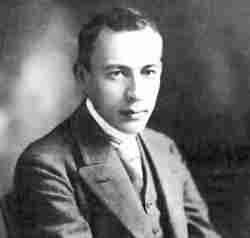
Sergei Rachmaninoff was a Russian composer, virtuoso pianist, and conductor. He was born on 1st April 1873 in Starussky Uyezd, Russia and died on 28th March 1943 in Beverly Hills, California, USA aged 69.
Major Works
Piano Concerto No. 2 (1901)
“Francesca da Rimini” (1905)
Piano Concerto No. 3 (1909)
“The Bells” (1913)
“Rhapsody on a Theme of Paganini” (1934)
Biography Timeline
1873: Sergei Vasilyevich Rachmaninoff was born at Semyonovo, near Novgorod in Russia on 1st April into an aristocratic family. His father, Vasily Arkadievich Rachmaninoff, was an army officer and amateur pianist and his mother was Lyubov Petrovna Butakova, the daughter of a wealthy army general. Sergei was the third child of six.
1877: The family move to another house on the Oneg estate, 110 miles north of Semyonovo, and the Semyonovo estate is sold in 1879. His mother begins to give him piano lessons and the young pianist Anna Ornatskaya is hired to teach him further. His father wants him to be educated for a military career but has to sell of several of his estates to pay his debts and cannot afford it.
1883: He begins studying at St Petersburg Conservatory and his father’s final estate is auctioned off. The family move to a small flat in the city with the children looked after by their grandmother. His father moves to Moscow. His sister Sofia dies of diphtheria later in the year.
1885: He moves to Moscow and starts piano lessons with Nikolay Zverev after failing his exams in St Petersburg. He meets fellow pupilAlexander Scriabin. His sister Yelena dies of pernicious anaemia.
1887: He begins composing his first piano pieces including three Nocturnes and a Romance for violin and piano.
1888: He joins the Moscow Conservatory where he is taught piano by Alexander Ziloti and harmony with Anton Arensky.
1889: He argues with Zverev after his teacher refuses to help rent a piano as he felt composition was a waste for a talented pianist and Rachmaninoff goes to live with his uncle and aunt Satin and their family in Moscow. There he falls in love with Vera, a neighbour’s daughter.
1890: He starts writing his Piano Concerto No.1.
1891: He is required to take his final piano before Ziloti leaves and despite his teacher having little faith in him he passes with honours in July. He then contracts malaria during his summer break at Ivanovka. He composes the two-piano “Rhapsodie Russe”, the tone poem “Prince Rostislav” and completes his first Piano Concerto and the first movement of the First Symphony.
1892: He performs his first independent concert in January premiering his“Trio Elegiaque” No 1. He takes his final theory and composition exams a year early and writes the one-act Opera “Aleko”, based on “The Gypsies” by Alexander Pushkin for them. It wins the Gold Medal from the Conservatory. He signs a contract to publish “Aleko” and some of his songs but is late getting paid and so he plays at the Moscow Electrical Exhibition in September performing Prelude in C-Sharp Minor from his “Morceaux de Fanatasie”.
1893: “Aleko” is premiered at the Bolshoi Theatre in May and Pyotr Tchaikovsky is in attendance and praises the work. Rachmaninoff completes the tone poem “The Rock”, which he dedicates to Rimsky-Korsakov and the songs “Morceaux de Salon”. Rachmaninoff returns to Moscow where Tchaikovsky has agreed to conduct “The Rock” but the latter sadly dies unexpectedly.
1894: He composes “Caprice Bohemien” and, short of money, returns to giving piano lessons which he hates.
1895: In September he completes his Symphony No. 1. He then goes on a three-month concert tour across Russia although he quits before the end and loses his performance fees. He composes “Six Moments Musicaux”.
1897: Symphony No 1 is premiered on 28th March in St Petersburg in a series of concerts devoted to Russian music conducted by Alexander Glazunov. It is panned by critics especially the composer Cesar Cui and is not performed again for the rest of Rachmaninoff’s life. The industrialist Savva Mamontov, founder of the Moscow Private Russian Opera, offers him a job as assistant conductor for the 1897–98 season and he readily accepts as he needs the money. He conducts Camille Saint-Saen’s “Samson and Delilah” on 12th October.
1899: In April he travels to London for the first time to perform and conduct at the Queen’s Hall. Later in the year he becomes so depressed he cannot compose and his aunt persuades Leo Tolstoy to visit him at home to encourage him.
1900: Between January and April he undergoes therapy sessions with Nikolai Dahl. These help and he resumes composition and begins his Piano Concerto No.2.
1901: Piano Concerto No.2 is premiered in Moscow in the autumn and earns him a Glinka Award. He composes the Cello Sonata in G minor.
1902: On 12th May 1902 he marries Natalia Satina, after a three-year engagement. Because they are first cousins, the marriage is forbidden under church law and so the ceremony takes place in an army barracks in a Moscow suburb. The couple are given a small house on the Ivanovka estate but on return from honeymoon they settle in Moscow where Rachmaninoff returns to work as a music teacher at St. Catherine’s Women’s College.
1903: He completes “Variations on a Theme of Chopin” and begins work on his three-act opera “The Miserly Knight”. Their first daughter, Irina, is born on 14th May.
1904: He becomes the conductor at the Bolshoi Theatre for two seasons where he pioneers a modern arrangement of the orchestra Influenced by Richard Wagner and premieres “The Miserly Knight”.
1905: He is not interested in politics although the 1905 revolution spills into the theatre and protests from the staff make working life difficult. He composes the opera “Francesca da Rimini”.
1906: In February he hands in his resignation and he and his family go on an extended tour around Italy with the hope of completing new compositions. Sadly both his wife and daughter become ill and they return to Ivanovka. In November they leave Moscow for Dresden to escape the political turmoil. He begins work on Symphony No. 2
1907: In May he takes part in Sergei Diaghilev’s season of Russian concerts in Paris performing the Piano Concerto No.2. Whilst there he sees “The Isle of the Dead” by Arnold Böcklin which inspires him to write an orchestral piece of the same name. His second daughter Tatyana is born at Ivanovka.
1908: He conducts the premiere of Symphony No.2 in St Petersburg.
1909: He is living in Dresden and completes the symphonic poem “The Isle of the Dead” and writes the Piano Concerto No.3 at his home in Ivanovka during the summer. He agrees to tour the United States with the Boston Symphony orchestra during the winter concert season where he makes 26 appearances starting in November. Even though the tour is popular he decides not to repeat it due to the length of time he has to spend away from his family.
1910: He returns home in February and is made the Vice President of the Imperial Russian Musical Society. He completes his choral work “Liturgy of St John Chrysostom“.
1911: He is appointed the permanent conductor of the Philharmonic Society of Moscow.
1912: He resigns from the Musical Society due to its anti-Semitism. He takes his family to Switzerland on holiday and then on to Rome. He is given a translation of Edgar Allan Poe’s “The Bells” and begins work on a choral symphony of the same name. They return to Moscow after six weeks.
1913: “The Bells” is premiered in Saint Petersburg.
1914: In January he tours England. At the outbreak of the First World War his position of Inspector of Music at Nobility High School for Girls means he is prevented from joining the Army.
1915: He completes the choral work“All Night Vigil” (containing “Vocalise”). After Alexander Scriabin’s death he undertakes piano recitals to raise money for Scriabin’s impoverished family.
1916: Death of his father Vasily Arkadievich Rachmaninoff.
1917: His estates are seized by the revolutionaries in February and during the October Revolution he is desperate to leave Russia and accepts an invitation for a concert tour in Sweden. They arrive in Stockholm on 24th December after a long journey by train and sled carrying only what would fit into suitcases.
1918: In January the family move to Copenhagen in Denmark but are desperately in need of money. He tours as a concert pianist between February and October to earn money. He receives offers to become conductor of three orchestras in the United States but declines all three however a loan from the Russian emigre Alexander Kamenka means they can buy a ticket to New York and leave from Oslo in November.
1919: He recovers from Spanish Flu and begins touring as a concert pianist. He is very popular and earns enough money to secure his family and employ servants, a chef, and a chauffeur. Their house in New York becomes a magnet for Russian emigres.
1920: He signs a recording contract with the Victor Talking Machine Company which gives him further money.
1921: His trip to Russia is postponed due to an operation on his right temple which is unsuccessful. He moves to Upper West Side Manhattan overlooking the Hudson River.
1922: He tours Europe again, to London and then Dresden.
1924: He turns down the post of conductor of the Boston Symphony Orchestra. He makes a recording of the Second Piano Concerto.
1925: He founds the Tair publishing house in Paris to publish his own and other Russian composers works. (The name is taken from his two daughters Tatyana and Irina).
1926: He composes the Piano Concerto No. 4 and “Three Russian Songs”.
1927: Piano Concerto No. 4 is poorly received at its premiere in March and Rachmaninoff removes it from his repertory.
1929: His mother Lyubov Petrovna Butakova dies.
1930: The Rachmaninoffs decide to build a villa on an estate on the shores of Lake Lucerne in Switzerland.
1931: He is one of a number of signatories in the New York Times criticising the cultural policies of the Soviet Union. The ViIla Senar begins construction.
1932: In October he begins a major concert season but due to the poor economic situation in the USA the audiences are small and he loses money.
1934: The family move into the completed Villa Senar, near Lucerne. He composes “Rhapsody on a Theme of Paganini” which he records with the Philadelphia Orchestra.
1935: He begins work on the Symphony No 3.
1938: He performs his Piano Concerto No. 2 at a charity concert at the Royal Albert Hall in London to celebrate Henry Wood, the founder of the Promenade concerts.
1939: Fokine’s Ballet about Paganini with music by Rachmaninoff premieres in London with his daughters present. He is unable to attend Covent Garden due to a fall at Villa Senar. He recovers in time to perform at the Lucerne International Music Festival on 11th August. He returns to Paris with the family and then heads to the USA on 23rd August. He performs with the Philadelphia Orchestra in New York City.
1940: He composes his final piece “Symphonic Dances” which is premiered in January 1941.
1941: He revises Piano Concerto No.4 and records it.
1942: He is advised by his doctor to live in a warmer climate to aid his health. In May he moves to Beverly Hills in California. After a performance at the Hollywood Bowl in July he suffers from lumbago and fatigue and vows that the season in October will be his last.
1943: On 1st February he and his wife Natalia attend a ceremony to become naturalised American Citizens in New York City. On 11th February he makes his last appearance as a soloist in Ludwig van Beethoven’s First Piano Concerto with the Chicago Symphony Orchestra. On 17th February he gives his final concert playing at Knoxville, Tennessee but is then taken to hospital and then home to Beverly Hills by his wife where he is reunited with his daughter Irma. On 26th March he loses consciousness.
Sergei Vasilyevich Rachmaninoff died on 28th March 1943 of a melanoma at his home in Beverly Hills, California, USA. His funeral took place at the Holy Virgin Mary Russian Orthodox Church in Silver Lake, Los Angeles. Although he wished to be buried in Moscow as an American citizen this was not allowed and so he was buried at Kensico Cemetery in Valhalla, New York.
Influences
Sergei Rachmaninoff was influenced primarily by his teacher at the Moscow Conservatory Anton Arensky and he even dedicated his symphonic poem “Prince Rostislav” to him. After that his major musical hero was Pyotr Ilyich Tchaikovsky particularly in compositional style. In 1885, Rachmaninoff’s sister Yelena died of pernicious anemia aged only eighteen and it was she who had first introduced him Tchaikovsky’s works. The two composers met when he was sixteen at a soiree and in 1893 when Rachmaninoff made his professional stage debut as a pianist playing his own composition “The Rock” Tchaikovsky offered to conduct but sadly died before the concert could take place.
Later still other Russian composers provided inspiration such as Nikolai Rimsky Korsakov, Alexander Scriabin and Alexander Borodin. He also admired Frederic Chopin whom he considered the king of the piano and he revised the Polish Composer’s “Melodie” in 1940. Other people he was influenced by were the composer and pianist Franz Liszt and the Swiss symbolist painter Arnold Bocklin.
Rachmaninoff’s reputation as a composer came later in life. Before that he was known principally as a pianist although he often performed his own works as soloist. He was known for his technical abilities and large hands which enabled him to cover greater ranges of the keyboard and because of this his piano concertos are among the most demanding in the repertoire for other performers. He also made recordings of his music for the Victor Talking Machine Company.
Although most of his work was written in the twentieth century its style remains firmly rooted in the nineteenth at a time when musical movements like Serialism and Modernism were starting to gain popularity. So much so that in the fifth edition of “Grove’s Dictionary of Music” in 1954 it was predicted that “the enormous popular success some few of Rachmaninov’s works had in his lifetime is not likely to last”. Not only have they lasted but many more are now enjoyed by the concert going public.
He is particularly popular in the United States of America where he has been quoted in popular music many times. The song “Never Gonna Fall in Love Again” by Eric Carmen takes its theme from the Adagio third movement of the Second Symphony. His music has also been used frequently in films, especially themes from his piano concertos, and parts of “Rhapsody on a Theme of Paganini”. For example, in 1945 the soundtrack of “Brief Encounter” prominently uses the Second Piano Concerto. In 1953 the film “The Story of Three Loves” features the “Rhapsody on a Theme of Paganini” and it was still popular when it was used again in 1993 in “Groundhog Day”. In 2006, in “The Devil Wears Prada”, Meryl Streep’s daughter’s play Rachmaninoff at a recital.
Further Information
List of compositions by Rachmaninoff.