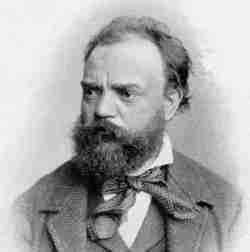
Antonín Dvořák was a Czech composer. He was born on 8th September 1841 in Nelahozeves, Czechia and died on 1st May 1904 in Prague, Czechia aged 62.
Major Works
“Slavonic Dances” (1878)
Ninth Symphony “From the New World” (1893)
“American” String Quartet (1893)
Cello Concerto (1895)
Biography Timeline
1841: Antonín Dvořák was born on 8th September in Nelahozeves near Prague, Chechia. His father was František Dvořák an innkeeper and a professional player of the zither. His mother was Anna, née Zdeňková, the daughter of Josef Zdeněk, the Bailiff of the Prince of Lobkowicz. He was the eldest of fourteen children.
1847: He starts primary school and is taught to play the violin by Joseph Spitz, a teacher. He plays in church and for the village band.
1854: His father sends him to Zlonice to live with his uncle, Antonín Zdenĕk, to learn the German language. There he has organ, piano, and violin lessons from his teacher Antonín Liehmann who was also the church organist. Dvořák is sometimes allowed to play the organ at services. He is taught music theory by Franz Hanke at Ceska Kamenice.
1855: His earliest known composition the “Forget-Me-Not Polka” is written around this time.
1857: In September he moves to Prague and joins the city’s Organ School He studies singing with Josef Zvonar, theory with Frantisek Blazek and organ with Joseph Foerster.
1858: He joins an orchestra led by Karel Komzak and they perform at balls and in restaurants in Prague.
1859: He graduates from the Organ School, second in his class. He applies to become organist at St. Henry’s Church but is unsuccessful.
1861: The work he called his Opus no 1, the String Quintet in A minor, is composed.
1862: He joins the Bohemian Provisional Theatre Orchestra where he plays the viola. He begins composing his first String Quartet.
1863: In July he plays in a programme devoted to the German composer Richard Wagner, who conducts the orchestra personally. Dvořák is deeply impressed by his music.
1864: Always short of money he shares a flat in Prague with five other people.
1865: His Symphony in C minor is composed which has become known as the First symphony.
1866: Bedrich Smetana becomes the chief conductor of the orchestra. Dvořák gives piano lessons to supplement his income and falls in love with one of his pupils, Josefína Čermáková and composes the song-cycle “Cypress Trees” for her. His love is unrequited and she marries another man later on.
1870: He composes his first opera “Alfred”. (this was not to be performed until 1938).
1871: He leaves the Provisional Theatre orchestra in order to spend more time on composition. His first publically performed work is the song “Vzpomínání” (Reminiscence) in October.
1872: His opera“The King and the Charcoal Burner” is deemed unplayable by the Provisional Theatre although Bedrich Smetana does conduct the overture. In November the Piano Quintet in A major is performed in Prague.
1873: Dvořák marries Anna Čermáková, the younger sister of Josefina, on 9th March. He leaves the orchestra and becomes organist at St. Adalbert’s, Church in Prague under his former organist professor Josef Foerster. His Czech cantata “The Heirs of the White Mountain” is performed by the Prague Hlahol Choral Society conducted by his friend Karel Bendl. It is a great success.
1874: His much-revised opera “King and Charcoal Burner” is finally given its premiere. He enters the Austrian State Stipendium for Composition. He enters fifteen works including his recently performed Third and Fourth Symphonies. The jury is prestigious and includes Eduard Hanslick the music critic and the composer Johannes Brahms.
1875: He wins the Austrian State Prize. His son Josefa is born. He composes the Second String Quintet and his Fifth Symphony amongst other works. He enters the Austrian State Prize again but is unsuccessful.
1876: His daughter Ruzena is born.
1877: Both Otakar and Ruzena die. He writes the “Symphonic Variations” which is given its premiere in Prague. He enters the Austrian State Prize once more submitting the “Moravian Duets” and possibly the Piano Concerto. This time he wins and both Hanslick and Brahms agree to assist him in making his music more widely known outside Bohemia. He dedicates his String Quartet No. 9 to Brahms. Simrock, his new publisher, recommended by the jury, commissions the “Slavonic Dances”.
1878: Otýlie is born. “Slavonic Dances” are first performed. In December the music critic Loius Ehlert reviews the “Moravian Duets” and “Slavonic Dances” in the Berlin “Nationalzeitung” newspaper and particularly praises the latter.
1879: He writes the String Sextet and his Violin Concerto.
1880: His daughter Anna is born. Dvořák’s “Stabat Mater” is performed at the Royal Albert Hall in London on 10th March. This is a great success and leads on to more performances of his work in Britain and the United States.
1881: His daughter Magdalena is born. Hans Richter had asked Dvořák to compose his Sixth Symphony to be played by the Vienna Philharmonic Orchestra but is members objected due to anti-Czech feeling prevalent at the time and therefore it receives its premiere on 25th March in Prague by the Philharmona Society.
1882: His opera “Dimitrij” receives its premiere.
1883: Birth of his son Antonín. The Violin Concerto is premiered in Prague in October by the violinist Frantisek Ondricek. The Birmingham Triennial Music Festival in Britain commission a large-scale oratorio and he begins work on “The Spectre’s Bride”.
1884: He plays his music in Britain to great acclaim.
1885: Otakar is born. Dvořák conducts the premiere of the Seventh Symphony at St James’s Hall, London on 22nd April. “The Spectre’s Bride” is premiered in Birmingham on 27th August.
1888: His daughter Aloisie is born. In February a performance of the “Stabat Mater” in Vienna is a failure due to more anti-Czech feeling. Despite this he thanks the conductor Hans Richter for his courage and sympathy in playing it.
1890: He visits Russia and conducts performances of his music in Moscow and St Petersburg.
1891: He is awarded an honorary degree by the University of Cambridge in Britain and is also offered a position at the Prague Conservatory as Professor of Composition and Instrumentation. His “Requiem” is premiered later in the year at the Birmingham Triennial Music Festival.
1892: He travels to New York City to become the director of the National Conservatory of Music. For the first time in his life he receives a large salary although financial crashes later on mean he won’t continue to receive all his money.
1893: He spends the summer in Spilville with his family where he composes the String Quartet in F (“The American”) and the String Quintet in E flat minor. The New York Philharmonic Orchestra had commissioned him to write his Ninth Symphony “From the New World” and it receives its premiere on 16th December conducted by Anton Seidl. The applause it receives amazes the composer.
1895: Hecompletes his Cello Concerto in February. He leaves the United States on 27th April after he hears he has been made an honorary member of the Gesellschaft der Musikfreunde in Vienna. In November he resumes his professorship at the Prague Conservatory.
1896: He writes his “Five Symphonic Poems” and the opera “Jakobin”. He visits London for the last time to conduct the premiere of the Cello Concerto. Johannes Brahms tries to get him and his family to move to Vienna but to no avail.
1897: Dvořák’s daughter Otilie marries his student, the composer Kosef Suk. He visits Brahms on his deathbed and attends his funeral on 6th April. In November he is appointed a member of the jury for the Viennese Artists’ Stipendium.
1898: He writes the opera “The Devil and Kate”. In November the Emperor Franz Joseph the First of Austria-Hungary awards him a gold medal for Litteris et Artibus.
1899: He attends Vienna to receive his award in June.
1900: He composes the opera “Rusalka”. On 4th April he conducts his last concert with the Czech Philharmonic Orchestra performing works by Brahms, Schubert and Beethoven as well as his own work the symphonic poem, “The Wild Dove”.
1901: He is appointed a member of the Austrian House of Lords by the Emperor in April. In November he becomes director of the Prague Conservatory until his death.
1902: He writes the opera “Armida”.
1904: On 25th March he is taken ill and has to leave a rehearsal of “Armida”. On 18th April he contracts influenza and cannot attend the first Czech Musical Festival being held that month which has a programme consisting almost entirely of Dvořák’s music.
Antonín Dvořák died on 1st May 1904 in Prague, Chechia probably of a stroke. His funeral service was held on 5th May and he was buried in Vysehrad Cemtery in Prague.
Influences
Antonín Dvořák was influenced by a variety of musical sources including Czech and Slavic folk music including the Polish mazurka and polonaise and Yugoslav Kolo and later in life that of native Americans of the United States. He was deeply impressed by the works of Ludwig van Beethoven and Franz Shubert but also had an ear for the then modern music of Franz Liszt and Richard Wagner and his countryman Bedrich Smetana. In his youth he was a great admirer of Wagner’s operas. Some of his works owe an allegiance to earlier forms as used earlier by Johann Sebastian Bach and Wolfgang Amadeus Mozart.
He was a committed Christian and lover of nature and much of his work is spiritual in tone. His father was a musician and encouraged his development, however, it is fair to say that his early career would not have taken off without his mentor Johannes Brahms through whom he developed a unique style. In 1874 the newly married and short of money composer entered fifteen compositions in the Austrian State Music Prize. Brahms was on the judging panel and was highly impressed with his talent and awarded him first place and in 1877 become his champion and recommended him to his own publisher and introduced him to Joseph Joachim, the leading European violinist of the day.
Dvořák became the first Bohemian composer to achieve worldwide recognition and was noted for being a nationalist composer and indeed encouraged other writers to incorporate folk music into their works. Hans Richter commissioned his sixth symphony for the Vienna Philharmonic Orchestra now his international fame was growing intending to premiere it in December 1880 however members of the orchestra objected to performing his works in two consecutive seasons, due to “anti-Czech feeling”. He had a better reception in Britain where his Stabat Mater was very well received at the Royal Albert Hall in March 1883 and he was invited to visit Britain in 1884 conducting concerts by the London Philharmonic Society, the first of eight visits.
Perhaps his most famous work the Symphony No. 9, “From the New World” incorporates elements of spirituals and Native American music although he was quick to state that he was not directly quoting them but rather paying tribute. He believed that these musical traditions could be the basis for an American music style. He learned much from his Black composition students and avidly read Henry Wadsworth Longfellow’s “Hiawatha”, which although he felt it was not wholly accurate, he acknowledged it had formed much of American opinion on the subject.
In 1890, influenced by Pyotr Ilyich Tchaikovsky, he visited Russia, and conducted several performances of his music in Moscow and St. Petersburg.
He influenced composers in the United States such as his students Will Marion Cook who later taught Duke Ellington, Rubin Goldmark who taught Aaron Copland and George Gershwin and Harry Rowe Shelley who taught Charles Ives. He also mentored younger composers in his homeland such as Leoš Janáček and through his composer son in law Josef Suk, he influenced the student Bohuslav Martinů.
Further Information
List of compositions by Dvořák.