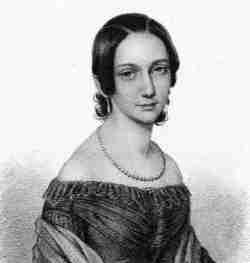
Clara Schumann was a German pianist, composer, and piano teacher. She was born on 13th September 1819 in Leipzig, Germany and died on 20th May 1896 in Frankfurt, Germany aged 76.
Major Works
Variations on a Theme by Bellini (Op. 8)
Scherzo (Op. 10)
Piano Concerto (1835)
“Liebesfruhling” (Love’s Spring) (1841)
Piano Trio (1846)
Biography Timeline
1819: Clara Josephine Schumann (nee Wieck) was born on 13th September in Leipzig, Germany. Her father was Friedrich Wieck a music teacher and her mother was Marianne Tromlitz.
1821: Birth of Alwin Wieck on 27th August.
1823: Birth of Gustav Wieck on 31st January.
1824: Birth of Victor Wieck on 22nd February. On 12th May her mother leaves Friedrich Wieck and the children. Clara spends the summer with her mother. She returns to her father in September and begins piano lessons in October.
1825: Her parents divorce on 22nd January. Her mother Mariane marries Adolph Bargiel in August.
1828: Robert Schumann arrives in Leipzig to study with Friedrich Wieck. On 3rd July Friedrich Wieck and Clemetine Fechner marry.
1829: Schumann leaves to study in Heidelberg on 4th July.
1830: She gives private concerts in Dresden in March and April. Schumann returns to Leipzig and boards with the Wieck family. Clara gives her first concert as soloist at the Leipzig Gewandhaus on 8th November.
1831: Clara and her father go on a concert tour to Paris in September.
1832: Birth of her half-sister Marie Wieck on 17th January. She tours in Germany and Schumann joins them in Zwickau in November.
1833: She gives concerts in Leipzig and other German towns.
1834: Schumann becomes the editor of Neues Zeitschrift fur Musik. Ernestine von Fricken boards with the Wiecks. Birth of her half-sister Cacilie in July. She goes on a concert tour to Hamburg and Hannover with her father from November until April the following year.
1835: Robert Schumann begins his courtship of Clara.
1836: Death of Schumann’s mother. Schumann meets Clara secretly in Dresden in February. She tours to Breslau and other German towns with her father.
1837: On 14th August there is a secret engagement between Schumann and Clara. Concert tour with her father to Hamburg and Bremen and she meets her mother in Berlin. On 13th September Schumann asks her father for her hand in marriage and is rejected as he wants her to concentrate on her piano playing. Concert tour to Vienna. Clara is named Royal and Imperial Virtuosa.
1838: Schumann leaves Leipzig for Vienna in September.
1839: She tours to Paris for several months without her father. She petitions the Court of Appeals for permission to marry without her father’s consent.
1840: She is in Berlin with mother and gives concerts there and in other north German towns accompanied by her mother. On 1st August the courts agree to a marriage. On 5th September Clara gives her last concert as Clara Wieck. She marries Schumann on 12th September one day before her 21st birthday.
1841: Her first concert as Clara Schumann is played at the Gewandhaus in Leipzig on 31st March. Their first child Marie is born on 1st September.
1842: She tours with Schumann to Hamburg and he returns to Leipzig in April and she goes to Copenhagen, Denmark.
1843: Birth of Elise in April.
1844: Schumann and Clara tour Russia and she is named as honorary member of the St Petersburg Philharmonic Society. The family finally settle in Dresden in December.
1845: Birth of daughter Julie on 11th March.
1846: Birth of Emil on 8th February. She goes on a concert tour to Vienna with Schumann and her two daughters.
1847: She visits Berlin for performances of Schumann’s work “Das Paradies und die Peri”. Emil dies on 22nd June. She attends the music festival in Zwickau in July.
1848: Birth of son Ludwig on 20th January.
1849: There is a revolution in Dresden during May. Ferdinand is born on 16th July.
1850: She gives concerts in Leipzig, Hamburg and Bremen with Schumann. “Genoveva” is first performed in Leipzig on 18th May. They move to Dusseldorf in September.
1851: Birth of Eugenie on 1st December. Clara gives more concerts and teaches students.
1852: “Schumann Week” is held in in Leipzig and she attends the Lower Rhine festival in May.
1853: Johannes Brahms arrives in Dusseldorf. He meets the Schumanns on 30th September for the first time and becomes a firm friend of them both. Schumann is dismissed as music director of the Dusseldorf orchestra. Clara goes on a concert tour to Holland with Schumann.
1854: Concerts in Hannover. Robert Schumann attempts suicide on 27th February by throwing himself into the river Rhine and is removed to the hospital at Endenich, on 4th March. Their son Felix is born on 11th June. Clara does more concert tours in October and December.
1855: Concert tours for most of the year.
1856: She tours to Vienna, Prague and Budapest and then England from April to July. On 27th July she sees Schumann for the first time in over 2 years although Brahms was allowed to visit the sanatorium. 29th July. Schumann dies. Clara goes on concert tours again from October.
1857: She moves to Berlin in October.
1863: Summer season concerts given in her in Baden Baden house.
1869: Marriage of daughter Julie to Count Marmorito in September.
1870: Son Ludwig is terminally ill and is sent to Colditz. Son Ferdinand is called up for the Franco-Prussian war.
1872: Death of her mother Marianne on 10th March. Death of daughter Julie 10th November.
1873: The Baden Baden house is sold and she moves to 11 in den Zelten, Berlin. Her father dies on 6th October.
1877: She begins editing Schumann’s collected works.
1878: She moves to Frankfurt am Main and works at the Hoch Conservatory as a teacher of the piano. She gives her fiftieth jubilee concerts in Frankfurt and Leipzig.
1879: Death of son Felix on 16th February.
1883: She edits the “Instructive Edition of Schumann’s Piano Works”.
1885: Death of brother Alwin on 21st October.
1887: Ferdinand is in hospital and she takes charge of his six children.
1888: She embarks on her final concert tour to England during February. She attends her sixtieth jubilee celebrations in Frankfurt in October.
1891: She gives her final public concert in Frankfurt in March. Her son Ferdinand dies on 6th June.
1892: She leaves the Hoch Conservatory.
Clara Schumann suffered a stroke on 26th March and died on 20th May 1896 in Frankfurt, Germany. She was buried next to her husband in the old cemetery in Bonn.
Influences
The major influence on Clara Schumann’s early life was her father, the piano teacher and builder Friedrich Wieck. He taught her how to play, taught her theory, harmony, composition, and counterpoint, micromanaged her childhood and even wrote her diary until her marriage. Her mother had started to teach her the piano from four years old and she became a child prodigy and one of the foremost piano virtuosos of the nineteenth century playing for over six decades and helping shape the public’s taste in music.
She met her husband Robert when he became a student of her father’s but he heartily disapproved of her marrying the penniless musician. The two most important musicians in the Schumann’s life were the violinist Joseph Joachim whom they met in November 1844, when he was fourteen years old and who played Felix Mendelssohn’s Violin Concerto in November 1845 and also Johannes Brahms who plucked up the courage in 1853 to knock on their door in Dusseldorf and introduce himself. From that point on they all became friends and Clara asked Brahms to visit her husband in the sanatorium in his final years and they kept up their friendship until the end of their own lives. Clara studied Robert’s music, counterpoint, and orchestration with Brahms and wrote in her diary that Brahms “seemed as if sent straight from God”.
As a performer she established the convention of musicians playing works from memory and brought historical composers such as J.S. Bach and Domenico Scarlatti to the concert platform as well as more recent pieces by Ludwig van Beethoven. According to Edvard Grieg she was “one of the most soulful and famous pianists of the day”. She stopped composing at age thirty-six possibly due to the death of her husband and her own declining health but she stated on composing there has never yet been a woman able to do it. Should I expect to be the one? Indeed, she was not recognised as a composer for many years until after her death but had a lasting effect as a pianist. She performed over one thousand three hundred concert programmes throughout Europe between 1831 through 1889 and was instrumental in getting the works of Robert Schumann recognised and added to the repertoire. She also championed the works of Johannes Brahms, Frederic Chopin and Felix Mendelssohn. The final performance she gave was of Brahms’s “Variations on a Theme by Haydn” in 1891.

During the second half of the nineteenth century what became known as the “War of the Romantics” began. Critics, performers and the public were either for Johannes Brahms and absolute music or Richard Wagner, Franz Liszt and the New German School. Naturally Clara sided with Brahms and her husband who was seen in the old German tradition.
Schumann influenced pianists through her teaching emphasising expression and a melodic tone, with an unflashy technique subordinated to the intentions of the composer. Her own students carried on the method in England and the Juilliard School in America.
Further Information
List of compositions by Clara Schumann.