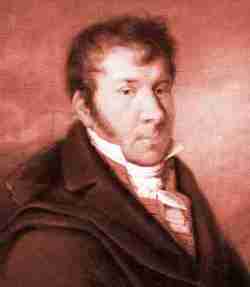
Johann Nepomuk Hummel was an Austrian composer straddling Classicism and Romanticism and a virtuoso pianist. He was born on 14th November 1778 in Pressburg, Hungary and died on 17th October 1837 in Weimar, Germany aged 58.
Major Works
8 piano Concertos
Trumpet Concerto (1803)
Variations for Piano on “God Save The King” (1804)
Double Concerto for Violin and Piano (1805)
Opera, “Mathilde von Guise” (1810)
Mass in B♭major (1816)
Biography Timeline
1778: Johann Nepomuk Hummel was born on 14th November in Pressburg, Hungary. (now Bratislava, Slovakia). His father, Johannes Hummel, was the conductor of the Imperial School of Military Music in Vienna and taught him the piano. His mother, Margarethe Sommer Hummel, was the widow of the wigmaker Josef Ludwig. He was an only child.
1786: He is a child prodigy and impresses Wolfgang Amadeus Mozart so much on his arrival in Vienna that he takes him on as a pupil aged eight. He lives free of charge with the Mozart family for the next two years and the two become friends.
1787: He makes a successful debut in one of Mozart’s concerts.
1788: He begins a four-year concert tour of Germany, Denmark, Scotland and England with his father. He has further lessons with Muzio Clementi in England.
1791: Joseph Haydn sees him play in London and composes a sonata for him. After his performance at the Hanover Square Rooms Haydn thanks him and gives him a guinea.
1793: He returns to Vienna via the Netherlands and is further taught by J.G. Albrechtsberger, Antonio Salieri and Haydn himself. He meets Ludwig van Beethoven, who is also being taught by Haydn, and the two become lifelong friends although their relationship is often stormy.
1803: He composes the Trumpet Concerto in E major for Anton Weidinger, the inventor of the keyed trumpet.
1804: He is appointed Konzertmeister to Prince Nikolaus Esterházy at Eisenstadt, following the retirement of Haydn and the Trumpet Concerto is first performed on New Year’s Day to mark the event. During this period, he composes several concerti, sacred works, solo piano pieces and short theatrical pieces.
1808: He is briefly dismissed from his post but re-instated, possibly due to the intervention of Haydn himself. Although he officially takes on the duties of Kapellmeister he is simply known as Concert Master in deference to his predecessor Haydn.
1809: He becomes officially Kappellmeister on the death of Haydn in May.
1811: He is dismissed by Prince Esterházy for neglecting his duties and returns to Vienna.
1813: He marries the opera singer Elisabeth Rockel and they go on to have two sons together.
1814: His son Eduard Joseph Hummel is born. His wife asks him to continue touring and they go to Russia and several places in Europe.
1816: He is appointed as Kapellmeister in Stuttgart where he composes the Piano Concerto No. 2 in A minor.
1819: He moves to Weimar with his family to become Kapellmeister to the Ducal Court. His main responsibilities are to direct operas and special events for the Royal Family. He becomes good friend with Johann Wolfgang von Goethe and he becomes one of the first to agitate for musical copyright to combat the piracy prevalent at the time.
1819: He composes the Piano Concerto No. 3 in B minor. His music is a particular influence on Robert Schumann. He dedicates his piano Sonata No 5 to his student Princess Marie of Saxe-Weimar-Eisenach.
1821: His son Carl Maria Nicolaus Hummel is born.
1825: The Parisian music-publishing firm of Aristide Farrenc acquires the French publishing rights for all his future works.
1827: He cuts short his concert tours where he had met John Field in Russia and Frederic Chopin in Poland to return to Vienna at the death ofLudwig van Beethoven. He is a pall bearer at his funeral and following Beethoven’s wishes, he organises a memorial concert improvising on themes of the master’s works. He meets Franz Schubert at the funeral who dedicates his last three sonatas to him. (Later changed to Schumann by the publishers due to the early death of Schubert). Franz Liszt also loved his works and would often play them in his repertoire.
1828: He publishes his “Klavierschule” (A Complete Theoretical and Practical Course of Instruction on the Art of Playing the Piano Forte) which sells thousands of copies within days of its publication and develops a new style of fingering technique.
1830: He visits Paris and London. In Paris one of his Rondos is performed by Louise Farrenc, Aristide Farrenc’s wife.
1831: He visits London again but his performances are already in decline due to ill health.
1832: In March the death of Goethe affects him badly and he has less contact with the theatre and descends into partial retirement.
1834: His final concert in Vienna is a failure.
Johann Nepomuk Hummel died peacefully on 17th October 1837 in Weimar, Germany. He was buried in the Historischer Friedhof Weimar (Historical Cemetery). He bequeathed a portion of his famous garden to his masonic lodge.
Influences
Johann Nepomuk Hummel was primarily influenced by the Viennese Classical tradition, through his studies with Wolfgang Amadeus Mozart whom he lived with for two years. Mozart was so impressed with Hummel that he taught him free of charge. Later teachers were Joseph Haydn, Muzio Clementi and the Austrian Johann Georg Albrechtsberger. Antonio Salieri, George Frideric Handel and Johann Sebastian Bach would also be major influences. In his development years there was a competitive relationship with Ludwig van Beethoven. Hummel openly admired Beethoven and published his own piano arrangements of Beethoven’s symphonies. Although generally less charitable in return in his last days, Beethoven specifically requested Hummel to perform at his memorial concert.
Despite being a bridge between classical and Romantic music he was also deeply influenced by Baroque models which is evident in his 1803 Trumpet Concerto. The concerto was specifically written for Anton Weidinger the inventor of the keyed trumpet. His piano music is also known for incorporating the lyrical, ornamental lines of the Italian bel canto opera style into keyboard writing.
As a resident of Weimar he couldn’t also escape from being influenced by the literary works of Johann Wolfgang von Goethe.
While in Germany, Hummel published in 1828 “Anweisung zum Pianofortespiel”, (A Complete Theoretical and Practical Course of Instruction on the Art of Playing the Piano Forte). It sold thousands of copies, was highly influential and brought about a new style of fingering to piano playing.
In addition to being a prolific composer, he was an important teacher. He taught Carl Czerny who would go on to be Franz Liszt’s tutor. Liszt knew and greatly admired Hummel and often performed his works, in particular his favourite the Septet Op. 74. According to Franz Schubert’s friend Albert Stadler, Schubert’s “Trout Quintet” was modelled on Hummel’s quintet version of his Septet in D minor for Flute, Oboe, Horn, Viola, Cello, Bass, and Piano, Op. 74. Other pupils were the Austrian Sigismond Thalberg and the German virtuoso pianist Adolf von Henselt who both carried forward his pedagogical ideas. He also taught the composers Ferdinand Hiller and Friedrich Silcher.
His influence can be seen in the early works of Felix Mendelssohn, whom he briefly taught, Frédéric Chopin and Robert Schummann. Chopin in particular was heavily influenced by Hummel’s brilliant style and piano concertos (specifically A minor and B minor) which he had heard the composer play on his tours of Poland. Schumann studied Hummel’s “Anweisung zum Pianofortespiel”, and considered becoming his pupil whereas Liszt’s father refused to pay the high tuition fee Hummel charged and thus he went with Czerny instead. All three admired his ability to blend Classical form with Romantic sensibility in the development of the virtuoso piano concerto.
Although famous he saw his music going out of fashion at the end of his life, with the advent of high Romanticism. At the classical revival of the early twentieth century he was again ignored only coming back into the standard concert repertoire in the late twentieth century.
Further Information
List of compositions by Hummel.