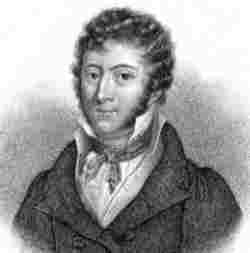
John Field was an Irish pianist, composer, and teacher widely thought to be the inventor of the nocturne. He was born on 26th July 1782 in Dublin, Ireland and died on 26th July 1837 in Moscow, Russia aged 54.
Major Works
Although he wrote other works such as 7 Piano Concerti he is chiefly remembered for inventing the Nocturne of which he wrote eighteen altogether and was thus an influence on Frederic Chopin.
Biography Timeline
1782: John Field was born on 26th July in Dublin, Ireland. His father, Robert Field, played the violin in Dublin theatres for a living. John’s grandfather (also called John) was an organist and taught him how to play the piano. He later studied under the Italian composer Tommaso Giordani.
1792: He makes his debut on 24th March in Dublin aged only nine.
1793: Some scholar’s think that the Field family moves to Bath in Somerset for a short while but this is disputed. Later in the year it is clear that they have settled in London. He studies with the Italian composer Muzio Clementi whom he helps as a demonstrator to sell pianos. He continues giving public performances and becomes well known in the city with both the press and audiences.
1795: Joseph Haydn praises his performance of a piano concerto by Jan Ladislav Dussek. He studies the violin with J. P. Solomon. His first published compositions are issued by Clementi.
1799: He premieres the Piano Concerto No. 1 on 7th February in London aged 16.
1801: His first official opus work is a set of three piano sonatas dedicated to Muzio Clementi.
1802: He visits Paris, Germany and Austria with Clementi during the summer. In Vienna he takes a short course in counterpoint with Johann Georg Albrechtsberger and then plays for Ludwig van Beethoven in October. They journey on to overwinter in St Petersburg, Russia.
1803: Clementi leaves Russia in June leaving his pupil to work as a teacher in Narva, modern Estonia. He gives concerts during the year and performs at the new Saint Petersburg Philharmonic Society.
1805: He tours the Baltic states and stays in Saint Petersburg during the summer.
1806: He gives his first concert in Moscow and Clementi arranges for the publication of some of Field’s older works in Russia.
1807: He goes to live permanently in Moscow in April. He develops his own style particulary in the sensitive use of the piano pedal.
1808: He begins publishing newly composed music beginning with piano variations on Russian folksongs for four hands entitled “Air Russe Varié” and “Kamarinskaya” for piano.
1810: He marries Adelaide Percheron, a French pianist, who was one of his former pupils.
1811: He returns to St Petersburg where he will spend the next ten years. He publishes many works with the Russian publisher H. J. Dalmas and the European Breitkopf and Hartel. He gives lessons to the young composer Mikhail Glinka.
1812: He composes the first of his eighteen nocturnes which are influential to later Romantic composers such as Frederic Chopin and Franz Liszt who both admire the form. He composes the Sonata in B major.
1814: His first three nocturnes are published.
1815: He fathers an illegitimate son called Leon Charpentier but remains with his wife.
1817: He publishes Nocturnes 4 and 5.
1818: He visits Moscow on business with the publisher Wenzel.
1819: He and his wife have a son called Adrien. He refuses the position of Court Pianist as he is now wealthy in his own right and becoming known for his extravagant lifestyle.
1821: He gives a series of concerts in Moscow with his wife Adelaide which are their last performances together. She then leaves him to start a solo career, taking Adrien with her. It is not successful.
1822: He meets Johann Nepomuk Hummel and helps perform the latter’s Sonata for 4-Hands, His health is now beginning to deteriorate.
1823: His concert appearances start decreasing from now on and later in the decade it becomes clear that he is suffering from rectal cancer.
1831: He visits London to seek medical attention and arrives in September. After an operation he gives concerts in London and Manchester. He meets Felix Mendelssohn during his stay.
1832: He performs his E flat piano concerto at a Philharmonic Society concert in London. In March his former teacher Clementi dies in Evesham, Worcestershire. The funeral is held 29th March at Westminster Abbey and he acts as a pallbearer. He performs his 7th Piano Concerto in Paris on Christmas Day.
1834: After travelling around European cities giving concerts he is admitted to hospital in Naples, Italy where he spends nine months. His Russian patrons finally rescue him and he stays with Carl Czerny in Vienna and gives recitals there before returning to Moscow with his son Adrien.
1836: He gives his last concert in March in Moscow.
John Field died on 23rd January 1837 of pneumonia in Moscow, Russia. He was buried in Vvedenskoye Catholic and Protestant Cemetery in the city.
Influences
John Field’s grandfather, who was a professional organist, gave him his first formal piano lessons. Encouraged by his father Robert, a violinist himself, he paid for further lessons by the Italian composer Tommaso Giodani in Dublin. He made his solo debut at the age of nine in a concert in Dublin.
The family moved to London, where he studied with the Italian keyboard player, manufacturer and teacher, Muzio Clementi. Clementi taught him rigorous keyboard technique. Over the following ten years he began performing extensively in London and other European cities and soon became a household name, lauded by the press and such luminaries as Joseph Haydn. He gave the premiere of his first piano concerto in 1799. In Vienna, he met Haydn and Ludwig van Beethoven. Beethoven was particularly impressed by this piano playing.
Irish music was always a major inspiration for him and he loved the sound of the harp from early childhood. He created his own “singing” piano tone with long, flowing melodic lines reminiscent of the harp and also inspired by eighteenth century Italian vocal styles and operatic arias.
On his trip to Russia with Clementi he became a sensation and he decided to settle in St Petersburg and Moscow. There he adopted Russian themes into his own compositions such as his “Variations on Kamarinskaya”. Throughout his life in Russia, his affinity with Irish Celtic culture however remained strong. His performances and extensive teaching career in Russia helped create an early regional school of piano interpretation that blended virtuosity with expression and atmospheric depth. He was so popular in Russia that he appears in their literature, most famously in Leo Tolstoy’s “War and Peace” where Countess Rostova calls on the Rostov household musician to play her favourite nocturne, one by Field.
He is credited with the invention the nocturne in 1814 which became an extremely popular style. His 18 nocturnes became some of the most influential pieces of the early Romantic period with a freeness of form that deviated from the classical norm. They are characterised by a singing melody in the right hand with a soft arpeggiated or broken-chord pattern in the left hand. His nocturnes were venerated by Franz Liszt and Frédéric Chopin who both went on to make the style famous.
Owing to his extravagant lifestyle, his health steeply declined by the mid-1820s and his concert appearances started decreasing. He gave his last concert in Moscow in March 1836 but before that he had sought medical treatment in London where he met Felix Mendelssohn Bartholdy.
He was a hugely influential figure in his day with composers such as Franz Liszt, who published a dedicated edition of Field’s nocturnes with a glowing biographical preface. Robert Schumann and Johannes Brahms were attracted by his atmospheric keyboard textures and Frédéric Chopin took the nocturne to greater heights.
In the twentieth-first century his work is little known but there are signs his works are attracting increased attention. There have been several new recordings made recently, including a complete recording of his Nocturnes played by the pianist Alice Sara Ott.
Further Information
Complete list of works by Field.