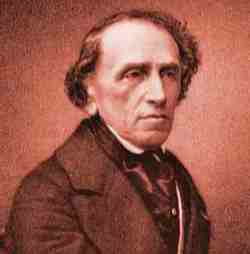
Giacomo Meyerbeer was a German opera composer whose works were the most frequently performed during the nineteenth century although his star has since waned somewhat. He is credited with linking Mozart through to Wagner. He was born on 5th September 1791 in Berlin, Germany and died on 2nd May 1864 in Paris, France aged 72.
Major Works
“Das Brandenburger Tor” (1814)
“Semiramide Riconosciuta” (1819)
“Margerita d’Anjou” (1810)
“L’Esule di Granata” (1822)
“Il Crociato in Egitto” (1824)
“Robert le Diable” (1831)
“Les Hugeuenots” (1836)
“Le Prophete” (1849)
“L’Africaine” (1865)
Biography Timeline
1791: Giacomo Meyerbeer was born Jakob Liebmann Meyer Beer on 5th September in Tasdorf, Berlin, Prussia. His father was Judah Herz Beer, a wealthy banker who was the leader of the Berlin Jewish community and maintained a private synagogue inside his house. His mother was Amalia Wulff, also from a rich family and the children were educated at home by the area’s finest tutors.
1801: His first keyboard teacher is Franz Lauska and he is also taught by Mario Clemenzi and Antonio Salieri. He makes his public debut playing Mozart’s D Minor Piano Concerto in Berlin.
1804: Louis Spohr organises a concert for him in Berlin.
1810: His first stage work is the ballet “Der Fischer und das Milchmädchen” (The Fisherman and the Milkmaid) which is premiered at the Court Opera in Berlin in March. He receives tuition from Abbe Vogler in Darmstadt, Germany.
1811: He adopts the surname Meyerbeer at the death of his grandfather, Liebmann Meyer Wulff. His oratorio “Gott und die Natur” (God and Nature) is performed in Berlin.
1812: His opera “Jephtas Gelubde” (Jephtha’s Vow) is performed in Munich but is not a success.
1813: On 12th February he is appointed Court Composer by Grand Duke Ludwig of Hesse-Darmstadt. “Wirth und Gast” (Landlord and Guest) is performed in Stuttgart. At this stage he does not know whether to become a performer or a full-time composer and he plays the timpani at the premiere of Beethoven’s Seventh Symphony on 8th December in Vienna.
1814: His opera “Die Beiden Kalifen”, a version of “Wirth und Gast”, is a flop in Vienna.
1816: After travelling to France and England he settles in Italy to further his career. During a visit to Sicily he studies a number of local folksongs.
1817: He begins to use the Italian Giacomo as his first name. His first Italian opera is “Romilda e Costanza” which is given in Padua.
1819: “Semiramide Riconosciuta” (Semiramide Recognised) is performed in Turin and “Emma di Resburgo” (Emma of Resburg) is given in Venice.
1820: “Margherita d”Anjou” (Margaret of Anjou) is performed in Milan.
1821: “L’Escule di Granata” (The School of Granada) is performed in Milan.
1824: His first major success, which establishes his name, is “Il Crociato in Egitto” (The Crusader in Egypt) which is premiered in Venice and then goes on to Paris and London.
1825: Death of his father.
1826: He marries his cousin, Minna Mosson. They go on to have five children together. Carl Maria von Weber dies and his widow asks him to complete her husband’s unfinished comic opera “Die Drei Pintos” but this is never achieved. (It is finally completed by Gustav Mahler much later).
1831: His first French opera is “Robert le Diable” (Robert the Devil). The lavish production is a triumph and turns him into a major figure when premiered in Paris. In audience on the night are Daniel Auber, Alexandre Dumas, Hector Berlioz and Victor Hugo amongst many others.
1832: In January he is awarded membership of the Legion d’Honneur and later he is appointed Court Kappellmeister in Berlin but not before the previous incumbent, Gaspare Spontini had trashed his reputation for the delay in producing “Robert le Diable” in Berlin. The poet Ludwig Rellstab also decries his music in an unapologetic anti-Semitic article.
1836: Meyerbeer has to pay his promoter for breach of contract for not producing his next work on the promised date of 1833 however “Les Huguenots” is a triumph at is premiere on 29th February at the Paris opera and is the first opera to be performed there more than 1,000 times.
1839: He meets Richard Wagner for the first time on 20th August in Boulogne on his way to Paris. They begin as friends but only much later does the relationship turn sour.
1841: By the end of the year he has completed the first draft of “Le Prophète” but refuses to have it staged as the Paris Opera does not agree to his conditions. Meyerbeer was in the unusual position for a musician at the time of being able to pick and choose his performances due to his wealth.
1842: He returns temporarily to Berlin, where he is appointed Generalmusikdirektor to the King of Prussia at the suggestion of Alexander von Humboldt and where he instigates the production of Wagner’s “Der Fliegende Holländer” (The Flying Dutchman) to take place. The Berlin premiere of “Les Huguenots” is arranged for 20th May.
1843: The Berlin Opera house burns down and the building of a new one allows for a new commission to be given to Meyerbeer.
1844: The new opera is “Ein Feldlager in Schlesien” (A Silesian Encampment) about part of the life of King Frederick the Great and its premiere has the Swedish soprano Jenny Lind taking the principal role.
1849: “Le Prophète” is finally performed in Paris.
1850: Richard Wagner, now in exile and without money is present at the forty seventh performance of “Le Prophète”. The success of the work financially and artistically annoys him and brings about his anti-Jewish denunciation of Meyerbeer and Felix Mendelssohn in his book “Das Judenthum in der Musik”.
1853: He sets the 91st Psalm to music.
1854: His mother dies which affects him deeply. His next work is the opéra-comique, “L’Etoile du Nord” (The North Star).
1859: His next work is “Le Pardon de Ploërmel” (sometimes known as “Dinorah”) and with it he becomes the most frequently performed composer at leading opera houses during the nineteenth century.
1861: He composes the Coronation March for King Wilhelm the First of Prussia,
1862: He composes an overture for the 1862 London International Exhibition of Industry and Art in South Kensington, London.
Giacomo Meyerbeer died on 2nd May 1864 in Paris. (Gioachino Rossini, who had not been told, fainted when he came to his apartment the next day and heard the news). A special train took his body to Berlin on 6th May and he was buried in the family vault at the Jewish cemetery in Schonhauser Allee. “L’Africaine”, which he had worked on since 1837, was premiered in Paris on 28th April 1865.
Influences
Jakob Beer, as he was then, was the son of a wealthy industrialist father and a mother from a rich banking family. In 1810 he left home to study music in Darmstadt and added his mother’s maiden name to his own to give Meyerbeer. He was an extremely talented pianist, the composer and friend Carl Maria von Weber even thought him to be “one of the best pianists, if not the best pianist of our time”, so it surprised many that he later became known as a composer of grand opera.
His early influences were his contemporary Gioachino Rossini, adopting his Italian operatic style in his early years, after studying in Italy as well as his teacher, Abbé Vogler. He had also studied under the Berlin opera conductor Bernhard Anselm Weber and made a thorough reading of the orchestral style of Christoph Willibald Gluck. He also received composition lessons from Carl Friedrich Zelter, the teacher of Felix Mendelssohn and became immersed in the German orchestral style.
In Paris however it was French grand opera which made his name. His work was famous for being large scale, melodramatic and often based on historical themes with other innovations from the Jewish musical tradition. Works such as “Robert le Diable” and “Les Huguenots” laid the foundations of what would become the French grand opera style. They incorporated large casts, dramatic vocal writing and large and spectacular staging and also fused Italian vocal traditions, dramatic libretti and German orchestration. His collaboration with the librettist Eugène Scribe was also a major factor in his success. He became the most frequently performed opera composer during the nineteenth century, linking Wolfgang Amadeus Mozart through to Richard Wagner. Already rich from his family he earned substantial amounts from his compositions and that combined with his insistence on maintaining his Jewish religion made many people jealous and he was often subjected to anti-semitism.
In the beginning Wagner was strongly influenced by his grand opera style, in such examples as “Rienzi” which Hans von Bülow facetiously called “Meyerbeer’s best opera”. He even supported Wagner financially and helped him get his works such as “Der Fliegender Höllander” (The Flying Dutchman) performed. Later however Wagner’s anti-Semitic views developed and he attacked Meyerbeer publicly accusing him of being interested only in money, not music and bribing the musical critics as he wrote in “Das Judenthum in der Musik”. Meyerbeer was a sensitive and serious musician and never fought back resigning himself to being a victim of his own success. During 1846 he turned down Wagner’s application for a loan of 1,200 thalers and Wagner resented his continuing success at a time when his own version of German opera was not prospering. These two factors probably explain the break between the two.
Other musicians were also critical. Robert Schumann wrote about a superficiality in his works as a critic and declared “Time and time again we had to turn away in disgust (from his non-Christian music). Hector Berlioz was impressed by his innovative orchestration and dramatic sense and referred to the score of “Les Huguenots” as a “musical encyclopedia” and included him in his “Treatise on Orchestration” of 1844. He also stated he was the only successful composer who has really shown genuine interest in me, however, he then went on to say “Monsieur Meyerbeer is the most fortunate of composers in this vale of tears. He is not only lucky to have talent, but also has a talent for being lucky” and was jealous of his administrative qualities and talent from self promotion. Felix Mendelssohn disapproved of his works on moral grounds, believing “Robert le Diable” to be ignoble. Potyr Tchaikovsky by contrast described him as “an artist of genius” and “Les Huguenots” remained one of his favourite operas all his life. Both Franz Liszt and Frédéric Chopin quoted his melodies in some of their works and Liszt’s “Reminiscences de Robert le Diable” sold out on the day of issue. The influence of of his operas on Giuseppe Verdi was also significant and works such as “Aida” would have been impossible without French Grand Opera.
It is interesting that Meyerbeer’s concern to integrate music with all the resources of contemporary theatre anticipated the ideas of Wagner’s Gesamtkuntswek (Total work of art) but during the nineteenth century Wagner’s star rose at the same time as his declined. At his death in Paris, a special train carried the coffin back to Germany and the streets were lined towards the railway station with musical greats, representatives of royalty and the military. In London special concerts were staged to mark his passing.
Other composers influenced by his work were Gaetano Donizetti and Fromental Halévy and later people such as Charles Gounod, Jules Massenet, Antonin Dvořák and Nikolai Rimsky-Korsakov.
During the twentieth century his works were banned in Germany by the Nazi Party and afterwards he suffered from the reputation that his massive works were too expensive to put on in most opera houses although in the twenty-first century his work, is reappearing in the repertory of European opera houses. The Royal Opera produced “Robert le Diable” in 2012 in London and the Paris Opera opened a new production of “Les Huguenots” in 2018. A major contribution to the revival of interest in his was the work by Heinz Becker who organised the publication of his complete diaries and correspondence between 1960 and 2006.
Further Information
List of operas by Meyerbeer.