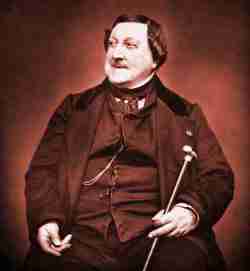
Gioachino Rossini was an Italian opera composer. He was born on 29th February 1792 in Pesaro, Italy and died on 13th November 1868 in Paris, France aged 76.
Major Works
“L’Italiana in Algeri” (The Italian Girl in Algiers) (1813)
“Il Barbiere di Siviglia” (The Barber of Seville) (1816)
“La Cenerentola” (Cinderella) (1817)
“Semiramide” (1823)
Biography Timeline
1792: Gioachino Antonio Rossini was born on 29th February, in Pesaro, Papal States in Italy. His father was Giuseppe Rossini, a trumpeter who played in several orchestras and bands. His mother was Anna Guidarini, a seamstress.
1798: His mother begins a professional career singing in comic opera.
1799: His father Giuseppe is imprisoned for the second time for republican activism and supporting the French troops against the local authorities.
1802: The family move to Lugo near Ravenna and Rossini gets his education locally and is taught the horn by his father and music by the local priest, Giuseppe Malerbe. He is fascinated by Malerbe’s library which contains scores by Haydn and Mozart.
1804: He composes works for strings including four sonatas for four instruments which are performed for a rich patron.
1806: At age of 14 Rossini enters the Liceo Musicale in Bologna studying singing, cello and piano and then composition. He writes several works as a student including a mass and a cantata. He also sings in public and plays the piano. He composes his first opera “Demetrio e Polibio” for the Mombelli family but it doesn’t get staged until 1812.
1807: He hears Isabella Colbran sing in Bologna.
1808: He is invited to continue his studies by the Music school but declines as he is eager to try his luck in the wider world.
1810: He writes his first opera for the tenor Domenico Mombelli called “Demetrio e Polibio” which gets staged in 1812. He moves to Venice later in the year to study with a family friend, the composer Giovanni Morandi. He composes his first comic opera “La Cambiale di Matrimonio” (The Bill of Marriage) which is performed there at the Teatro San Moise with some success but the soloists declare it difficult. Nevertheless, it earns him what he describes as a considerable sum.
1811: Back in Bologna his two-act comic opera “L’equivoca Stravagante” (The Extravagant Misunderstanding) is produced with little success. He has a success conducting Joseph Haydn’s “The Seasons” and works at the opera houses in Ferrara and Rome.
1812: The one act opera “L’inganno Felice” (The Fortunate Deception) is produced at the Teatro San Moise in Venice on 8th January. Rossini writes the oratorio “Ciro in Babilonia” (Cyrus in Babylon) and the comic opera “La Scala di Seta” (The Silken Ladder). The singer Marietta Marcolini recommends Rossini to the committee of La Scala Milan and he begins to write “La Pietra del Paragone” (The Touchstone).
1813: After the comic opera “Il Signor Bruschino” was performed at San Moisè in Venice during May he begins to write his first serious opera, “Tancredi” for La Fenice which becomes an instant success. Rossini also has another hit with “L’Italiana in Algeri” (The Italian Girl in Algiers).
1814: His next work is “Aureliano in Palmira” but is not a success. He writes “Il Turco in Italia” for Milan and “Sigismondo” for Venice neither of which catch the public’s imagination.
1815: He moves to Naples in May to take up the post of Director of Music for the royal theatres. Isabella Colbran sings the main part there of “Elisabetta, Regina d’Inghilterra” (Elizabeth, Queen of England) and it is a great success. At first the Neapolitans saw him as an intruder to their traditions but quickly warm to his music.
1816: The success of “Elisabetta” led to an invitation from Rome for new works for the carnival season. Both of these were unsuccessful, the second “Almaviva”, soon to be retitled “Il Barbiere di Siviglia” (The Barber of Seville), the more so as the Romans preferred an earlier version by Giovanni Paisiello. However when it is produced elsewhere in Italy it is received with great enthusiasm. His next serious opera “Otello” (Othello), based on the Shakespeare play was panned by Lord Byron when he saw it.
1817: The next works produced are “La Cenerentola” (Cinderella) in Rome and “La Gazza Ladra” (The Thieving Magpie) which is particularly popular in Milan. He also writes a Grand Opera “Armida”. “L’Italiana in Algeri” receives its first performance in Paris.
1818: He produces “Mose in Egitto” (Moses in Egypt).
1819: “La Donna del Lago” (based on “The Lady of the Lake” by Sir Walter Scott) is a failure at its premiere but then finds an audience.
1820: He composes “Maometto the Second”.
1821: He hears Beethoven’s “Eroica”symphony for the first time and is determined to meet him.
1822: He marries Isabella Colbran in March just outside Bologna at Castenaso and the couple then move to Vienna with the theatrical company where Rossini he meetsLudwig van Beethoven. The failure of the tragic opera “Ermione” had encouraged the move. Beethoven is not so pleased to see him and tells him he is not cut out to write serious opera and that he should write more “Barbers”. However in Vienna Rossini is received like a hero by the public and he becomes the favourite composer of the Chancellor Klemens von Metternich.
1823: He returns to Venice where he produces “Semiramide” for La Fenice. The Venetians are nonplussed by this long and ambitious work and so Rossini decides to move on to Paris. He is welcomed by the Academy there. In November he visits London and plays for King George the Fourth but is unenamoured by the food in England. Rossini and Colbran had signed contracts for a season at the King’s Theatre in the Haymarket but no new work is offered as the impresario, Vincenzo Benelli, defaults on his contract with the composer and so the couple return to Paris.
1824: He gains a lucrative contract with the French government under King Louis the Eighteenth to produce one grand opera for the Académie Royale de Musique and a comic opera for the Théâtre-Italien. The King dies in September changing Rossini’s plans.
1825: His first new work for Paris is “il Viaggio a Reims” (The Journey to Rheims) for the coronation of the new King Charles the Tenth in June.
1826: His contract stipulates he should reform the orchestra and give more prominence to the chorus. His next work “Le Siège de Corinthe” (The Siege of Corinth) which is hailed as a great work by Hector Berlioz.
1827: His mother dies and he is distraught. He writes “Moise et Pharaon”.
1828: He writes “Le Comte Ory” (Count Ory) his only comic opera in French.
1829: His final opera is “Guillaume Tell” (William Tell) based on the play by Friedrich Schiller which is a triumph in Paris. The Rossinis move back to Castenaso as he is suffering from another bout of depression and illness and he doesn’t honour the contract for another four operas.
1830: The overthrow of King Charles the Tenth in the July revolution and cutbacks under Louis Phillippe the First reducing his lifetime annuity mean that Rossini has to leave Paris and return to Italy. He also wanted to see his new mistress Olympe Pelissier. He composes the first of “Soirées Musicales” songs for duet and piano.
1831: He begins composing his “Stabat Mater”.
1837: He settles in Bologna and begins a formal separation from his wife, who has remained in Castenaso all the while he was in Paris.
1839: His father dies.
1841: The “Stabat Mater” is completed and first performed the following year.
1843: He returns to Paris to see Jean Civiale for medical treatment. Rumours abound that he is about to write an opera about Joan of Arc.
1844: The Paris Opéra produces a French version of “Otello”.
1845: His wife Isabella Colbran becomes very ill and Rossini travels to meet her in September but she dies a month later.
1846: His opera “Robert the Bruce” is produced in Paris but controversially he assembles it with music from his past works which had never been heard in the city before. He also writes the “Petite Messe Solennelle”.
1847: He marries Olympe Pélissier and busies himself with writing songs for private use.
1848: The 1848 revolution causes him to leave Bologna and to move to Florence where he feels safer.
1855: In April he returns to Paris and stays there in a house in Passy or in a central flat in the Rue de la Chausee-d’Antin for the remainder of his life. He becomes well known for his gourmet dinners.
1858: He begins the samedi soirs, Saturday salons where the greats of intellectual life gather. By now both his mental and physical health are in steady decline.
1857: In April he dedicates his song cycle “Musique Anodine,” to his wife and writes numerous others for his weekly gatherings. Many composers attend including Daniel Auber, Charles Gounod, Franz Liszt, Giacomo Meyebeer and Guiseppe Verdi.
1860: Richard Wagner visits him.
1864: He is made a grand officer of the Legion of Honour by Emperor Napoleon the Third. His “Petite Messe Solennelle” is first performed.
Gioachino Rossini died on13th November 1868 after an operation to treat colorectal cancer in Passy, near Paris, France. More than four thousand people attended his funeral at Sainte-Trinitie Church and he was buried in Pere Lachaise cemetery in Paris. In 1887 his remains were moved to the church of Santa Croce in Florence, Italy.
Influences
Gioachino Rossini’s family were very musical. His father played the horn and taught him music and his mother was a singer. The local priest when the family moved to Lugo, Giuseppe Malerbe, gave him full rein to use his extensive library and the young boy became increasingly influenced by the works of Joseph Haydn and Wolfgang Amadeus Mozart whose music was relatively unknown in Italy at the time. At 15 he had already learned the violin, horn, and harpsichord and sang in public to earn some money. He later became an accompanist and then a conductor.
His early operas were influenced by the Italian composers Domenico Cimarosa, Giovanni Paisiello and Luigi Cherubini as well as Christoph Willibald Gluck. Later in his career he would be influenced by Ludwig van Beethoven who he met in 1821 and who respected his talent and frenetic output. Rossini adapted many of Beethoven’s innovations in orchestration and thematic development. He broke with traditional operatic forms by allowing the music to become more part of the action rather than merely a minor accompaniment. He became known as “The Swan of Pesaro” or the “The Italian Mozart” and was the most popular composer during the first half of the nineteenth century and ushered in the “Golden Century” of Italian opera. He was prolific and composed thirty-nine operas by the time his was 38, some in Italian and some in French.
His withdrawal from composing for the last 40 years of his life has never been explained fully. Various suggestions have been ill health, having enough money to live on without it or the rise of large-scale grand operas by composers such as Giacomo Meyerbeer. In. 1855 he settled in Paris and began to write again but mainly for private family consumption. One of his few late works intended for public performance was the 1864 work “Petite Messe Solennelle”. He and his wife held famous Saturday evening salons at the period in their home and they were attended by such luminaries as Daniel Auber, Charles Gounod, Franz Liszt, Giuseppe Verdi and even Meyerbeer himself.
Although his comic operas were popular with the pubic it was his opera seria that were an important influence on Giuseppe Verdi, Jacques Offenbach and even Richard Wagner who visited him in 1860. Pyotr Tchaikovsky praised “The Barber of Seville” as “a priceless pearl of Italian music” and an “inimitable opera”. His work also influenced the Italian opera composers who immediately followed him, namely Gaetano Donizetti and Vincenzo Bellini.
The popularity of Rossini’s melodies led many contemporary piano virtuosi to create transcriptions orworks based on them. Variations on “Non più mesta” from “La Cenerentola” (Cinderella) were produced by Frédéric Chopin and Friedrich Burgmüller and Liszt wrote a transcription of the “William Tell” overture in 1838. Not only did his operas influence many future Italian composers but also the French musical scene including Daniel Auber, Adolphe Adam and Fromental Halévy. Not all composers were sympathetic however. Hector Berlioz wrote about his “melodic cynicism, his contempt for dramatic and good sense, his endless repetition of a single form of cadence, his eternal puerile crescendo and his brutal bass drum”. He had plenty of supporters outside music however. The writer Stendhal was so enamoured that he wrote “Life of Rossini”.
After his death his reputation began to fade. George Bernard Shaw writing in 1886, said “The once universal Rossini, whose “Semiramide” appeared to our greener grandfathers a Ninevesque wonder, came at last to be no longer looked upon as a serious musician”. In the twentieth century his star began to rise again and Ottorino Respighi paid him several tributes and used excerpts from the “Péchés de Viellesse” in his ballet “La Boutique Fantasque” of 1918. The “Fondazione G. Rossini” was created by the city of Pesaro in 1940. In the later part of the century a re-evaluation of his importance began and critical editions of his works were produced.
In the twenty-first century opera houses around the world still perform “Il Barbiere di Siviglia” (The Barber of Seville) and “La Cenerentola” on a regular basis. Music from “William Tell” has been used in several TV and film productions and famously provided the theme tune to the American cowboy series “The Lone Ranger”.
Further Information
List of compositions by Rossini.