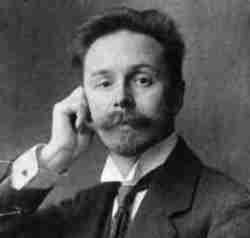
Alexander Scriabin was a late Romantic Russian composer and virtuoso pianist. He was born on 6th January 1872 in Moscow, Russia and died on 14th April 1915 in Moscow, aged 43.
Major Works
Piano Concerto (1896)
Symphony No. 1 (1900)
Symphony No.3 (1905)
Symphonic Poem “Poem of Ecstasy” (1908)
“Prometheus: The Poem of Fire” (1911)
Biography Timeline
1872: Aleksandr Scriabin was born on 6th January in Moscow, Russia. His father Nikolai Aleksandrovich Scriabin was a student at the time of his birth and from a noble family. His mother, Lyubov Petrovna Schetinina, was a concert pianist. He was educated at local schools.
1873: His mother dies of tuberculosis. His father studies the Turkish language in the Institute of Oriental Languages in St Petersburg and thereafter moved to Turkey and becomes a military attaché. Scriabin is brought up by his grandmother and aunts. The young boy is fascinated by the piano even to the extent of building his own.
1882: He enters the Moscow Cadet School but continues taking piano lessons. He does well academically but is exempted from drill practice due to his frail physique.
1888: He enters the Moscow Conservatory and studies the piano under V.I. Safonov and composition with Sergey Taneyev and Anton Arensky. He damages his right hand whilst practising a particularly difficult piece by Franz Liszt and although the doctors said he will never recover he eventually does. He writes his Piano Sonata No.1.
1892: He graduates from the Conservatory with the Little Gold Medal in piano performance, but does not complete a composition degree because of differences with Arensky.
1894: He makes his debut as a pianist in St. Petersburg receiving good reviews. The publisher Mitrofan Velyayev agrees to publish some of his compositions.
1896: He composes his Piano Concerto.
1897: In August he marries the pianist Vera Ivanovna Isakovich and then tours Russia and further afield. He goes on to have four children with her and three by another wife.
1898: He holds successful concerts in Paris and later becomes a teacher at the Moscow Conservatory. He writes a cycle of etudes and preludes.
1900: He becomes interested in mystical philosophy and is influenced the works of Arthur Schopenhauer, Friedrich Nietzsche and the music of Richard Wagner. He also dabbles in Theosophy and reads the writings of Helena Blavatsky. He composes his Symphony No. 1 which contains a choral finale.
1901: He has ideas for writing an opera but this never materialises. The Poem Op. 32 and the Poème Tragique Op. 34 were originally conceived as arias for the opera.
1902: Symphony No. 2 is first performed in St Petersburg on 12th January.
1903: He finishes teaching at the Moscow Conservatory.
1904: He settles in Geneva, Switzerland and devotes himself to composition and works on Symphony No. 3. which is first performed a year later in Paris. He legally separates from his wife.
1905: He begins writing “Le Poème de l’Extase”. (The Poem of Ecstasy). He remarries to the pianist Tatiana Fyodorovna. Schlözer.
1906: He tours the United States.
1907: He becomes friendly with the Canadian composer Alfred La Liberte who is influenced by his music. Later in the year he moves to Paris and gives concerts there organised by Sergei Diaghilev and then moves on to Brussels, Belgium.
1908: The “Poem of Ecstasy” is first performed and he joins the theosophical circles in Brussels.
1909: He is encouraged to return to Russia by the conductor Serge Koussevitzky. He begins work on a grand multimedia work entitled “Mysterium” but only sketches are completed. The introductory section “L’Acte Préalable” (Prefatory Action) is eventually made into a performable version by Alexander Nemtin.
1911: He composes “Prometheus: The Poem of Fire” which stipulates the projection of colours onto a screen during performance.
1914: He gives performances in London, England.
1915: He gives his last concert on 2nd April in St Petersburg receiving very good reviews from the critics. He returns to his Moscow apartment on 4th April and notices a pimple on his lip. His temperature begins to rise and he has to cancel all further concerts as it gets worse and he becomes bedridden. Doctors try to remove the lump on the 12th but it has already poisoned his blood and he becomes delirious.
Aleksandr Scriabin died of sepsis on 27th April 1915 at home in Moscow. His funeral was attended by so many people that tickets had to be issued. Sergei Rachmaninoff was a pallbearer and carried out a later concert tour of Russia of the composer’s music for the family’s benefit.
Influences
As a young child Alexander Scriabin was introduced to music from an early age by his family. He became a musical prodigy and he began to construct complicated toy pianos, complete with soundboards, pedals, and moveable keys aged seven.
He entered the Moscow Cadet School in 1882 but continued to study music at the same time and also took piano lessons. In 1888 he moved to the Moscow Conservatory where he studied the piano with V.I. Safonov and composition with Sergey Taneyev and Anton Arensky. His early style was profoundly influenced by the romantic piano works of Frédéric Chopin which can be seen in études, mazurkas, and preludes.
He had a condition called Synaesthesia which means that stimulation of one sensory or cognitive pathway leads to involuntary experiences in other sensory or cognitive pathways. This has often been described as seeing particular colours when a piece of music is played or vice versa but is a far more complex phenomenon in practice but nonetheless heavily influenced his own compositions. He was particularly inspired by the paintings of the Symbolist movement as well as the idea of Gesamtkunstwerk (total work of art as popularised by Richard Wagner). He created a colour-coded circle of fifths for his compositions and even designed a “colour organ” to project coloured light into the concert hall during performances of “Prometheus”.
At the beginning of the twentieth century, he avidly read the philosophy of Friedrich Nietzsche and other German idealist philosophers such as Arthur Schopenhauer. He was mystically driven and later integrated the religious and theosophical ideas of the Russian/American mystic Helena Blavatsky into his work. Many of these ideas formed the basis of his later orchestral works such as “The Poem of Ecstasy” of 1908 and “Prometheus” from 1910. In Russia he was well received and the novelist Leo Tolstoy said of his music it was “a sincere expression of genius”. The Soviet Encyclopedia said of him, “no composer has had more scorn heaped on him or greater love bestowed”.
He was one of a few major composers who revolutionised musical style in the first decade of the twentieth century by eliminating key as a structural principle and by utilising dissonant harmonies. He said of Sergei Rachmaninoff’s music “It is all the same, all the same whining, dull lyricism, seagullishness. There is no impulse, no power, no light – music for suicides. Despite this Rachmaninoff was a pallbearer at his funeral and subsequently went on a grand tour of Russia, performing only Scriabin’s music for the family’s financial benefit.
Sergei Prokofiev was also a great admirer of his music particularly during his time as a student at the St. Petersburg Conservatory. His “Visions fugitives”, a cycle of twenty piano miniatures, bears great likeness to Scriabin’s tone and style. Other composers influenced by his dissonant, mystical, and colour-associated harmonies can be seen in the work of Russians such as Igor Stravinsky, Samuil Feinberg and Nikolai Roslavets. The last named has had several critics saying he most resembles the older composer.
His later atonal and synthetic chord structures including the famous “mystic chord” laid the groundwork for musical serialism and inspired other contemporary Russian composers such as Arthur Lourié, Sergei Protopopov, and Alexander Mosolov.
In Poland Karol Szymanowski and in Great Britain Kaikhosru Sorabji were both admirers and Sorabji promoted Scriabin even during the years when his popularity had decreased greatly. In America Aaron Copland praised him as “truly individual, truly inspired”, but criticised him for using old classical forms such as the sonata which he felt was a strait-jacket on his ideas.
During the 1930’s his music was disparaged in the West (possibly for political reasons) with Sir Adrian Boult in England refusing to play his music which he described as “evil works”. In 1935, the writer Gerald Abraham called him a “sad pathological case, erotic and egotistic to the point of mania”. However the pianist Edward Mitchell, compiled a catalogue of Scriabin’s piano music in 1927, and regarded him as “the greatest composer since Beethoven“.
In recent years his work has undergone a total rehabilitation and is now played in concert halls worldwide.
Further Information
List of compositions by Scriabin.