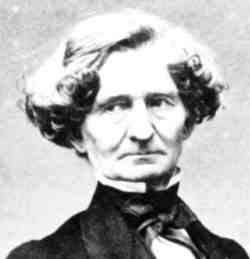
Hector Berlioz was a French Romantic composer and conductor. He composed symphonies, operas and choral pieces in an individualistic style. He was born on 11th December 1803 in La Côte-Saint-André and died in Paris on 8th March 1869 aged 65.
Major Works
“Symphonie Fantastique” (1830)
“Harold in Italy” (1834)
“Grande Messe des Morts”
“Romeo and Juliette” (1839)
“Grande Symphonie Funebre et Triumphale” (1840)
“Les Troyens” (1858)
Biography Timeline
1803: Louis Hector Berlioz is born on 11th December at no 83 Rue National in La Cote Saint-Andre, France to a Doctor Loius Berlin and his wife Marie-Antoinette-Josephine Marmion. He is the eldest of five children. He is educated by his father.
1815: Berlioz learns to read Latin and translates Virgil into French.
1816: He makes his earliest attempts at musical composition.
1817: Imbert, the second violin of the Theatre de Lyon, becomes his musical tutor and Berlioz learns the flute.
1819: He composes his first published work “Le Debit de la Burger”.
1821: Berlioz goes to Paris to study medicine in October and sees his first opera which has a profound effect on him.
1822: He studies the scores of Gluck in the Conservatoire library and decides to devote himself to music.
1823: He writes his first oratorio and Jean-Francois Le Sueur is impressed and takes him on as one of his pupils.
1824: He is made Bachelier ès sciences physiques (12 January). He finally abandons medicine and embarks on a career in music.
1825: Berlioz’s “Messe Solennelle” is performed at Saint Rich in July.
1826: He is eliminated from the early rounds of the Prix de Rome but undeterred he enrols at the Conservatoire.
1827: He becomes a singer at the Theatre des Nouveautes to supplement the allowance he gets from his father. He again enters the Prix de Rome but doesn’t win. He sees two Shakespeare plays at the Odeon theatre in Paris and is particularly taken by the Irish actress Harriet Smithson.
1828: Berlioz hears Beethoven’s third and fifth symphonies for the first time at the Conservatoire. His entrant at the Prix de Rome, the cantata “Herminie”, this time wins second prize. He reads Goethe’s Faust for the first time.
1829: He publishes his opus 1 as “Huit scènes de Faust“. His cantata “Cleopatre” fails to win anything at the Prix de Rome.
1830: He begins the composition of the “Symphonie Fantastique”. His cantata “Sardanapale” wins first prize in the Prix de Rome. The “Symphonie Fantastique” is premiered at the Conservatoire on 5th December conducted by Francois-Antoine Habeneck. Franz Liszt is at the Concert and the two become firm friends. He leaves for Italy own the 30th December as a Prix de Rome Laureate he is required to spend two years there.
1831: He finally arrives at the French Academy in Rome in March. He meets Felix Mendelssohn whilst he is there. He receives a letter from his fiancé Camille Moke’s mother informing him that she has in fact married someone else while he is away. In a fit of rage he decides to go back to Paris to kill all three protagonists but later decides against it.
1832: After a long tour though Italy he finally arrives back in Paris in November. Another concert takes place on 9th December which includes the “Symphonie Fantastique”. It is a great success and in the audience are Victor Hugo, Alexandre Dumas, Nicolo Paganini, Franz Liszt, Frederic Chopin, George Sand and Harriet Smithson. He finally meets the actress a few days later.
1833: Berlioz and Harriet marry each other on 3rd October at the British Embassy in Paris although Berlioz’s family are strongly opposed to the match.
1834: Berlioz composes the symphony “Harold in Italie”. Berlioz and Harriet move to Montmartre and their son Louis is born on 14th August.
1835: To earn money for his family he becomes a music critic for the “Journal des Debats”.
1836: He composes the opera “Benvenuto Cellini”. Harriet appears for the last time on stage in December.
1837: The “Grande Messe des Morts” is commissioned and then given its first performance at Les Invalides on 5th December.
1838: Berlioz’s mother dies in February. “Benvenuto Cellini” receives a hostile reception at its premiere on 10th September at the Opera.
1839: Due to a gift of 20,000 francs given to him the previous year by Paganini he is able to devote time to composing “Romeo and Juliette”. Berlioz is made Chevalier de la Légion d’honneur. Richard Wagner is present at the last performance of “Romeo and Juliette” but Paganini never hears it.
1840: The “Symphonie Funebre at Triomphale” is written by Berlioz to celebrate the tenth anniversary of the 1830 Revolution.
1841: “Les Nuits d’Ete” is completed in September. He begins a relationship with Marie Recio a mezzo-soprano singer.
1842: Marie accompanies him on a concert tour to Brussels and then to Germany.
1843: In Germany Berlioz meets Felix Mendelssohn, Richard Wagner, Giacomo Meyerbeer and Robert Schumann. He composes the overture “Le Carnival Romain” later in the year back in Paris.
1844: Berlioz and Harriet separate and Berlioz moves to live with Marie Recio, however he continues to pay for Harriet’s accommodation and expenses.
1845: He is invited to the unveiling of the statue to Beethoven in his birthplace in Bonn, Germany. He begins work on“La Damnation de Faust”.
1846: He orchestrates the Hungarian National Anthem and later incorporates it into “La Damnation de Faust” as the “Marche Hongroise”. “La Damnation de Faust” ” is given its premiere in Paris in December but it is not well received and leaves Berlioz with a significant debt.
1847: He visits Russia and meets Princess Sayn-Wittgenstein in St Petersburg. He also makes his first visit to London later in the year and conducts the orchestra at the Theatre Royal, Drury Lane.
1848: The February Revolution breaks out in Paris. Marie Recio joins Berlioz in London. His father dies in July and Berlioz visits La Cote to see his sisters. Harriet suffers several strokes and Berlioz pays for her nursing care and visits her regularly in Paris.
1849: The “Te Deum” is completed.
1850: He forms the Society Philharmonique de Paris and takes on the paid position of Librarian at the Conservatoire.
1851: Berlioz is rejected as a member of the Institut de France. The French Government sends him to the Great Exhibition in London to review the musical instruments.
1852: He conducts more concerts in London. Franz Liszt puts on a revival in Weimar, Germany of “Benvenuto Cellini” and it becomes known as the Weimar version.
1853: He travels to London again to produce and conduct “Benvenuto Cellini” at the Royal Opera House, Covent Garden. It only receives one performance due to a bad reception from the audience.
1854: Harriet Smithson dies in March and is buried in Montmartre. Berlioz marries Marie Recio on 19th October. He completes “L’Enfance du Christ” and it is well received at its first performance in December.
1855: He conducts the first performance of the “Te Deum“. He meets Richard Wagner in London later in the year.
1856: He begins the composition of the opera “Les Troyens” which is based on Virgil’s “Aeneid”.
1859: He is taken ill and cancels a visit to Baden Baden in Germany.
1860: “Les Troyens” receives it first performance in January. He begins composing “Béatrice et Bénédict“.
1861: Berlioz is present at the first performance of Richard Wagner’s “Tannhauser” in Paris on 13th March.
1862: He completes “Béatrice et Bénédict” (based on Shakespeare’s Much Ado About Nothing“). Marie Recio dies of a heart attack at the young age of 48 and she is buried at Montmartre Cemetery. Berlioz fails to become permanent secretary of the Académie des Beaux-Arts. He meets a young woman called Amelie in the cemetery and becomes close friends with her. “Beatrice and Benedict” is first performed at Baden Baden in August.
1863: He breaks off his relationship with Amélie at her request.
1864: Harriet Smithson’s remains are moved to the main cemetery in Monmartre from the smaller St Vincent which was about to be demolished. Berlioz resigns as music critic of the Journal des Débats. He is made an Officier de la Légion d’Honneur. He discovers Amelie’s grave in Montmartre and discovers she has been dead for six months. He meets Estelle Fournier, his first love, for the first time in 40 years in Lyon.
1865: Berlioz visits Estelle Fornier in Geneva, Switzerland.
1866: Berlioz meets Franz Liszt for the last time.
1867: His son Louis, a merchant seaman, dies of yellow fever in Havana, Cuba on 5 June. Berlioz makes another visit to Russia in November.
1868: Berlioz experiences two falls in Nice.
Berlioz dies on the 8th March 1869 at No 4 Rue de Calais, Paris. He is buried next to his two wives in Montmartre Cemetery.
Influences
In music Berlioz was most influenced Ludwig van Beethoven, the French composer Jean-François Le Sueur and the Italian opera composer Gaspare Spontini. In literature he was particularly influenced by the Englishman Thomas De Quincey and his “Confessions of an English Opium Eater” and the works of Johann Wolfgang von Goethe and both writers can be seen as models in his most famous work “Symphonie Fantastique”. William Shakespeare was also a great influence and he set many of his plays to music.
It is well known that he was smitten by the Irish actress Harriet Smithson and the “Symphonie fantastique” can be seen as an extravagant attempt to attract Harriet’s attention. Indeed, he was an extravagant and controversial figure to both the musical establishment and the staid society of the day who were used to strict Victorian values and were shocked at the paganism and sacrilegious figures in the work.
Not one to be put off by the critics he wrote the first text book on orchestration in 1844 and it became one of his most important and influential works to later artists and is still studied today even though many instruments have changed beyond recognition or were not even invented at the time. Maurice Ravel for instance was greatly influenced by Berlioz. Composers such as Frederic Chopin and Pyotr Tchaikovsky followed his lead in writing about inner feelings if not following his techniques to the letter. After the “Symphonie Fantastique” composers were free to make symphonies of any length and form they chose and Gustav Mahler followed this idea to its fullest. He was the first also to invent the “idee fixe” which became so much of Richard Wagner’s output and he played a major role in the development of symphonic program music which influenced Franz Liszt and many others.
His first biography was written during his lifetime by Eugene de Mirecourt and several more were written immediately after his death such was his fame. Critics were divided into the pro and anti camps. The anti were quite vociferous and George Templeton Strong called the composer’s music “the work of a tipsy chimpanzee” and many others described his lack of technical knowledge and even in the twentieth century “The Record Guide” stated “No other composer [is] so controversial as Hector Berlioz”. As few of his works were actually performed in the late nineteenth century people believed the rumours they had heard rather against him being second rate rather than actually hearing the music itself and it was only when sound recordings became available to the masses that his star rose once more. Even Debussy had once called him a monster.
Many composers had praised his genius however including Robert Schumann, Richard Wagner, Cesar Franck and Modest Mussorgsky and that fact was not lost on the critics of the 1950’s who began a complete reappraisal of his work which removed many of the long-standing myths. In 1957 “The Trojans” was staged at the Royal Opera House, Covent Garden in London followed by the complete French version in 1969. D. Kern Holoman published the first thematic catalogue of Berlioz’s works in 1987 and Julien Tiersot’s collection of the composer’s letters was published in 2016 eighty years after his death.
Further Information
List of Works by Hector Berlioz.
The following is a fantastically comprehensive site covering Berlioz compiled by the husband and wife team of Michel Austin and Monir Tayeb, both academics by profession, based in universities in Scotland. Go to site.