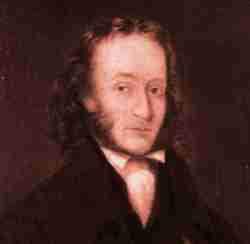
Niccolò Paganini was an Italian violinist and composer and was celebrated as the greatest violin virtuoso of his day. He was born on 27th October 1782 in Genoa, Italy and died on 27th May 1840 in Nice, France aged 57.
Major Works
24 Caprices for Solo Violin (1802-1817)
Violin Concerto No. 1 (1818)
“Moses Fantasy” (1818)
Variations on God Save the King (1829)
“Moto Perpetuo” (1835)
Biography Timeline
1782: Niccolo Paganini was born on 27th October in Genoa, Italy. His father was an unsuccessful shipping trader but made some money by playing the mandolin. Paganini studied early on with his father and then with a local violinist, Servetto, and then finally with the famous Giacomo Costa.
1793: He makes his first concert appearance and then moved to Parma to take lessons with Alessandro Rolla and Gaspare Ghiretti.
1796: The French invade northern Italy including Genoa during March and the Paganinis take refuge at their country property in Romairone, near Bolzaneto.
1797: He tours Lombardy with his father giving concerts. Once his reputation had increased he became independent but also indulged himself in gambling and womanising. A French merchant lent him a Guarneri violin to play at a concert because he had pawned his own. He was so impressed with his playing that he gave the instrument to Paganini permanently..
1800: He travels to Livorno to give concerts.
1801: He is appointed as the first violin of the Republic of Lucca. He begins to write the first of his 24 Capricci for solo violin which all use innovative techniques.
1805: Lucca is annexed by Napoleon Bonaparte and the region is given to Napoleon’s sister Elisa Bonaparte Baciocchi to rule over. Paganini is appointed as Director of Music at Piombino by Elisa and he gives private lessons to her husband Felice for ten years.
1807: Elisa Baciocchi becomes the Grand Duchess of Tuscany and her court transfers to Florence.Paganini travels with the entourage.
1809: At the end of the year he leaves the Baciocci court to become freelance.
1813: He performs at La Scala, Milan for the first time. The concert was a great success and his fame begins to rise amongst the music establishment in Europe. Whilst there he meets a singer named Antonia Bianchi who is originally from Como and the two start a close relationship and travel to concerts together.
1818: He meets Giachino Rossini in Bologna during the summer.
1819: The Violin Concerto No. 1, opus 6, is premiered in Naples on the 31st of March.
1821: He meets Rossini again on his return from Naples in Rome and stands in as the conductor for Rossini’s opera “Matilde di Shabran” after the sudden death of the main conductor.
1822: He contracts Syphilis.
1824: He falls in love with the singer Antonia Bianchi.
1825: Bianchi gives birth to their son, Achille Ciro Alessandro, on 23rd July in Palermo, Sicily and he was baptised at San Bartolomeo’s church.
1826: The Violin Concerto No. 2 in B minor, opus. 7, and the Violin Concerto No. 3 in E major are composed by Paganini.
1827: He receives the Order of the Golden Spur from Pope Leo XII.
1828: He breaks up with Achille Ciro Alessandro. He then travels to Vienna on 15th August. The concert is great success and his fame begins to spread further across Europe and he continues to give more concerts in major cities in Germany, Poland, and Bohemia which last until Strasbourg in February 1831.
1829: The Violin Concerto No. 4 in D minor is composed in the autumn.
1830: The Violin Concerto No. 5 in A minor is composed.
1831: His concerts in Paris and London cause a sensation and he is now a major star.
1832: He tours England and Scotland and these concerts in particular make him a wealthy man.
1833: He settles in Paris, where he commissions the composer Hector Berlioz to write a symphony. “Harold en Italie” is the result but Paganini thought the viola part was too easy for him and never played it.
1834: He is very ill with tuberculosis in Paris and returns to Genoa on 15th September. This puts an end to his public playing career.
1835: He returns to Parma and is employed by Archduchess Marie Louise of Austria, Napoleon Bonapart’s second wife.
1836: He returns to Paris to set up Casino. Paganini. Its failure leaves him in financially ruined and he has to auction off his personal effects, including his musical instruments.
1838: He leaves Paris for Marseille at Christmas after the failure of his casino.
1839: In Nice his illness has begins to get worse.
1840: In May the Bishop of Nice sent Paganini a local priest to perform the last rites but the composer thought this was premature and refused.
Niccolo Paganini died on the 27th May from internal hemorrhaging before another priest could be summoned. Because of this, and his supposed association with the devil which allowed him to play so wildly, the Church denied his body a Catholic burial in Genoa. After four years and an appeal to the Pope his body was taken to Genoa, but it was still not buried. He was finally buried in 1876 in Parma and finally reinterred in a new cemetery in Parma in 1896.
Influences
Niccolò Paganini was taught music by his father Antonio, who taught him the mandolin and later the violin, and a local violinist, G. Servetto and later with Giacomo Costa. He was seen as a child prodigy. In 1793 he gave his first performance and then went on to study with Alessandro Rolla and Gaspare Ghiretti in Parma. He was influenced by the innovative techniques of violinists Pietro Locatelli (1693–1746) and August Duranowski (Auguste Frédéric Durand) (1770–1834) and their performing styles.
After a tour of Lombardy in 1797 with his father his reputation began to grow and he quickly became independent. His new-found wealth however, led him into excessive gambling and numerous love affairs. Pawning his violin to pay off debts he was lent a Guarneri violin by a French merchant. When he heard him play was the merchant was so impressed he gifted the instrument to him.
Beginning in 1801 he began to write his famous “24 Capricci” (Caprices) to show off his technique. This would influence many composers in the future. In 1805 Napoleon Bonaparte’s sister Elisa appointed him Director of Music in Piombino and he gave many recitals throughout Italy. In 1828 he was a sensation in Vienna and in 1831 the same happened in Paris and London. His tour throughout England and Scotland in the following year made him a very wealthy man. In 1833 he settled down in Paris and commissioned Hector Berlioz to write the symphony “Harold in Italie” for him although he never played it himself describing the viola part as too slight. He did give the struggling French composer 20,000 Francs to help his career. After the failure of his Casino Paganini he went to Marseille.
He was a flamboyant showman and improvised brilliantly. He used tricks such as deliberately breaking one or two violin strings and continuing the piece of music on those remaining. At the time he was the only one who could actually play his compositions. Later virtuosi such as Pablo Sarasate and Eugène Ysaÿe copied this idea. His fantastic abilities and hands would lead to rumours that he was in league with the devil or under witchcraft but in the twentieth century doctors realised he suffered from Marfan syndrome a genetic disorder affecting connective tissue and often characterised by tall stature, long limbs, and flexible joints.
Franz Liszt was so impressed by his extreme mastery of the violin that he vowed to do the same for the piano and gave up performing for several years while he improved his skills. In 1829 he was on a concert tour in Europe and Frédéric Chopin saw him play in Warsaw and was greatly impressed and from then on determined to remove the boundaries to his own piano playing. Gioachino Rossini also said, “I wept the first time I heard Paganini play”.
Themes from the “Capricci”, especially “La Campanella”, inspired works by Liszt himself as well as Robert Schumann, Johannes Brahms and Sergei Rachmaninoff. The list of other composers inspired by him or using parts of his music in their compositions is long and covers the centuries after his death. This list includes Chopin’s “Souvenir de Paganini for solo piano published posthumously in 1829, Robert Schumann’s Studies after Caprices by Paganini of 1832; 6 Concert Studies on Caprices by Paganini of 1833; “Carnaval” of 1851, Johann Nepomuk Hummel’s “Souvenir de Paganini”, Fritz Kreisler’s “Paganini Concerto in D major”, Franz Lehár’s operetta “Paganini” of 1925 Brahm’s “Variations on a Theme of Paganini”, Rachmaninoff’s “Rhapsody on a Theme of Paganini” and Nathan Milstein’s “Paganiniana” variations.
In the twentieth century Polish composer Witold Lutosławski was also influenced by his work and produced a set of Paganini variations and the popular composer Andrew Lloyd Webber did the same for his cello playing brother Julian.
Further Information
List of compositions by Paganini.