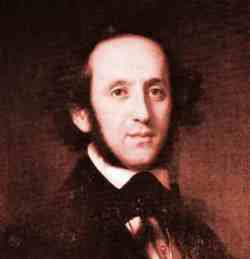
Felix Mendelssohn Bartholdy was a German composer, pianist, organist and conductor of the early Romantic period. His works consist of symphonies, concertos, piano music, organ music and chamber music. He was born on 3rd February 1809 in Hamburg, Germany and died on 4th November 1847 in Leipzig, Germany aged 38.
Major Works
Two piano concertos
Overture to “A Midsummer Night’s Dream” (1826)
“Italian” Symphony (1833)
Violin Concerto (1844)
“Elijah” (1846)
Biography Timeline
1809: Felix Jakob Ludwig Mendelssohn was born on 3rd February in Hamburg, Germany. His father Abraham was a banker and his grandfather was the liberal philosopher Moses Mendelssohn. Abraham had renounced the Jewish religion prior to his son’s birth due to anti-semitism. His mother was Leah nee Saloman, an amateur artist and musician, who came from a wealthy Jewish family in Berlin and taught the piano to her son. Mendelssohn was the second of four children.
1812: The family move to Berlin to escape from France’s Napoleonic army which occupies Hamburg and would have taken a dim view of Abraham’s bank trying to break the Continental System blockade then in force. His father becomes a town councillor and gives his children a thorough education. He feels that Felix’s sister Fanny would become the most musically gifted. All the children study the piano under Ludwig Berger.
1816: His father adds the Bartholdy suffix to the family name. This was the name of Lea’s brother’s house and also the surname he took himself. On 21st March all the children are baptised in a private ceremony at home by the Reformed Protestant minister of the Jerusalem Church. Mendelssohn receives some lessons in Paris from Marie Bigot.
1818: He makes his first public concert appearance at the age of nine, accompanying a horn duo on the piano.
1819: In May he and his sister Fanny study counterpoint and composition with Carl Friedrich Zelter in Berlin.
1820: He joins the Singakademie music society in Berlin, directed by Carl Friedrich Zelter.
1821: Zelter introduces Mendelssohn to his friend and Johan Wolfgang von Goethe in Weimar and he plays for the poet several hours a day. Goethe is very impressed with the young pianist and put him on a par with Mozart, whom he had met in his youth.
1822: His father and mother are baptised and formally adopt the surname Mendelssohn Bartholdy on all correspondence although they had used it informally since 1812.
1824: He studies under the composer and piano virtuoso Ignaz Moschelles who states in his diaries that he has little to teach him. Mendelssohn, still only fifteen, conducts his First Symphony at the Philharmonic Society in London.
1825: He dedicates his Octet opus 20 to Goethe. He translates Publius Terentius Afer’s “Andria” for his tutor Heyse who has it published the following year.
1826: He writes the Overture to “A Midsummer Night’s Dream”. His translation work qualifies him to study at the University of Berlin where, amongst other things, he attends lectures on aesthetics by Georg Wilhelm Friedrich Hegel.
1827: His opera “Die Hochzeit des Camacho” (The Wedding Camacho) is given its premiere and only performance in Berlin and disillusioned he moves away from writing in the format.
1829: He conducts Bach’s “St. Matthew Passion” in Berlin in March. The success of this performance and its first ever outside of Leipzig marks a revival of Bach’s music in Germany and later in the rest of Europe. He completes his time at the university of Berlin. Mendelssohn makes his first visit to London where the composer Ignaz Moscheles introduces him to the city’s musical circles. Later in the summer he visits Edinburgh. In the summer he visits Edinburgh and is inspired to begin wring his “Scottish Symphony” (No. 3) after a visit to Holyrood House. His father writes to him to adopt the surname Bartholdy instead of Mendelssohn as a clear break from his Jewish traditions. Neither Felix nor his sister Fanny are that keen on the name.
1830: He composes the “Hebrides Overture“ which was inspired by his visit to Fingal’s Cave on the Isle of Staffa during the previous year.
1832: He writes the cantata “Die Erste Walpurgisnacht” (The First Walpurgis Night).
1833: Carl Friedrich Zelter dies and he hopes to succeed him as conductor of the Singakademie but the vote goes to Carl Freidrich Rungenhagen instead. Mendelssohn now decides to divide his professional time over the next few years between Britain and Dusseldorf, where he takes up his first paid post of musical director at the opera. His first role is to conduct Mozart’s “Don Giovanni” at the end of the year. His student the British composer and pianist Willliam Sterndale Bennett works with him in London. He writes the “Italian Symphony” No 4.
1834: He resigns from Düsseldorf at the end of the year as he feels they are too inward looking.
1835: He accepts the post of conductor for the Leipzig Gewandhaus Orchestra. Both at the Lower Rhine Music Festival where he was director in Düsseldorf and in Leipzig he promotes music by other composers; older ones such as Bach and Handel and newer ones such as Robert Schumann, Clara Schumann and Richard Wagner, whom he upset by losing the manuscript of his early symphony. He writes “Calm Sea and a Prosperous Voyage”.
1836: The premiere of his oratorio “Paulus” (St Paul) is held at the Lower Rhenish Festival. Bennett continues to appear with Mendelssohn in concerts in Leipzig throughout the 1836/1837 season.
1837: He marries Cécile Jeanrenaud in March in Frankfurt. She is the daughter of a minister in the French Reformed Church. He is the guest conductor at the 1837 Birmingham Triennial Music Festival. He conducts a performance of “Paulus”, plays the organ and plays the piano at the premiere of his Piano Concerto No 2 which was specially commissioned by the Festival.
1839: Robert Schumann discovers the manuscript of Schubert’s Ninth Symphony and sends it to Mendelssohn, who premieres it in Leipzig on 21st March.
1840: His 2nd Symphony (composed after the 3rd and 4th) is completed and premiered in Leipzig to commemorate the 400th anniversary of the printing press invented by Johannes Gutenberg. Freidrich Wilhelm the Fourth ascends the Prussian throne and wants to make Berlin a cultural capital. He asks Mendelssohn to become Music Director of a new music school there in order to make sweeping reforms.
1841: He writes music for a production of Sophocles’ play “Antigone”.
1842: He finally completes his Symphony No 3. “Scottish”.
1843: He founds the Leipzig Conservatory. He writes the rest of the incidental music for Shakespeare’s “A Midsummer Night’s Dream” which includes the universally famous “Wedding March” section.
1844: He finishes his Violin Concerto after working on it for six years.
1845: He writes music for “Oedipus at Colonus” and “Athalie” by Racine. Money for the music school in Berlin. along with other promises, never happens and he returns to Leipzig.
1846: His oratorio “Elijah” is premiered at the Birmingham Triennial Music Festival on 26th August 1846, at Birmingham Town Hall, and given again in Manchester and London. It is well received by all audiences.
1847: On his last visit to Britain he is the soloist in Beethoven’s Piano Concerto No. 4 and conducts the Philharmonic Orchestra in his “Scottish Symphony”. Queen Victoria and Prince Albert are in the audience. His sister Fanny dies of a stroke in Leipzig in May. Mendelssohn is greatly shocked and upset and visits Scotland to find some peace. He writes his Quartet No. 6 in F Minor in honour of his sister. He suffers a minor stroke himself and is sent to Switzerland to recuperate but he has a second stroke in September which leaves him partially paralysed. A third stroke hits him on 3rd November.
Felix Mendelssohn died on 4th November 1847 in Leipzig after a series of strokes. His funeral was held at the Paukinerkirche in Leipzig and he was buried at the Dreifalttigkeitsfriedhof in Berlin next to his sister. Robert Schumann was amongst the pallbearers.
Influences
As a young composer Felix Mendelsohn was Influenced by Johann Sebastian Bach, George Frideric Handel, Joseph Haydn, Wolfgang Amadeus Mozart Ludwig van Beethoven, and Heinrich Heine. Although he never met Beethoven he was in awe of all his works which reflect in his symphonies and programme music.
He was a child prodigy, teenage sensation, pianist, composer, conductor and brilliant arts administrator and by all accounts his early compositions were more advanced than any of Mozart’s at a similar age. Johann Wolfgang von Goethe at least thought him better than Mozart. He began piano lessons from his mother when he was six and he probably made his first public concert appearance at the age of nine. In later life he prepared an edition of all of J.S. Bach’s organ works which was published in London beginning in 1845 and he made sure Franz Schubert’s Ninth Symphony received its premiere after Robert Schumann found the score.
He was well respected amongst the musical world and he and Frederic Chopin became friends. Queen Victoria in England described him as “the greatest musical genius since Mozart” and “the most amiable man” however Franz Liszt despite being appreciative of his many talents when they met in 1831 suggested “the only thing he seems to me to lack is a true talent for compositions, I mean original ideas”. Peter Ilyich Tchaikovsky on the other hand greatly appreciated his music and in his newspaper articles in the 1870s he often supported him against his detractors. One of his favourite works seems to have been the “Italian Symphony” and he lavished praise on the incidental music to “A Midsummer Night’s Dream”. Richard Wagner also owed him a great debt and his inventive powers as an orchestrator heavily influenced “The Flying Dutchman”.
His influence on Western music at the time was immense, tirelessly introducing new works to the repertoire and resurrecting music of the past and conducting many himself as Music Director of the Gewandhaus Orchestra in Leipzig where he was the first to use a baton.
After his death his music ceased to be popular in concert halls due to a preference for the big beasts such as Bach, Beethoven, Brahms and Wagner and he was often dismissed as quaint and insignificant. The rise in anti-Semitism that swept through mid-nineteenth century Europe did not help either and continued in Germany into the National Socialist period where performances of his music were banned and his name erased from history books. The British playwright George Bernard Shaw compared his legacy to a vanished world. Some composers in the early twentieth century however did learn much from his grace and perfection of style particularly in France.
Since that period his reputation has increased and there is much scholarly interest in him in the twenty first century and a desire to publish his complete works. The musicologist Carl Dahlhaus has talked about “the Mendelssohn problem” and there is now a more objective re-evaluation and appreciation of his works and legacy.
Further Information
List of compositions by Mendelssohn.