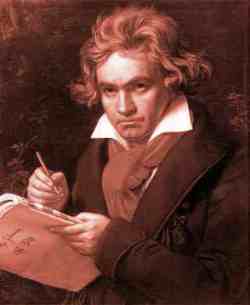
Ludwig van Beethoven was a German composer and pianist considered by many to be amongst the greatest who ever lived. He provided the transition from the classical period to the Romantic and ushered in the artist as a creative in their own right rather than a hired servant. He was born in Bonn, Germany on 17th December 1770 and died in Vienna on 26th March 1827 aged 56.
Major Works
Nine symphonies
Five piano Concertos
32 piano Sonatas
“Fidelio” 1805
Violin Concerto (1806)
“Missa Solemnis” (1823)
Biography Timeline
1770: Ludwig van Beethoven was born on 17th December in Bonn, Germany and baptised in the St Remigus church. He was the son of Johann and Maria van Beethoven.
1773: His grandfather, Kapellmeister Ludwig van Beethoven dies on 24th December.
1778: He makes his first known public performance, in Cologne at the age of six. He played several keyboard works.
1780: He begins music lessons with Gottlob Neefe.
1783: He composes his first piece, “Nine Variations on a March by Dressler” aged twelve.
1784: He is appointed as assistant court organist alongside Neefe.
1787: He travels to Vienna where he meets Wolfgang Amadeus Mozart. Mozart is impressed and wants to take him on as a pupil but Beethoven has to return to Bonn where his mother Maria Magdalena is gravely ill. She dies of tuberculosis in July.
1789: His father retires from the Elector’s choir due to excessive drinking ruining his voice. Half of his salary from this post is given over to Ludwig.
1790: He composes the Cantata on the Death of Joseph II, and the Cantata on the Elevation of Leopold II. In December Haydn is introduced to him and is impressed by his work and suggests he comes to Vienna as a pupil.
1791: He composes the Ritterballet but allows his patron Count Waldstein to claim it as his own work.
1792: He finally leaves for Vienna in November to study with Haydn. He is given six months leave by the Elector but remains there for the rest of his life.
1793: He takes part in improvisation contests and establishes himself as one of the best pianists in Vienna.
1794: His brother Caspar Carl moves to Vienna. He begins composing Piano Trios opus No. 1.
1795: He makes his first public performance in Vienna as a composer, where he premieres either his First or Second Piano Concerto. His other brother Nikolaus Johann moves to Vienna.
1796: He travels to Prague, Chechia with his patron Prince Lichnowsky where he gives a concert. He goes on to Dresden, Leipzig and Berlin.
1797: He becomes seriously ill in the summer which some scholars think is typhus and this could probably be the beginning of his later deafness.
1798: He completes several chamber music pieces and piano sonatas including the Pathétique Sonata opus No. 13.
1799: He begins work on his first Symphony.
1800: Symphony No 1 is premiered and he begins work on his second symphony.
1801: He composes music for “The Creatures of Prometheus”. He mentions his deafness to his doctor friend in Bonn for the first time. Beethoven falls in love with Countess Guiletta Guicciardi and he dedicates a piano sonata to her. Many years after his death this work has become known as the famous “Moonlight Sonata“.
1802: He moves to Heiligenstadt north of Vienna in April for the summer period to relieve his hearing. He completes Symphony No. 2 whilst there. In October he writes the Heiligenstadt Testament, (last will and testament) publicly acknowledging his deafness for the first time.
1803: He is appointed composer at the Theater an der Wien, moving into lodgings there with his brother Carl and composes the oratorio “Christus am Ölberge“. In April he premieres the Third Piano concerto at the Theatre playing the piano himself. During the Summer Beethoven composes the Eroica Symphony No.3 in the village of Döbling to the south of Vienna.
1804: His contract at the Theater an der Wien is terminated after it is bought by a new owner. In May Napoleon Bonaparte proclaims himself Emperor of France and Beethoven tears up the dedication on title page of the Eroica to him. The Eroica Symphony is performed in a room at Prince Lobkowitz’s palace.
1805: He composes the Piano Sonata op. 57, “Appassionata”. He completes composition of his opera “Leonore” but the censor bans the projected performance at the Theater an der Wien. The French army occupies Vienna and Napoleon establishes his headquarters at Schönbrunn Palace in November.
1806: He revises “Leonore”, with an altered text by Stephan von Breuning. His brother Carl van Beethoven marries Johanna Reiss on 25th May. Beethoven works on the three Razumovsky String Quartets and the Fourth Symphony and then the fifth later in the year. Beethoven’s nephew Karl is born in September.
1807: His Mass in C is performed at Prince Esterhazy’s castle chapel in Eisenstadt in September and Beethoven completes the Symphony No. 5.
1808: During the summer he composes the Pastoral Symphony No. 6 while staying in Heiligenstadt. He publishes the Fourth Piano Concerto and Violin Concerto. On 22nd December Beethoven gives a benefit concert at the Theater an der Wien, which sees the first public performance of the Fifth and Sixth “Pastoral” Symphonies.
1809: He accepts the offer of Kapellmeister in Kassel. He begins work on the Fifth Piano Concerto, the “Emperor”. In February Archduke Rudolph, Prince Lobkowitz and Prince Kinsky agree to pay him an annuity for life on the sole condition that he remain in Vienna. Austria declares war on France on the 9th April and on the 10th May the French Army bombard and capture the city. Beethoven seeks refuge in his brother Carl’s cellar.
1810: Archduke Rudolph returns to Vienna on 30th January. The critic E.T.A. Hoffman’s famous review of Beethoven’s Fifth Symphony is published in the Allgemeine Musikalische Zeitung.
1811: Austria’s currency is devalued which drastically reduces his income. He completes the ‘Archduke’ Trio and begins writing the seventh symphony.
1812: He begins the Eighth Symphony. In June he leaves Vienna for Prague on his way to Teplitz in Bohemia. On 6th July he writes letter to an unnamed woman whom he calls his “eternally beloved”. Whilst in Teplitz Beethoven meetsJohann von Goethe several times. In September Beethoven decides to travel to Linz in Austria to try to prevent the marriage of his brother Johann to his housekeeper.
1813: The “Battle Symphony” Opus 91, a tribute to the Duke of Wellington receives its premiere on 8th March. In April his bother Carl is seriously ill with tuberculosis and says he wants Beethoven to be his son Karl’s guardian in the event of his death. On 16th October Napoleon is defeated by the Austrians, Prussians, Russians and Swedes at the Battle of Leipzig. The orchestral version of the “Battle Symphony” and the Symphony No 7 are heard in public for the first time on 8th December.
1814: He agrees to revive his opera “Leonore/Fidelio” with a new libretto. Napoleon abdicates on 6th April. “Fidelio” is performed for the first time in its final form on 18th July and then is performed at the Congress of Vienna in September.
1815: Napoleon escapes from Elba on 1st March. In June the Philharmonic Society of London commission three overtures from Beethoven. Napoleon is finally defeated at the Battle of Waterloo on June 18th. His brother Carl van Beethoven finally dies on 15th November and his widow Johanna and Beethoven are appointed joint guardians of Karl, aged nine. He appeals to the Landrecht, the court of the nobility, to exclude his sister-in-law from the guardianship of Karl beginning a long legal battle for years to come.
1816: The Landrecht rules in Beethoven’s favour over the guardianship of Karl and he is forcibly removed from his mother. Carl Czerny, begins giving Karl piano lessons.
1817: He begins work on what is to become the “Hammerklavier” Sonata, opus No. 106.
1818: Karl leaves his boarding school and begins living with Beethoven. Beethoven’s trip to London is cancelled due to poor health.
He begins the use of his conversation books to communicate with people. He beings work on the Ninth Symphony. Appeals from his mother are rejected by the state but Karl runs away to his mother on 3rd December but Beethoven calls the police to bring him back.
1819: He loses guardianship of Karl. In March he begins a set of variations for the publisher Diabelli based on his theme and in April Beethoven begins the “Missa Solemnis” which was intended for the enthronement of Archduke Rudolph as Archbishop in the following year.
1820: Archduke Rudolph is enthroned as Archbishop of Olmütz on 9th March but the “Missa Solemnis” is not ready for the event. In April the Court of Appeal makes a final rule in favour of Beethoven’s guardianship of Karl. Johanna appeals directly to the Emperor but he refuses to become involved.
1821: He falls seriously ill with rheumatic fever and then in July develops jaundice. He finally completes the “Missa Solemnis“.
1822: He starts work on setting Schiller’s poem “A die Freude” to music for a new symphony which will include soloists and a choir. He meets a young Franz Liszt in the autumn and is impressed by his paint playing. In November the Philharmonic Society of London offer him £50 for a new symphony which will eventually become his Ninth.
1823: In the summer he goes to stay in Baden for his health where he works on the Ninth Symphony.
1824: The Missa Solemnis and Ninth Symphony are given their premieres at the Kärntnertor theatre on 7th May. At the end of the Ninth Symphony, the soloist Karoline Unger turns Beethoven round so he can hear the applause.
1825: He becomes ill in April with an abdominal complaint. His nephew Karl informs his uncle of his decision to join the army. Beethoven begins work on the String Quartet Opus No. 130. and completes Opus No. 132. In August he begins work on the “Grosse Fuge” which was intended as the finale for Opus No. 130 but is later published separately as Opus No. 133. He moves to his final lodgings, the Schwarzspanierhaus on 15th October.
1826: He agrees to compose a new final movement to replace the “Grosse Fuge”. In July Karl buys a pistol intending to commit suicide but is found out by Beethoven. He pawns his watch to buy another pistol and goes to Baden where he fires two shots. He only succeeds in giving himself a minor wound and he is taken to his mother to recover. He begins his last String Quartet, Opus No. 135 in July. In September he and Karl leave Vienna to stay with his brother Johann at Gneixendorf but in December after a row Beethoven leaves in the middle of the night with Karl in an open carriage and catches a chill. Back in Vienna he has an operation to reduce abdominal swelling.
1827: Karl departs for military service in Iglau in Bohemia in January and Beethoven has a second operation to drain fluid. After a third and fourth operation and contracting an infection his health rapidly declines. In March he starts on ideas for his tenth symphony but by the 22nd he is so ill he receives the last rites.
Ludwig van Beethoven died on 26th March 1827. At his funeral on 29th it is estimated that 20,000 people line the streets of Vienna. He is buried in the Centralfriedhof in Vienna.
Influences
It is impossible to overestimate the impact that Ludwig van Beethoven has had, not only on the world of music but the arts in general. He was aware of the popular music of the day and the rhythms of Rhineland folk music and as a boy he was also a voracious reader of works of the Sturm und Drang period which were a reaction against the rationalism of the early 18th century. In particular he read the novel “The Sorrows of Young Werther” by Johann Wolfgang von Goethe in 1774 and the works of Friedrich Schiller.
He was exposed to music in the French style in Mannheim and at the Bonn National Theatre and was an enthusiast for the ideals of the French revolution if not its aftermath. His formal music teacher was Joseph Haydn and he was taught in the classical style and influenced by the work of Haydn himself as well as Wolfgang Amadeus Mozart. Other early influences were Johann Sebastian Bach and Georg Frideric Handel. As an undoubted piano virtuoso (until deafness set in in) he was influenced by the sonatas and teachings of Carl Philipp Emanuel Bach. As a composer, it soon became clear that Haydn couldn’t keep up with his genius and he took extra lessons in secret with the organist Johann Georg Albrechtsberger and the Imperial Kappellmeister Antonio Salieri.
To Beethoven feeling was as important in music as any theory and this becomes prevalent in his second period around 1804 and the writing of the Third Symphony “Eroica”. It is well known that he scratched out the name of its dedicatee Napoleon Bonaparte when the latter proclaimed himself Emperor of the French and the composer declared the work representative of any hero. Beethoven once the famous piano virtuoso was now becoming a respected composer in his own right and from now on began to command higher fees from publishers than Haydn or Mozart ever could.
His most personal music was in the piano sonata which in his day were private chamber music pieces unlike string quartets which were performed publicly. In 1803 he dedicated the so called “Moonlight Sonata” Op. 27 no. 2 to his piano pupil Giulietta Guicciardi whom he fell in love with and proposed to but who went on to marry Count Wenzel Robert Gallenberg, a composer of ballet and occasional music instead. In 1810 E.T.A. Hoffman wrote an appreciation of the Fifth Symphony, which did much to launch the work on its triumphant fame throughout the world and, above all, to interest the Romantics in its composer. His greatest achievement was to raise instrumental music, historically considered inferior to vocal, to the highest plane of art and above all the composer as an artist rather than just a paid servant of a rich employer. He enriched both the orchestra and the quartet form with a new greatly expanded range of sounds and texture. The same is true of the concerto in which he introduced formal innovations that would prove equally influential. In Fourth concerto he begins to place the piano at the forefront of the score which reinforces the sense of the soloist as a protagonist. The fourth and fifth piano cocnertos have exerted a strong influence on concerto composers ever since. In his one opera “Fidelio” he was influenced by the music of Luigi Cherubini whom he greatly admired.
There have been several suggestions as to whom the “Immortal Beloved” written about in one of his letters actually was but Bettina von Arnim or more likely her sister in law seem the best possible candidates. In 1812 Bettina introduced Beethoven to Johann Wolfgang von Goethe in Teplitz. Despite being a former hero, the composer described Goethe as being “too fond on courtly manners” and the great writer reciprocated by saying Beethoven was “an utterly untamed personality who is not altogether in the wrong in holding the world to be detestable, but surely does not make it any the more enjoyable either for himself or for others by his attitude”.
The Fifth and Sixth “Pastoral” symphonies with their progression through to ultimate triumph influenced composers such as Hector Berlioz in the “Symphonie Fantastique”, Johannes Brahms in his First, Cesar Franck in Symphony in D Minor or Tchaikovsky’s late works. Gustav Mahler and Arnold Schoenberg took his lead in transforming the symphony form into one entirely their own. The Ninth Symphony first performed in 1824 is a colossal work which has become a major influence on subsequent music in its own right. Commissioned by the Philharmonic Society of London after the composer had become completely deaf in 1819 it shows he is a master of choral effects and drama. Although never comfortable with writing for the solo voice his song cycle “An die Ferne Geliebte” became an important influence on later composers and especially Robert Schumann.
Such was the fame of the man that 20,000 people attended his funeral in Vienna and pallbearers included the famous pianist Johann Nepomuk Hummel with Franz Schubert carrying a torch and also carrying on the Romantic flame.
Further Information
List of works by Beethoven.