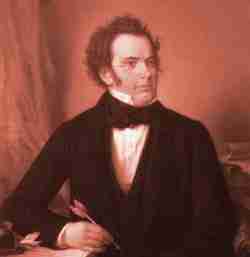
Franz Schubert was an Austrian composer of the late Classical and early Romantic eras. He was born on 31st January 1797 in Himmelpfortgrund, Vienna, Austria and died on 19th November 1828, Vienna, Austria aged 30.
Major Works
“Erlkönig” (1815)
Symphony No 8 (“Unfinished”) (1822)
“Ave Maria!” (1825)
Symphony No. 9 (“The Great”) (1825)
Biography Timeline
1797: Franz Schubert was born on 31st January in Himmelpfortgrund, Vienna, Austria. His father was a schoolmaster and his mother was the daughter of a locksmith. Schubert was one of thirteen children but only five survived past infancy. His father taught him the violin while his brother taught him the piano.
1804: Schubert’s singing voice was heard by one of the most famous composers of the day in Vienna, Antonio Salieri and he began to give him lessons in music theory and composition. Their instructor/pupil relationship ended in 1817.
1808: He wins a scholarship for choir studies at the Stadtkonvikt school.
1813: He leaves the Stadtkonvikt.
1814: He begins work at his father’s school as a teacher. Schubert met Therese Grob during the year and was so smitten that he wanted to marry her even though he did not have the funds to support her. Possibly due to his many male friends in later life some historians think that he was in fact homosexual.
1816: He fails to get the post of Kapellmeister at Laibach and resigns from his teaching duties at his father’s school. He then moves into a home with his wealthy friend, Franz von Schober. This became a fertile period for his musical compositions even though he failed in his bid to join the Gesellschaft der Musikfreunde. He composed the String Quartet in E Major and his Symphony No 5.
1817: Salieri stops teaching Schubert and towards the end of the year he has to return to teaching.
1818: The first public performance of one of his works is given, a secular overture. Schubert becomes teacher to the daughter of a Count which pays well and allows him to work at his music more.
1819: He composes the piano quintet in A Major (“The Trout”).
1820: He and some of his friends are arrested for agitation against the state. One friend was sentenced to a year in prison and banned from Vienna but Schubert himself was let off with a verbal warning. Schubert put on two on his operas which meant that he became known to a larger audience.
1822: He starts composing Symphony No. 8 in B minor which has gone down in history as the “Unfinished Symphony”. Experts are still divided as to why it was never finished. He also composes the “Fantasia in C Major, The Wanderer”. He meets the great Hungarian pianist and composer Franz Liszt who at that time was also being taught by Salieri. It is thought that sometime during the ensuing winter Schubert caught syphilis.
1823: He composes the song cycle “Die schöne Müllerin“.”
1824: He composes String Quartet No 13 in A minor.
1826: He composes String Quartets No 14 in D minor (known as “Death and the Maiden”) and No 15 in G major.
1827: He composes “Winterreise”. (Winter Journey).
1828: He completes his Symphony No 9 in C major “The Great” as well as two piano sonatas and a string quintet and “Schwanengesang”.
Schubert spent the last few weeks of his life at his brother’s house in Vienna suffering from a fever. He died on 19th November 1828. He was buried next to Ludwig van Beethoven only a year after he had attended Beethoven’s own funeral. (The two composers have since been moved and the original site is now called the Schubert Park.
Influences
Franz Schubert was influenced as a music student by Joseph Haydn, Wolfgang Amadeus Mozart and his particular favourite, Ludwig van Beethoven.
When he was seven he sat an audition for Antonio Salieri who was very impressed and later invited him to sing for services at the Imperial Hofkapelle in Vienna. When he was eight, his father gave him violin lessons and now a child prodigy he played in the family string quartet. At eleven he had a full scholarship to the Kaiserlich-königliches Stadtkonvikt (Imperial and Royal City College).
Always politically active he sympathised with students when they protested against the Klemens Metternich’s government’s imprisonment of a fellow student. From 1817–1818 he was a member of the Nonsense Society, a secret society mainly comprising young painters and poets. His father was a devoted Catholic and by the time he was nineteen, his son had written four settings of the Catholic Mass. Two more would follow about ten years later.
In literature he read the works of Heinrich Heine, Friedrich Ruckert, Friedrich Schiller and Johann Wolfgang von Goethe and he set many of Goethe’s poems to music.
His first meeting with Beethoven was in 1822 when he visited the master with the publisher Anton Diabelli. Schubert dedicated a set of Variations on a French Song to Beethoven and was eager to present him with a copy. His brother Ferdinand stated that “He often met Beethoven, whom he revered” and who often expressed his great appreciation for his songs.
Up until 1818 he taught students in his father’s school but was always unsuccessful when trying to secure a post of conductor and was consequently always short of money, which was further exacerbated by his heavy drinking and use of brothels. Another major influence was the German composer Johann Rudolf Zumsteeg who had championed the operas of Mozart and his own friend the musician Franz Lachner.
Schubert composed over six hundred Lieder (German art songs) from the age of fifteen onwards and he elevated the form to concert performance level. Many are miniature dramatic works in their own right. He wrote many of his Lieder and soprano solos for his teenage sweetheart Therese Grob, including the solo in the Mass in G Major and also composed Lieder for Countess Caroline Esterházy. Of his vocal works he is probably best known today for “Ave Maria!” after a poem by Goethe which was written in 1825. He is seen as a link between the classical era and early Romanticism and influenced many composers at the time including Carl Czerny. He was known for his chamber music and songs during his lifetime but his orchestral pieces and ideas for opera didn’t gain any traction and some were almost lost. Famously Robert Schumann found the score of the Ninth Symphony “The Great” in 1839 while searching through documents in Ferdinand’s house. Schumann arranged for Felix Mendelssohn to conduct the premiere of the symphony in Leipzig on 29th March 1839.
From the 1830s up until the 1870s, Franz Liszt transcribed and arranged several of Schubert’s works and described him as “the most poetic of composers”. Other composers helped his posthumous reputation. Johannes Brahms helped the publishers Breitkopf and Härtel edit the first series of his collected works in 1884 which contained eight of the symphonies. He also created a number of orchestral and instrumental arrangements of Schubert’s songs and a piano transcription of the Great Mass in E-flat major.
Other Romantic composers influenced by him were Felix Mendelssohn himself, Hector Berlioz, Frédéric Chopin and Antonín Dvořák. Later composers such as Hugo Wolf, Anton Bruckner and Gustav Mahler owe him a great debt.
The Wiener Schubertbund was founded in 1863 and became one of Vienna’s leading choral societies and in 1872 a statue of him was erected in Vienna’s Stadtpark, paid for by the chorus of the Wiener Männergesang-Verein.
In the twentieth century, composers including Richard Strauss, Anton Webern and Benjamin Britten have all spoken highly of Schubert’s music and the German electronic music group “Kraftwerk” called one of their tracks “Franz Schubert” on their “Trans Europe Express” album in 1977. Many of his harmonies were adopted by pop group “The Beatles”.
In the early twenty-first century his chamber music topped the polls in a survey of the genre by an Australian Music Radio Station with the ever popular “Trout Quintet” coming first. Several more made the list including String Quartet No 14 “Death and the Maiden” and the “Adagio and Rondo Concertante” for Piano Quartet.
Further Information
List of compositions by Schubert.