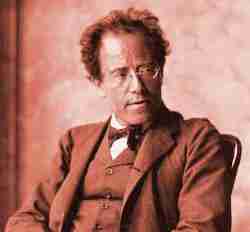
Gustav Mahler was an Austro-Bohemian Romantic composer as well as one of the leading conductors of his generation. He is seen as a link between 19th-century Romantic music and early 20th Century modernism. He was born on 7th July 1860 in Kaliště, Bohemia and died in Vienna on 18th May 1911 aged 50.
Major Works
10 symphonies.
“Lieder Eines Fahrenden Gesellen” (1886)
“Des Knaben Wunderhorn” (1892-1904)
“Kindertotenlieder” (1901-4)
“Das Lied von der Erde” (1908-9)
Biography Timeline
1860: Gustav Mahler was born on 7th July in Kalischt on the border between Bohemia and Moravia. He was the eldest surviving child of fourteen of Bernhard Mahler a cafe owner and Maria (nee Hermann). The Mahler family move to Iglau on 23 October.
1868: Birth of Mahler’s sister Justine.
1869: He enters Iglau Grammar School.
1870: He makes public début playing the piano at a concert at the Iglau Theatre in October.
1873: Birth of his brother Otto on 18th June.
1875: Death of his brother Ernst on 13th April. On 10th September he enrols at Vienna Conservatory to study piano and composition.
1876: He writes the first movement of a Piano Quartet in A minor and wins first prize for piano at Conservatory for a performance of a Schubert Sonata in A minor. He attends a public concert by Franz Liszt in Vienna during March.
1878: He completes the text of “Das Klagende Lied”. In July he wins first prize for Scherzo from his Piano Quintet and receives a diploma from the Conservatory.
1879: During April he plays one of Liszt’s Hungarian Rhapsodies, Schumann’s “Humoreske” and a Schubert Sonata in A Minor at the Iglau theatre. Alma Schindler is born in Vienna on 31st August. He completes “Das klagende Lied” and takes on pupils to earn some money.
1881: On 3rd September he becomes the chief conductor at the Landestheater in Laibach (now Ljubljana) in Slovenia where he conducts several operas. In March he is the soloist in a performance of Mendelssohn’s Capriccio Brillant.
1883: He is conductor at Königliches Städtisches Theater in Olmütz ( now Olomouc) in Moravia. He conducts operas by Meyerbeer and Verdi. On 21 August he is appointed to be Music Director and Chorus Master to the Royal Prussian Court Theatre in Kassel. He falls in love with Johanna Richter, a singer at the Kassel Theatre. He also writes to Hans von Bulow after seeing him conduct another concert but receives no reply.
1885: He resigns from Kassel and moves to the Deutsches Theater in Prague where he has an affair with the soprano Betty Frank.
1886: On 21st February he conducts Beethoven’s Ninth Symphony for the first time. In August he takes up an appointment with Leipzig Opera.
1887: In October he completes “Die drei Pintos”. He conducts Wagner’s “Tannhäuser” and Cosima Wagner is in the audience on 13th November.
1888: His father dies on 18th February. Mahler has an affair with Marion von Weber, wife of Carl. He writes his first “Wunderhorn-Lieder” and begins the First Symphony. “Die drei Pintos” is premièred in Leipzig. He has a meeting with Tchaikovsky on 26th January. His eldest sister Leopoldine dies on 27th September and his mother on 11th October. In October he is appointed director of the Hungarian Opera in Budapest.
1890: He is introduced to Johannes Brahms.
1891: He resigns from Budapest in March after conducting Wagner’s “Lohengrin” and moves to the Hamburg Stadt-Theater.
1892: He completes the orchestral version of the Wunderhorn songs. He travels to London to conduct several parts of Wagner’s Ring Cycle at Covent Garden and the Theatre Royal Drury Lane. He take over from Hans von Bulow on 12th December conducting Mendelssohn’s “Overture to a Midsummer Night’s Dream”.
1893: He revises “Lieder eines Fahrenden Gesellen” (Songs of a Wayfarer) and further revises the first symphony whilst working on the Second.
1894: Hans von Bülow dies on 12th February.
1895: Otto Mahler commits suicide on 6th February. Mahler conducts the first three movements of the Second Symphony in Berlin. He begins work on the Third Symphony.
1896: He conducts the First Symphony, “Lieder eines Fahrenden Gesellen” and “Todtenfeier” (Funeral RIghts) in Berlin on 16th March.
1897: He converts to Catholicism form Judaism in February. During March he visits Russia to give a concert in Moscow.
His appointment as Kapellmeister at the Vienna Court Opera is public announced in April and in October he becomes Director of the Vienna Opera where he conducts “Die Fledermaus” with the composer Johann Strauss the Second in the audience.
1898: Emma Mahler and Eduard Rosév are married on 2nd June. In September Mahler is appointed as the chief conductor of the Vienna Philharmonic Orchestra.
1900: An anti-Semitic campaign against him begins. He gives concerts in Paris in June as part of the World Exhibition. The Fourth Symphony is completed in August.
1901: The first performance of “Das Klagende Lied” (|The Song of Lamentation) is given at the Vienna Musikverein. The first performance of the Fourth Symphony in Munich is a failure on 25th November. On 27th Mahler and Alma get engaged.
1902: Mahler and Alma marry on 9th March. Maria Anna is born on 3rd November.
1903: Henry Wood conducts his First Symphony in London in October and in December Mahler conducts the Third Symphony in Frankfurt am Main, Germany.
1904: Birth of daughter Anna Justine on 15th June. Mahler completes the second and fifth “Kindertotenlieder” and works on the Sixth and Seventh Symphonies.
1905: First performance of the “Kindertotenlieder” (Songs on the Death of Children) with words by Friedrich Rückert, the four “Rückert Lieder” and four “Wunderhorn-Lieder”. In May there is a fire at Opera during a performance of Mozart’s “Magic Flute” whilst Mahler is conducting. He competes the Seventh Symphony.
1906: In May he conducts the first performance of the Sixth Symphony at the Allgemeiner Deutscher Musikverein in Essen, Germany.
1907: A major press campaign tries to remove Mahler from Vienna. Maria Anna dies of diphtheria on 12th July. In October he meets Jean Sibelius in Helsinki and then he travels to Russia to give concerts in St Petersburg. In December he sets off for New York via Paris.
1908: He conducts the first performance of the Seventh Symphony in Prague on 19th September. In November he again sails to the USA for concerts in New York.
1909: On 31st March he conducts the New York Philharmonic in Beethoven’s Seventh Symphony and Wagner’s Siegfried Idyll and Tannhäuser Overture. He meets the sculptor Rodin in Paris in April and sits for him. In September the first draft score of the ninth Symphony is complete. On 12th October he again sets sail for New York.
1910: He leaves New York in April. During June Alma has an affair with the architect Walter Gropius. He begins work on his Tenth Symphony. The Eighth Symphony (of a Thousand”) is given its first performance at the Munich Exhibition Centre on 12th September. He leaves for New York in October where he conducts forty seven concerts in various venues.
1911: He becomes ill on 24th February with endocarditis, although it was initially thought to be influenza. He leaves New York on 8th April and goes ton Paris to see Dr Defaut. He sets off for Vienna on 11th May and is taken to the Loew Sanatorium.
Gustav Mahler dies on 22nd May 1911 and was buried at Grinzing in the suburbs of Vienna.
Influences
Gustav Mahler’s favourite composers were Christoph Willibald von Gluck and above all Ludwig van Beethoven. Given that his last words were reportedly “Mozart” we can probably also add Wolfgang Amadeus to that list. In his compositions he was indebted to the work of Richard Wagner and both shared a loved of large orchestras and chromatic music. He was also influenced to a certain extent by the compositions of Franz Schubert, Johannes Brahms, Franz Liszt and Anton Bruckner. He studied at the Vienna Conservatory where Bruckner was one of the professors and the two became friends in the early days.
During his days as a student he developed an interest in German philosophy after his friend Siegfried Lipiner introduced him to the works of Arthur Schopenhauer, Friedrich Nietzsche, Gustav Fechner and Hermann Lotzeand they were to influence his music for the rest of his life.
He became one of the world’s finest conductors by popular acclaim and spent ten years as principal conductor of the Vienna Court Opera, where he added over thirty news operas to the repertory. Above all he conducted the works of Wagner which undoubtedly influenced him in his later work as he often alluded to passages from Wagnerian operas throughout his life.
During Pyotr Tchaikovsky’s first concert tour in Western Europe in 1888 he met Mahler at a musical soirée in Leipzig and the Austrian was not only impressed by his music but took on some of his ideas himself.
He was a great family man and worrier, bordering on the neurotic and was especially concerned for the health of his daughter Maria from 1902 onwards. She was to die later aged only four and this explains his love of melancholy poems by Friedrich Rückert’s and works such as the 1904 “Kindertotenlieder” (Songs on the Death of Children).
His marriage was often rocky with his wife prone to affairs and in 1910 he consulted the eminent psychoanalyst Sigmund Freud about its collapse. He was advised to encourage his wife Alma to return to composing herself and he helped her edit her songs and publish them meanwhile attacking himself for his selfishness. Only fourteen of her lieder survive today and she didn’t continue composing after his death saying she had been sucked dry by living with such a neurotic genius.
Although he was famous in his lifetime, becoming the link between late Romanticism and the early twentieth century modernism of Schoenberg and others, it wasn’t always plain sailing particularly with the musicians of the Vienna Opera House due to his strict conducting manner and his Jewish heritage in what was a very anti-semitic atmosphere at the time.
He was an influence on his good friend Richard Strauss and they both played each other’s music wherever they went. Mahler declared “Strauss and I tunnel from opposite sides of the mountain. One day we shall meet”. He also influenced many of his immediate successors including the Second Viennese School which included Arnold Schoenberg, Alban Berg and Anton Webern.
In the later twentieth century Dmitri Shostakovich and Benjamin Britten both admitted to being admirers of his. Shostakovich was particularly influenced by his use of contrasts and tonality. In Britain Gustav Holst was also influenced by him and as a young man he had seen Mahler conduct a performance of Wagner’s “Götterdämmerung” from the “Ring Cycle”.
Although his music fell out of fashion shortly after his death it later went through a renaissance in the concert hall not least because of the use of his music in the world of the screen. The 1971 film “Death in Venice” used his adagietto from Symphony No 5 as a backdrop to the 1912 novel by Thomas Mann where the character of Gustav von Aschenbach is based on Mahler himself. Benjamin Britten also produced an opera of the same name in 1975. More recently still the composer John Williams has used an extract from the Symphony No 2 “Resurrection” in the soundtrack of the first Harry Potter film.
Further Information
List of compositions by Mahler.