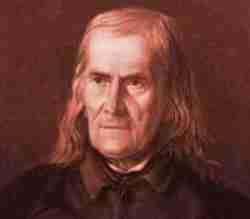
Johann Michael Friedrich Rückert was a German Poet, professor of Oriental languages and translator. He was born on 16th May 1788 in Schweinfurt, Bavaria, then part of the Holy Roman Empire and died on 31st January 1866 in Neuses, Saxe-Coburg and Gotha, Germany aged 77.
Major Works
“Geharnischte Sonette” (1814)
“Kindertotenlieder “(Songs on the Deaths of Children) (1834)
“Die Weisheit des Brahmanen” (The Wisdom of the Brahmins) (1836-39)
“Liebesfrühling” (Spring of Love) (1844)
Biography Timeline
1788: Johann Michael Friedrich Rückert was born on 16th May in Schweinfurt, Bavaria, then part of the Holy Roman Empire. His father was Johann Adam Rückert was a lawyer and his mother was Maria Barbara. He was educated at the local Gymnasium school in Schweinfurt and then at the universities of Wurzburg and Heidelberg.
1814: He publishes his first volume, “Deutsche Gedichte” (German Poems) under the pseudonym Freimund Raimar which includes the powerful “Geharnischte Sonette” (Armoured Sonnets) which asks for the Prussians to join in the Wars of Liberation from Napoleon Bonaparte. He stayed at home however at the request of his parents.
1815: As a student he visits Jena, where he engages in philology and literary studies. Early sections of his “Napoleon, Eine Politische Komödie in Drei Stücken” (Napoleon, a Political Comedy in Three Parts) begin to appear. Only two parts are subsequently published due to it not being popular.
1816: He works on the editorial staff and writes articles for the “Morgenblatt” newspaper in Stuttgart.
1817: He publishes “Der Kranz der Zeit” (The Wreath of Time).
1818: He spends nearly a whole year in Rome.
1820: He moves to live in Coburg where he stays until 1826.
1821: He marries Luise Wiethaus-Fischer.
1822: He publishes a collection of poems called “Östliche Rosen” (Eastern Roses).
1826: He is appointed Professor of Oriental Languages at the University of Erlangen. He translates “Maqamat” by the Arab poet Al-Hairiri of Basra which establishes his early fame.
1828: He publishes the Indian story “Nal und Damajanti,”.
1830: He publishes “Rostem und Suhrab, Eine Heldengeschichte” (Rostem and Suhrab, a Story of Heroes).
1834: He begins publishing the first of six volumes of his “Gesammelte Gedichte” (Collected Poems) which takes until 1838. He writes “Kindertotenlieder” (Songs on the Deaths of Children) after the death of two of his children. It is not published until 1872 after his death. This song cycle would be set to music by Gustav Mahler in 1904.
1836: He begins publishing one of his major works “Die Weisheit des Brahmanen” (The Wisdom of the Brahmins) one of the Hindu castes. It is completed in 1839.
1837: He publishes “Morgenländische Sagen und Geschichten” (Oriental Myths and Poems).
1838: He completes his “Erbauliches und Beschauliches aus dem Morgenland” (Edifying and Contemplations from the Orient).
1839: He publishes “Brahmanische Erzählungen” (Brahmin Stories).
1841: He is appointed to the position of Professor of Oriental Languages in Berlin and becomes a Privy Councilor to the state.
1843: He begins publishing the dramas “Saul und David”.
1844: He publishes “Liebesfrühling” (Spring of Love) about his wife Luise and “Herodes der Große (Herod the Great).
1845: He publishes “Kaiser Heinrich the Fourth” and “Christofero Colombo”.
1846: He publishes “Hamasa, Oder die Ältesten Arabischen Volkslieder” (Hamasa, or the Oldest Arabian Folk Songs).
1849: He resigns his professorship at Berlin as he was never really happy teaching students and retires to live in his Gut (estate) at Neuses and concentrates on writing.
1864: During the Second Schleswig War against Denmark he writes “Ein Dutzend Kampflieder für Schleswig-Holstein” (A Dozen Battle Songs for Schleswig-Holstein) and publishes them anonymously. They become very popular.
Friedrich Ruckert died on 31st January 1866 in Neuses, Saxe-Coburg and Gotha, Germany and is buried in the cemetery there.
Influences
Friedrich Rückert’s great love was oriental writing and especially the life and works of Mawlana Jalaluddin Rumi. He also put a lot of his own experiences into his writing including the emotional effects of a near-death he experienced which influenced his Rückert-Lieder.
He was self-educated in Oriental languages and introduced German readers to Arabic, Persian, Indian, and Chinese mythology and verse. He also became an expert in Sanskrit. Despite some hostile criticism from the “Jahrbücher” of Halle for a few years his reputation gradually increased throughout his life.
A comprehensive but incomplete edition of his poetical works appeared after his death from 1868–1869 and ran to twelve volumes. Many other editions appeared over the next few years up until the end of the nineteenth century with G. Voigt’s “Rückerts Gedankenlyrik” (Rückert’s Lyrics) of 1891.
More than one hundred and twenty of his poems have been set to music. He is the fourth most popular German poet for this after Johann Wolfgang von Goethe, Heinrich Heine and Rainer Maria Rilke. Composers who have used his work are Franz Schubert, both Robert and Clara Schumann, Johannes Brahms, Josef Rheinberger, Max Bruch, Max Reger and of course Gustav Mahler’s famous “Kindertotenlieder” of 1904 and his “Rückert Lieder” completed in the same year.
Further Information
Complete list of poems by Friedrich Rückert.