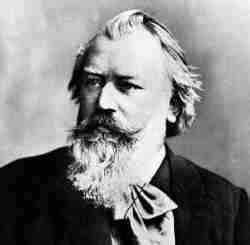
Johannes Brahms was a German composer, pianist, and conductor of the mid-Romantic period. Much of his career was spent in Vienna. He was born in Hamburg, Germany on 7th May 1833 and died in Vienna on 3rd April 1897 aged 63.
Major Works
Four Symphonies
Two Piano Concertos
“Hungarian Dances” (1869–1880)
“Academic Festival Overture” (1880)
“A German Requiem” (1865–1868)
Violin Concerto (1878)
“Variations on a Theme by Haydn” (1873)
Biography Timeline
1833: Johannes Brahms was born on 7th May in Hamburg. He was the son of Johann Jakob Brahms, an innkeeper and amateur musician and Christina Nissen Brahms. His father taught him to play violin and piano.
1839: At the age of six Brahms creates his personal way of writing music in order to get things onto paper quickly.
1840: He begins studies with the musician Otto Cossel.
1843: He plays a private concert to gain money for his future education.
1845: He has piano lessons with Eduard Marxsen.
1848: He gives his first public performance as a solo pianist and plays in local taverns regularly. He also gives music lessons to help with his family’s finances. His constant work schedule affects his health and he does not gain widespread recognition in Hamburg.
1850: He meets the Hungarian violinist Eduard Hoffman Reményi, who introduces him to gypsy dance songs that would be a later inspiration for his compositions.
1853: Remenyi and Brahms tour North Germany and they meet the violin virtuoso Joseph Joachim in Gottingen. In Weimar they meet Franz Liszt. Liszt was greatly impressed with Brahms’s work and was pleased to see them but Brahms refused to become a member of Liszt’s group of composers as he was not keen on Liszt’s style of composition. On 31st October Brahms meets Robert Schumann and Clara Schumann in Dusseldorf. Robert is a great admirer and helps to publicise Brahms’s music especially through writing a glowing article in the “Neue Zeitschrift für Musik”.
1854: He accepts the position of Director of Court Concerts and Choral Society for the Prince of Lippe-Detmold. During February, Robert Schumann suffers a nervous breakdown after attempting suicide and confines himself to an asylum. Brahms rushes to Düsseldorf to help Clara and is the only one allowed to actually see Robert in the hospital. Brahms writes the Piano Trio No. 1, the “Variations on a Theme of Schumann” for piano, and the “Ballades”.
1856: Robert Schumann dies on 29th July but Brahms stays close to Clara for the rest of his life even though they never marry and it is has often been debated if they were actually lovers rather than spiritual friends. To earn his living Brahms continues to give private piano lessons and give concerts. Two concerts in particular with the singer Julius Stockhausen establish him as an important composer of songs.
1857: He premieres two serenades in the ducal court of Detmold where he works as court pianist and conductor of the choir and then returns to Hamburg.
1858: He resigns from the Lippe-Detmold appointment and spends March and April in Berlin with Clara Schumann, and the summer in Göttingen where he meets Agathe von Siebold. He works on his Piano Concerto in D Minor.
1859: His Piano Concerto No.1 in D minor is premiered in Hanover and then is repeated in Leipzig and Hamburg. Only in Hamburg did it find a favourable audience. Brahms is also appointed conductor of a ladies’ choir in Hamburg, for whom he writes the “Marienlieder”.
1860: He moves to Winterthür, to be near the composer Theodor Kirchner and then returns to Hamburg. When he reads in the press that all musicians are accepting the theories of the “New German” school led by Franz Liszt he writes to say this is not true as he is not one of them.
1861: He visits Vienna, then travels to Hamm in Germany.
1862: During June he attends the Rhein Music Festival in Cologne and also visits Clara Schumann in Münster am Stein. In July he returns to Hamburg but then in September he moves permanently to Vienna.
1863: He is appointed the director of the Vienna Singakademie choir. He gives concerts of his songs. He meets Richard Wagner and Elisabeth von Stockhausen. Although he had been openly critical of Wagner in the press, they both admired each other’s work. He applies for a job in Hamburg but this is given to Julius Stockhausen and he returns to Vienna.
1864: He resigns from the Singakademie and pays a short visit to Hamburg.
1865: His mother dies on 31st January and he begins working on the “German Requiem” in her memory. He travels to Switzerland.
1866: During August he visits Zürich and Baden-Baden.
1868: He completes the “German Requiem”.
1869: The “German Requiem” is published and given its premiere.
1871: He composes the “Triumphlied”.
1872: His father dies on 11th February and in September he is appointed the conductor of the Vienna Gesellschaft der Musikfreunde.
1873: He composes the “Variations on a Theme of Haydn”.
1874: He spends the summer in Rüschlikon, Ziegelhausen, Sassnitz and Hamburg.
1875: He resigns as conductor of the Gesellschaft der Musikfreunde on 18th April as he found it was affecting his health. During the summer he begins work on his First Symphony and sketches the Second symphony.
1876: The First Symphony is completed and receives its premiere on 4th November in Karlsruhe conducted by his friend Felix Otto Dessoff.
1877: He spends the summer in Portschach am Wörthersee with Elisabeth von Herzogenberg. The Second Symphony is completed and receives its first performance on 30th December by the Vienna Philharmonic Orchestra conducted by Hans Richter. Later Hans von Bülow, the famous conductor, changed his allegiance from the Liszt-Wagner circle to Brahms and was instrumental in making sure his work received a wider audience.
1878: He spends the summer in Leipzig and gives concerts in Hamburg. He composes the Violin Concerto.
1879: He composes the “21 Hungarian Dances”.
1880: In May he attends the unveiling of the monument to Robert Schumann and sees Clara. He is awarded a Doctor’s Degree by the University of Breslau and writes two pieces for their concert. He spends the summer in Bad Ischl.
1881: During February the Meinigen Court Orchestra offers its services for rehearsals of his works.
1882: He spends January in Berlin and then returns to Vienna after spending the summer in Bad Ischl.
1883: He completes his Third Symphony. During the summer he meets the alto singer Hermine Spies in Wiesbaden and becomes infatuated with her.
1884: He spends the summer in Meinigen and Mürzzuschlag.
1885: He completes his Fourth Symphony and it receives its premiere on 25th October in Meinigen.
1886: He spends the summer in Hofstetten on Lake Thun. Switzerland.
1887: Edward Marxsen, his former piano tutor, dies. Brahms interrupts his summer visit to Hofstetten to visit Clara Schumann in Frankfurt. He composes the “Double Concerto”.
1889: He is appointed a “Freeman of Hamburg”. He spends the summer in Bad Ischl.
1890: During October he begins destroying abandoned or incomplete works.
1892: Both his sister Elise and the pianist Elisabeth von Herzogenberg (nee Stockhausen) die.
1893: Hermine Spies dies aged 36.
1895: Death of Brahms’s brother Fritz and Theodor Billroth his doctor and friend.
1896: On 21st May Clara Schumann dies in Bonn and Brahms is heartbroken. He composes his “Vier ernste Gesänge”. (Four Serious Songs). In September he visits Karlsbad for medical treatment.
1897: He is confined to his bed with liver cancer on 26th March 1897 in Vienna.
Johannes Brahms died on 3rd April. His funeral was held on 6th April at the Stadtkirche, and he was buried in Vienna’s Zentralfriedhof next to Johann Strauss the Second, Ludwig van Beethoven and Franz Schubert.
Influences
Brahms was introduced to music and composition at an early age by his father who was a double-bass player in the Hamburg Philharmonic Society and he began playing the piano at the age of seven. When his family fell on hard times, he was sent out to perform at local inns to supplement their income. He was well steeped in the music of Johann Sebastian Bach, Wolfgang Amadeus Mozart, Joseph Haydn and particularly by that of Ludwig van Beethoven whom he was often compared to in later life.
A turning point came in 1853 when he met composer and critic Robert Schumann who became a friend and supporter of his talents and nicknamed him the “young eagle”. Schumann and Brahms were followers of a more classical style of composition. He began to study the works of pre-classical composers such as Giovanni Pierluigi da Palestrina, Domenico Scarlatti and George Frideric Handel. Consequently, he developed his own style different from Beethoven or Franz Schubert. During his stay in Vienna in 1862–63, he became particularly interested in the music of Franz Schubert but never emulated him.
Although the so called “Brahms style” would have many followers it put him at odds with the disciples of Richard Wagner and Franz Liszt (the latter he disliked personally and the feeling was mutual). Ironically, he was influenced by both these composers even though he didn’t follow their strict forms. His music has its own control of rhythm and movement that distinguishes him from his contemporaries.
For literary texts he often turned to Johann Wolfgang von Goethe and Heinrich Heine.
His followers included Robert Fuchs, Julius Röntgen, Ferruccio Busoni in his lifetime as well as his composition pupil Gustav Jenner. His legacy as a composer, pianist, and conductor continued after his death as an inspiration to other musicians. Edward Elgar, Hubert Parry, Antonin Dvorak, Bela Bartok and the Swede Wilhelm Stenhammar are some examples but there are many more. Later composers of the Second Viennese School such as Arnold Schoenberg and Anton Webern have all expressed a debt to his music.
Further Information
List of compositions by Brahms.