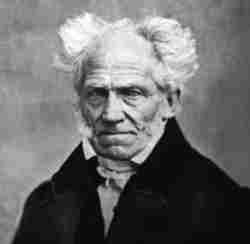
Arthur Schopenhauer was a German philosopher best known for his work on the World as Will and Representation which characterizes the will into a set of universal objects or Platonic Ideas that constitute the timeless patterns for each of the individual things that we experience. He was born in Gdansk, Poland (then part of German Prussia) on 22nd February 1788 and died in Frankfurt, Germany on 21st September 1860 aged 71.
Major Works
“The World as Will and Representation” (1818 – expanded 1844)
Biography Timeline
1788: Arthur Schopenhauer was born on 22nd February in Danzig (present day Gdansk, Poland). He was the son of Heinrich Floris Schopenhauer and Johanna (nee Trosiener), an author who were both part of wealthy Protestant German families. Both were staunch republicans.
1793: Danzig becomes part of Prussia and his father Heinrich moves the family to Hamburg then a free republican city.
1797: His sister and only sibling Adele is born on 12th July. Schopenhauer is sent to Le Havre in France for two years to live with Grégoire de Blésimaire, a business associate of his father in order to learn French and business.
1799: He begins playing the flute.
1803: He accompanies his parents on a European tour of Holland, Britain, France, Switzerland Austria and Prussia. His father gave him a choice to go with them or start working towards his degree. He regrets the decision as he finds it tedious especially the twelve weeks studying at a school in Wimbledon, Britain which had religion at the heart of all its teachings.
1804: His father, Heinrich drowns in a canal in Hamburg and his mother suspected suicide as he was an anxious man prone to depressions. His estate was split in three between his wife and the two children. Schopenhauer invested his share wisely when he reached the age of consent which gave him a substantial allowance. He quits his merchant apprenticeship and studies at the Ernestine Gymnasium in Gotha, Saxe-Gotha-Altenburg but leaves the school after writing a satirical poem about his teachers and was probably expelled. He then spends the next two years working as a merchant.
1805: His mother and sister move to Weimar and she become famous there for her soirees with writers and artists such as August Wilhelm von Schlegel, Friedrich von Schlegel and Johann Wolfgang von Goethe. Schopenhauer and his mother did not get on and she described him as “unbearable” so he lives with a friend in Hamburg, Jean Anthime.
1809: He finally moves to Weimar but does not stay with his mother whom he thought frivolous. He only attends his mother’s parties when he knows Goethe is there. He falls in love with Kaorline Jagermann, the mistress of Karl August, Grand Duke of Saxe-Weimar-Eisenach, and writes her his only known love poem although this is not reciprocated. He does have liaisons with several women in the town and claimed to a friend later that out-of-wedlock daughters were born in 1819 and 1836 but this is not substantiated. Later that year he leaves Weimar to become a student at the University of Gottingen studying medicine. There he was more interested in metaphysics, psychology and logic under and Gottlob Ernst Schulze makes an impression on him and advises him to study Plato and Kant.
1810: He decides to switch from medicine to philosophy and seeks a place at the new University of Berlin. His mother publishes her first book, a biography of her friend, the art critic Karl Ludwig Fernow which was a great success.
1811: He arrives in Berlin for the winter term and attends lectures by the philosopher Johann Gottlieb Fichte. He is critical of Fichte seeing him as a poor substitute for Kant. He also attends lectures by Friedrich Schleiermacher but quickly dislikes him as well.
1813: He leaves Berlin fearing that the city would be attacked by French troops and that he could be pressed into military service by Prussia. He visits Weimar but is appalled that his mother is now living with her lover Georg Friedrich Konrad Ludwig Müller von Gerstenbergk, a civil servant twelve years her junior. He meets Friedrich Majer, a historian of religion and orientalist who engenders in him a love of Buddhism and Indian religions. He moves on to Rudolfstadt spending his time walking in the forests and mountains and completing his dissertation “On the Fourfold Root of the Principle of Sufficient Reason” which was done under the backdrop of the Battle of Leipzig from 16th to 19th October. His mother had just published her second book “Reminiscences of a Journey in the Years 1803, 1804, and 1805” which became very popular with readers.Her publishers, Brockhaus, agreed to publish his work due to the fact that she was so popular. He sends a copy to Goethe as a gift and the great man agreed to meet hm.
1814: He moves to Dresden and continues his philosophical studies where he works on “The World as Will and Representation”.
1816: Influenced by Goethe’s work on colour theory Schopenhauer starts writing his own book on the subject, “On Vision and Colours”.
1818: “The World as Will and Representation” is finally published. In September he leaves for a year long trip to Italy in order to escape an affair with a maid who has become pregnant. He visits Venice, Bologna, Florence, Naples and Milan and spends the winter in Rome where he argues with tourists in the local cafes. He continues to write to his sister Adele who tells him that their mother risks bankruptcy due to the collapse of their bank.
1819: His stay in Italy is cut short to deal with the bank and he returns to Dresden. He decides he needs a proper income and becomes a lecturer at the University of Berlin.
1820: He takes part in a lengthy dispute with Georg Friedrich Wilhelm Hegel over his philosophy and when he finally starts his own lectures, he times them to clash with Hegel. Needless to say hardly anyone turns up to hear him.
1821: In August he is accused of pushing his Berlin neighbour, Caroline Louise Marquet, to the ground so violently that she becomes paralysed and cannot work. She sues him and the resultant legal dispute lasts until May 1827 when a court finally finds him guilty and forces him to pay her an annual pension. He leaves academia and goes on a long tour of Germany and Italy.
1822: After eight months in Florence he leaves for Munich to rest his health and finally returns to Berlin. He courts several young women there and has a continuing relationship Caroline Richter, a Dancer at the Berlin Opera who was fourteen years younger than he.
1831: A cholera epidemic in Berlin forces Schopenhauer to leave. He offers to take Caroline with him on the condition that she leaves her young son behind. She refuses and goes off alone although he did leave her a significant amount of money in his will. He moves on to Frankfurt and claims to see an apparition of his dead father. He begins investigating paranormal phenomena and magic. He renews correspondence with his mother who is alarmed that he might commit suicide like his father.
1832: In July he goes to Mannheim.
1833: He returns to Frankfurt in July and remains there for the rest of his life where he lives alone with a succession of dogs.
1836: He publishes “On the Will in Nature”. He sends his essay “On the Freedom of the Will” to a contest organised by the Royal Norwegian Society of Sciences which wins the prize the following year.
1838: Death of his mother.
1840: His essay to the Royal Danish Society for Scientific Studies, “On the Basis of Morality” does not win the prize, despite being the only contestant, as they dislike his philosophy.
1841: He publishes his Danish essays as “The Two Basic Problems of Ethics”.
1848: There is revolution in Frankfurt as General Hans Adolf Erdmann von Auerswald and Prince Felix Lichnowsky are murdered. As the young followers of Hegel were advocating change and progress, Schopenhauer claimed that misery is a normal state for humans and that, even in a utopian society, people would still fight each other out of boredom or starve due to overpopulation.
1849: Death of his sister Adele.
1851: “Parega and Paralipomena” is finally published. It contains supplementary essays to his main theories and becomes his most successful and widely read book due to the influence his new followers. Principal amongst these is Julius Frauenstadt who finds him another publisher after Brockhaus declines to publish it. He writes “On University Philosophy”, where he outlines his resentment to the university system of learning.
1856: The University of Leipzig sponsors an essay contest about Schopenhauer’s philosophy, which is won by Rudolf Seydel’s very critical essay.
1859: Frauenstädt and Schopenhauer renew their communication and Schopenhauer names him heir to his literary estate. Frauenstädt later edits the first collected works of Schopenhauer. Well known for extending his already published works he produces a third edition of “The World as Will and Idea”.
1860: In the Spring his health begins to deteriorate. In September he suffers inflammation of the lungs. He publishes a second edition of “Ethics”. His notes during this time were published posthumously under the title “Senilia”.
Arthur Schopenhauer died of on 21st September 1860 of pulmonary respiratory failure while sitting at home. Despite his anti-religious feelings the funeral was conducted by a Lutheran Minister and he was buried in the Hauptfriedhof Cemetery in Frankfurt.
Influences
Arthur Schopenhauer was extremely well read, an academic and a loner. His two major influences were Plato and Immanuel Kant but the list of others is long. These include other ancients such as Aristotle, earlier philosophers such as Baruch Spinoza, Thomas Hobbes, John Locke, Gordano Brumo and Giacomo Leopardi, spiritual leaders such as The Buddha, Jakob Böhme and the Spanish priest Baltasar Gracian and scientists such as Joseph Priestly. From his contemporaries he was influenced by Friedrich Wilhelm Joseph Schelling and Johann Wolfgang von Goethe. He also read widely the works of William Shakespeare.
Schopenhauer’s idea that the subject-object distinction is the basis for human knowledge owes its source to Kant’s “Critique of Pure Reason” although his moral philosophy was opposed to Kant saying pure practical reason is an illusion and morality can arise only from the feeling of compassion not reason alone. He famously stated “Man can do what he wills but he cannot will what he wills”.
He has been called the artist’s philosopher due to his work on aesthetics which has influenced artists of all kinds. He was also influenced by Indian religious texts and claimed that Buddhism was the “best of all possible religions”. Often known as the philosopher of pessimism his worldview often challenged the value of existence.
He remained the most influential German philosopher until the First World War and was dominant throughout the West. He did, however, have his critics. His early pupil Julius Frauenstädt, Neo-Kantians such as Eugen Dühring and Eduard von Hartmann all disputed his supremacy. Friedrich Nietzsche read Schopenhauer when he was young and initially agreed with his pessimistic ideas on life but after a while became disillusioned with him when he saw Schopenhauer’s advocacy of quietism as symptomatic of decadence and of a negative order of life.
Several late nineteenth and early twentieth century artists, writers and musicians were influenced by him such as Richard Wagner, Johannes Brahms, Leo Tolstoy (who described him as is the greatest genius among men), Gustav Mahler, Thomas Hardy, Thomas Mann, Rainer Maria Rilke, Marcel Proust, Charles Baudelaire, Paul Verlaine and Arnold Schönberg. Soren Kierkegaard on the other hand thought him a hypocrite.
Richard Wagner’s “Tristan und Isolde” was inspired by “The World as Will and Representation”. Schopenhauer himself was not overly impressed however and stated “I remain faithful to Rossini and Mozart!”. Sergei Prokofiev became fascinated with his works after reading “Aphorisms on the Wisdom of Life” in “Parerga and Paralipomena” declaring “With his truths Schopenhauer gave me a spiritual world and an awareness of happiness”. The American novelist Herman Melville read the essays whilst he was writing “Billy Budd” particularly noting the reflections on the moral ambiguities of genius.
Schopenhauer was the earliest and perhaps the greatest philosophical influence on Ludwig Wittgenstein which he had admitted to friends. In the “Tractatus Logico‐Philosophicus” he adopted Schopenhauer’s division of total reality into phenomenal and noumenal (i.e something which exists independent of the senses). Later Wittgenstein became highly dismissive of Schopenhauer describing him as a shallow thinker and Bertrand Russell agreed with this view.
Albert Einstein felt him important and a genius and thought his works were “a continual consolation in the face of life’s hardships, my own and others and an unfailing wellspring of tolerance”. Einstein was not the only physicist to be influenced. Erwin Schrödinger described him as “The greatest savant of the West” and even considered switching his study of physics to philosophy.
The French writer Guy de Maupassant best summed up those for and against his views by saying that “today even those who execrate him seem to carry in their own souls particles of his thought”.
In the twenty-first century Schopenhauer is considered in some quarters as the founding father of antinatalism, i.e the philosophical theory that says procreation is unethical, arguing that coming into existence is a serious harm for sentient beings who have no choice to be born and that life entails inevitable suffering and death.
Further Information
List of works by popularity written by Schopenhauer.