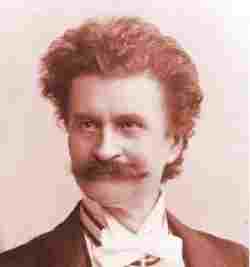
Johann Strauss II (also known as Johann Strauss Junior, the Younger or the Son) was an Austrian composer of dance music and operettas as well as an accomplished violinist. He was the brother of Josef Strauss and the son of Johann Strauss 1. He was born on 25th October 1825 in Vienna, Austria and died there on 3rd June 1899 aged 73.
Major Works
“Morgenblätter” (Morning Papers) (1864)
“An der Schönen Blauen Donau” (On the Beautiful Blue Danube) (1867)
“Künstlerleben” (Artist’s Life) (1867)
“Geschichten aus dem Wienerwald” (Tales from the Vienna Woods) (1868)
“Wein, Weib und Gesang” (Wine, Women and Song) (1869)
“Wiener Blut” (Vienna Blood) (1871)
“Die Fledermaus” (The Bat) (1874)
“Der Zigeunerbaron” (The Gypsy Baron) (1885)
“Kaiserwaltzer” (Emperor Waltz) (1888)
Biography Timeline
1825: Johann Strauss the Younger is born on 25th October in St Ulrich, near Vienna, Austria. His father was the composer Johann Strauss the Elder but wanted his son to be a banker and not a musician. His mother was Maria Anna Streim and the family were all Catholics. When his father saw him secretly playing the violin as a child with Franz Amon, the first violinist of his orchestra, he gave him a beating saying that he was going to “beat the music out of the boy”.
1834: His father Johann Strauss the Elder takes a mistress called Emilie Trampusch and his son can now openly study music with the help of his mother. He goes on to study counterpoint and harmony with Professor Joachim Hoffmann.
1844: His father had eight children with Emily and when he publicly admits to their paternity his mother sues for divorce. Strauss forms his own orchestra in Vienna after receiving a licence to perform and composes “Tu qui regis totum orbem”. He makes his debut at Dommayer’s Casino in October, thus angering his father and he performs waltzes such as “Sinngedichte” and “Gunstwerber” and the polka “Herzenslust”. The critics are very positive.
1845: He is given the honorary position of “Kapellmeister of the 2nd Vienna Citizen’s Regiment” which had been vacant since the death of Joseph Lanner two years before.
1848: Vienna is the scene of revolutions in the Austrian Empire and the rivalry between father and son gets stronger. Strauss junior sides with the revolutionary forces and the Royal Family deny him the post of Kaiserlich und Königlich Hofballmusikdirektor (Music Director of the Royal Court Balls), which was originally created for his father. He is also arrested by the police for publicly playing La Marseillaise but is later acquitted. Meanwhile his father, still loyal to the monarchy, composes the famous “Radetzky March” in honour of Field Marshal Joseph Radetzky von Radetz.
1849: Johann Strauss the Elder dies of Scarlet fever and his son merges his orchestra with that of his father. Strauss Junior composes several works dedicated to the new Emperor Franz Josef such as the “Kaiser Franz-Josef Marsch” and the “Kaiser Franz Josef Rettungs Jubel-Marsch”.
1853: He suffers a nervous breakdown from constant work and takes a holiday for seven weeks in the nearby countryside on the advice of his doctors. His younger brother Josef Strauss is encouraged to abandon his work as an engineer and run the orchestra in his absence.
1856: He accepts commissions from the Tsarskoye-Selo Railway Company of St Petersburg to play in Russia in the Vauxhall Pavilion in Pavlovsk. He will play in Russia every year until 1865.
1858: The “Tritsch-Tratsch” polka is first performed.
1862: His other younger brother Eduard Strauss joins the orchestra as a conductor. Strauss marries the singer Henrietta Treffz.
1863: He tours Austria, Poland and Germany with his orchestra and finally attains the position of Kaiserlich und Königlich Hofballmusikdirektor.
1864: “Morgenblätter” (Morning Newspapers) waltz is first performed.
1867: “An der Schönen Blauen Donau” (By the Beautiful Blue Danube) waltz is first performed. “Künstlerleben” (An Artist’s Life) waltz is first performed.
1868: “Tales from the Vienna Woods” waltz is first performed as is the “Thunder & Lightning” polka.
1869: “Wine, Women and Song” waltz is first performed.
1870: Eduard stops conducting the orchestra. “Freuet euch des Lebens” (Enjoy Life) waltz is first performed.
1872: He tours the United States and takes part in the Boston Festival. He is the lead conductor in a concert of over 1,000 performers and performs “By the Beautiful Blue Danube” and other works and is a huge success. The large number of requests for locks of his hair from female audience members means that his valet has to clip parts off the coat of his Newfoundland dog!
1873: The “Wiener Blut” (Vienna Blood) waltz is first performed.
1874: His operetta “Die Fledermaus” (The Bat) is first performed on 5th April.
1878: His wife Henrietta dies of a heart attack on 8th April after a long period of illness having seen him achieve some financial success. Six weeks after her death, Strauss marries the actress Angelika Dittrich.
1880: The waltz “Rosen aus dem Süden” (Roses from the South) is first performed.
1882: “Frühlingsstimmen” (Voices of Spring) is first performed.
1885: His other famous operetta “Der Zigeunerbaron” (The Gypsy Baron) is first performed.
1887: Angelika Dittrich was not a supporter of his music and Strauss is prevented from divorcing her by the Catholic church. He therefore changes his nationality in January to become a citizen of Saxe-Coburg-Gotha and a Protestant in order to divorce his wife. In August he marries his third wife Adele Deutsch who is a great help to him in his composition. Johannes Brahms was a personal friend of Strauss and when Adele asked him to sign her fan, as was the custom, Brahms inscribed a few measures of the Blue Danube on it and wrote “Unfortunately not by Johannes Brahms”.
1888: He composes the “Kaiser Jubiläum” (Kaiser Jubilee Waltz) to commemorate the fortieth anniversary of the accession of Emperor Franz Joseph.
1889: His second most famous waltz “Kaiser-Walzer” (Emperor Waltz) is performed for the first time.
1895: He composes the “Klug Gretelein” (Clever Little Gretel) waltz for chorus & orchestra.
1899: He begins composing his only ballet “Aschenbrödel” (Cinderella) but never completes it.
Johann Strauss the Younger died on 3rd June 1899 of pleuropneumonia. He was buried in the Zentralfriedhof in Vienna.
Influences
The biggest influence on Johan Strauss the Younger was undoubtedly his father who was a renowned composer in his own right. Despite his father not wanting him to have a musical career, as it was fraught with problems on earning a living, he secretly took violin lessons and studied musical theory and Austrian folk music with the help of his mother Anna. He was a talented child from an early age and composed his first waltz at the age of six.
When he was older, he was influenced by his contemporary Joseph Lanner’s waltzes and started his own orchestra in competition with his father. He quickly gained a reputation for his waltzes, polkas and other dance forms. His brother Josef also became a composer and conductor and before long the orchestra became a family business.
Although he became now as the “Waltz King” he composed other types of music and his first wife, the singer Henriette “Jetty” Treffz, encouraged him to write operettas such as “Der Fledermaus” (The Bat). He became the darling of the Viennese public and couldn’t keep up with demand which led to frequent illnesses and calls on his two younger brothers to help out with conducting and composition. One thing he wasn’t though was a good dancer and he always refused to dance to his own music.
Perhaps his most famous work the waltz “An der Schönen Blauen Donau” (On the Beautiful Blue Danube) was based on a poem written by Karl Isidor Beck (1817-79) where each stanza ends with the line “By the Danube, beautiful blue Danube”. His output however was huge and he composed over five hundred pieces in various forms and indeed he was working on the score for the ballet “Aschenbrödel” (Cinderella) to be conducted by Gustav Mahler when he died in 1899.
Many other composers admired his work including Richard Wagner who particularly enjoyed the waltz “Wein, Weib und Gesang” (Wine Women and Song). Johannes Brahms was a personal friend of his and dedicated his own waltz “Seid Umschlungen, Millionen!” (Embrace Each other Everyone) to him and once declared he wished he had written “The Blue Danube”.
His youngest brother Eduard finally wound up the Strauss Orchestra in 1901 after performing concerts in 840 cities around the world. The orchestra’s last violins were destroyed during bombing in the Second World War. Eduard is responsible for recording the music of the family but following a pact with his brothers he destroyed many of the original Strauss archives in a furnace in Vienna in 1907 so that they could not fall into the hands of rival composers such as Karl Michael Ziehrer.
Other composers who were influenced by him were Richard Strauss (no Relation) who when he was composing “Der Rosenkavalier” said “How could I forget the laughing genius of Vienna?”. Franz Lehár was seen as one of his successors. Maurice Ravel described his “La Valse” as an homage to Johann and other composers included Josef Bayer, Alfons Czibulka, Richard Eilenberg, and Edmund Eysler.
In 1929 the conductor Clemens Karuass performed an all Strauss programme with the Vienna Philharmonic Orchestra and this has morphed into the New Year’s Day concert that is still performed today in the city. In 1966 the Wiener Johann Strauss Orchester was formed as a travelling band and the Dutch violinist André Rieu has also created a Johann Strauss Orchestra such is his popularity today.
Further Information
List of general compositions by Strauss.
List of operettas by Strauss.