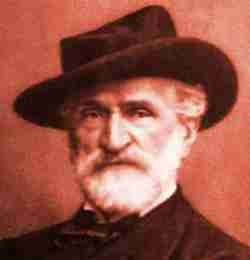
Giuseppe Verdi was an Italian composer best known for his large-scale dramatic operas. He was born on 10th October 1813 in Le Roncole, Italy and died on 27th January 1901 in Milan aged 87.
Major Works
“Rigoletto” (1851)
“Il Trovatore” (1853)
“La Traviata” (1853)
“Aida” (1871)
Biography Timeline
1813: Giuseppe Verdi was born on the 10th October at Roncole, Busseto, Italy.
1832-1835: He studied privately in Milan with Vincenzo Lavigna.
1836: He wins the competition of “Maestro di Musica” of the town council of Busseto. He marries Margherita Barezzi on 4th May.
1839: His first work the opera “Oberto Conte di San Bonifacio” was performaned at the Teatro alla Scala in Milan on 17th November and was well received.
1840: His children Virginia and Icilio die earlier in the year and on 18th June his wife Margherita dies suddenly. “Un giorno di regno” appears at La Scala but is cancelled after one performance.
1842: “Nabucco” by contrast is a great success on 9th March.
1843: “Lombardi alla Prima Crociata” is performed at La Scala.
1844: “Ernani” is put on at the “Teatro La Fenice” in Venice. and “I Due Foscari” is performed in Rome at “Teatro Argentina”.
1845: “Giovanna D’Arco” is performed at La Scala, Milan and “Alzira” at the “San Carlo” Theatre in Naples.
1846: “Attila” is performed at “Teatro La Fenice” Venice on the 17th March.
1847: “Macbeth” is performed at the “Pergola” in Florence in March and “I Masnadieri” in London (Her Majesty’s Theatre) in July. He moves in with the soprano Giuseppina Strepponi.
1848: “Il Corsaro” is performed at the “Teatro Grande” in Trieste in October.
1849: “Luisa Miller” is performed at the “San Carlo” theatre in Naples.
1850: “Stiffelio” is performed in Trieste.
1851: “Rigoletto” is performed at “La Fenice” on 11th March. Verdi’s mother dies on 28th June.
1853: “Il Trovatore” is performed at the Apollo Theatre in Rome on the 19th January and“La Traviata” at “Teatro La Fenice” on the 6th March.
1855: “I Vespri Siciliani” is performed at the “Opera” in Paris on the 13th June.
1857: “Simon Boccanegra” is performed at “Teatro La Fenice” on the 12th March.
1858: He marries Giuseppina Strepponi on 29th August in Savoia.
1862: He visits London, England for the inaugural performance of “Hymn of the Nations”. “The Force of Destiny” is performed in St Petersburg, Russia in November.
1867: His father dies on 14th January. From May he begins to look after his cousin Maria Filomena Verdi.
1868: On the 30th June he visits Alessandro Manzoni in Milan. Giochono Rossini dies on the 13th November and Verdi organises a requiem mass to be given in his honour.
1869: A new version of “The Force of Destiny” is performed at tLa Scala on the 27th February.
1871: The first performance of Verdi’s opera “Aida” is given in Cairo on the 24th December to celebrate the opening of the Suez Canal.
1874: “The Requiem Mass”, composed in honour of Alessandro Manzoni, is conducted by Verdi in the Church of San Marco in Milan on the 22nd May.
1881: “Simon Boccanegra” is performed at La Scala Milan on the 24th March.
1884: His first performance of “Don Carlo” is performed at La Scala, Milan on the 10th January.
1887: “Othello” is performed at La Scala Milan on the 5th February.
1893: “Falstaff” is performed at La Scala Milan on the 9th February.
1897: His wife Giuseppina dies on the 14th November at Saint Agata.
Giusseppi Verdi died on the 27th January 1901 at the “Hotel Milan” in Milan. He was originally buried at Milan’s Cimitero Monumental but a month later his body was re-interred in the crypt of the Casa di Riposo in Milan, Italy.
Influences
Giuseppe Verdi was particularly interested in Renaissance music and especially that of the father of Italian music Giovanni Pierluigi da Palestrina. Other Italians who were an influence included Gioachino Rossini, Vincenzo Bellini and Gaetano Donizetti. He also owed a great debt to Giacomo Meyerbeer, the German opera composer who was very famous at the time. He was well read and loved the work of William Shakespeare and wrote a number of operas based on his works such as “Macbeth” and “Othello”. Other notable literary influences were Voltaire, Lord Byron, Victor Hugo and Friedrich Schiller.
He liked to tell people he was born poor but in reality, his family were landowners in rural Italy who could afford musical tuition for their son. He was always interested in opera from a very young age and in 1825, aged twelve, he was enrolled in the music school run by the composer Ferdinando Provesi who taught him composition. As a teenager he produced music in a variety of styles from church music through old folk tunes to marches. At eighteen he went to Milan and tried to get into the Conservatory but was not allowed to join as he was too old. Instead he studied with Vincenzo Lavigna, the maestro at La Scala theatre.
He was a pioneer in Romantic musical compositions and was well known for his use of melody and drama and became adept at finding new ways to entertain his audience. He dominated the Italian opera scene from the 1860’s onwards and although he incorporated artistic styles from other nations, he became a symbol for Italy itself as he was so famous. His three major works, “Rigoletto” of 1851, “Il Trovatore” of 1853) and “La Traviata” of 1853 reinforced his status as an opera great. “Rigoletto” itself was based on an 1832 play by Victor Hugo “Le Roi s’Amuse”.
Although he claimed not to be religious his Requiem is world famous and operatic in tone. It was written at the death of the Italian writer and statesman Alessandro Francesco Tommaso Antonio Manzoni and is sometimes referred to as the Manzoni Requiem.
As he became more famous, he could spend more time on his works and give each one a distinctive character, tinta as he stated. After the influence of Meyerbeer his operas began to have a cast of thousands and lavish productions. One such was “Aida” premiered on 24th December 1871 in Cairo to celebrate the opening of the Suez Canal. He also gave detailed instructions as to how each character should perform. Verdi himself was never ashamed of the popularity of his music and as his style developed he would re-write some of his earlier works.
Despite his fame not all contemporary critics approved of his work. Some non-Italians such as the London critic Henry Chorley described his music as “crude and noisy” however in 1910 the British “Groves Dictionary of Music” described him as “one of the greatest and most popular opera composers of the nineteenth century”.
His music has been described as nationalistic however several people have argued that music critics at the time hardly mentioned any political themes and have suggested this was an interpretation put on by later historians. However some pieces such as “Va, Pensier” from “Nabucco”, better known today as the “Chorus of the Hebrew Slaves” was taken up by Italian patriots calling for the unification of Italy. He was active himself in the Risorgimento (Re-Unification) and was elected to the first Italian parliament in 1861.
He had no pupils and therefore no school of his own to copy him and by his death the new style of Verismo (Reality) had taken over. Other composers from the time were influenced by him such as Richard Wagner (even though apparently the two of them did not like each other) Giacomo Puccini and Pyotr Tchaikovsky who claimed that Verdi showed younger Italian composers how to escape Wagner’s influence.
From 1898 his work was popular at the New York Opera house in America and in the 1920’s in Germany and England there was a revival and several biographies appeared. In 1959 the Istituto Nazionale di Studi Verdiani was founded in Parma, Italy as a centre for research and the American Institute for Verdi Studies was created at New York University in the 1970’s. Today he is produced all around the world and many many recordings have been made. His belief in “sound first” has influenced several modern composers.
Further Information
List of compositions by Verdi.