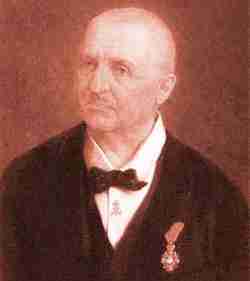
Anton Bruckner was an Austrian composer, organist, and music theorist. He is particularly well known for his symphonies and religious works. He was born in Ansfelden, Austria on 4th September 1824 and died in Vienna on 11th October 1896 aged 72.
Major Works
Eleven symphonies
“Mass in D minor” (1864)
“Te Deum” (1884)
Biography Timeline
1824: Anton Bruckner was born on 4th September in Ansfelden, now a suburb of Linz, Austria. His father was a school teacher who took over from his father and he also played the organ in the local church and music in the local taverns. His mother was Therese Bruckner nee Helm and Anton was the eldest of eleven children. The Bruckners lived in the old schoolhouse at Augustinerstr. 3 and his father taught him music and to play the organ from a young age.
1830: He enters school aged six and helps his father teach the other children.
1833: He is confirmed in the church and is a devout Catholic for the rest of his life. His father sends him to another school in Horsching where the schoolmaster there, Johann Baptist Weiss, is a well thought of organist.
1835: He writes his first composition, a Pange Lingua. When his father became ill, he returns to Ansfelden to help him with his work.
1837: His father dies suddenly. His mother, short of income, now manages to find him a place in the Augustinian Monastery of St Florian stift near Linz where he becomes a member of the choir and receives music lessons and plays the organ (which today is known as the “Bruckner Organ”). She moves with her surviving four children to Ebelsberg.
1840: He leaves St Florian to attend the Präparandenschule in Linz to learn how to become a teacher. He becomes involved with secular music for the first time and learns harmony with Johann August Dürrnberger.
1841: After completing his training with distinction he is sent to become a teacher’s assistant at a school in Winhaag. There he teaches a variety of subjects except for music. The pay is very low and Bruckner, always a shy individual, is humiliated by Franz Fuchs his senior teacher. The Prelate Michael Arneth realises Bruckner’s plight and finds him a teacher’s assistant position in Kronstorf an der Enns for two years.
1843: He studies under the guidance of Leopold von Zenetti in Kronstorf an der Enns.
1845: On passing his teacher’s qualification in May he is employed in St. Florian as an assistant teacher where he will remain for the next ten years. He begins to compose seriously from now on. He also studies to become a teacher of higher education.
1848: He becomes the main organist at St Florian which is made permanent in 1851.
1855: Friends urge Bruckner to apply for the vacant organist position at Linz Cathedral and he beats all competition to the job. He leaves his teaching post and takes up residence on Pfarrplatz in Linz. He continues musical studies under the Viennese music theorist Simon Sechter, whom he had impressed with his “Missa Solemnis”. Sechter had a profound effect on Bruckner and he would later use his book “Die Grundsätze der musikalischen Komposition” for his own teaching career.
1860: He takes over responsibility for the Liedertafel Frohsinn choir and gains a significant reputation as a composer and conductor of choral work.
1861: He furthers his studies with Otto Kitzler and in May he makes his concert debut, as both composer and conductor of his “Ave Maria”. By this time, he had already met the composer and fellow Catholic Franz Liszt whose music he admired.
1862: He considers his work under the tutelage of Kitzler of the period such as the March in D minor and the Overture in G minor as mere exercises and not to be taken as part of his main work.
1863: Kitzler introduces him to the music of Richard Wagner.
1864: He composes the Mass in D minor which is seen as his first mature work.
1865: He meets Richard Wagner in Munich during May at the first performance of “Tristan und Isolde”. Bruckner was in awe of Wagner but the feeling was not mutual as Wagner considered him an ungainly bumpkin.
1866: The E minor Mass is performed in Linz Cathedral.
1868: His work as cathedral organist, choir director, and composer takes its toll on his nerves and he goes to Bad Kreuzen for several months to recuperate. The first performance of the First Symphony takes place in the Redoutensaal in Linz and is well received. Later in the year Sechter dies and Bruckner takes up his post of music theory at the Vienna Conservatory. He moves to the city and lives with his sister Anna (“Nani”).
1869: He visits Nancy and then Paris in France. The Emperor of Austria had donated a new organ to the rebuilt church of Saint-Epvre in Nancy and sent his organist and professor of the Vienna Conservatory for its inauguration. In Paris he plays a concert at the cathedral of Notre Dame at which Camille Saint-Saens, Cesar Franck, Daniel Auber and Charles Gounod were present. The first two, accomplished organists in their own right, were extremely impressed with his talent.
1870: His sister Anna dies and Katharina Kachelmaier becomes his housekeeper until the end of his life.
1871: He visits Britain and plays the new organ at the Royal Albert Hall and gives concerts at the Crystal Palace.
1873: The Musikverein Hall in Vienna is the site of world premieres of five of his symphonies and “Te Deum”. This begins with his Third Symphony however the Vienna Philharmonic Orchestra refuses to play the work during the year and he rewrites it with a second version finally getting its premiere in 1877. His other “crime” was to dedicate the work to Richard Wagner, his idol, which upset the music critic Eduard Hanslick and he found himself unwittingly in the middle of the dispute between the “traditionalists” around Johannes Brahms and the “new Germans” around Franz Liszt and Wagner.
1875: He accepts a post at Vienna University and tries make music theory a major part of the curriculum. Seen as a “Wagnerite” by Hanslick this period is not a happy one although he does have supporters such as the critic Theodor Helm who writes for the Deutsche Zeitung. Several conductors try to showcase his music and suggest improvements which he accepts although he made a point of bequeathing his original scores to the Austrian National Library.
1876: He visits Bayreuth for the first time and meets Richard Wagner.
1877: At the premiere of the second version of the Third Symphony most of the audience leave and only twelve are there at the end.
1880: He falls in love with a seventeen-year-old peasant girl in the cast of the Oberammergau Passion Play. Due to his Catholic upbringing he believed younger girls were without sin. Needless to say, this came to nothing and he remained a bachelor throughout his life.
1881: He rehearses his Fourth Symphony and gives the conductor Hans Richter a tip due to his enthusiasm. Richter wore the coin on his watchchain ever after. On 8th December the Ring Theatre in Vienna burns down due to a gas explosion which killed four hundred people. Bruckner witnesses events from his apartment.
1884: The Seventh Symphony receives its premiere.
1885: The Seventh Symphony is performed again in Munich and is a triumph. Bruckner described it as one of the great moments of his life.
1886: In July the Emperor confers the Order of Franz Joseph on him.
1892: The Eighth Symphony receives its premiere in the Musikverein Hall in Vienna. Bruckner receives a great ovation from the audience. Eduard Hanslick and Johannes Brahms are also in the audience and remain unmoved. He most likely retires from his position at the University of Vienna at this time.
1894: He had proposed to nine girls in total in his life and his last, when he was 70 years old, becomes famous. He falls in love with Ida Buhz, a parlour maid at a hotel in Berlin where he is staying. Although officially engaged he calls it off when he finds out that she is a Protestant and won’t convert to Catholicism.
Anton Bruckner died on 11th October 1896 in Vienna of heart trouble. He was buried on in the crypt of the monastery church at St Florian underneath his beloved organ at his own request.
Influences
Major influences on Anton Bruckner were earlier composers such as Giovanni Pierluigi da Palestrina and his particular hero Johann Sebastian Bach. After them he regarded the First Viennese School very highly which included Joseph Haydn, Wolfgang Amadeus Mozart and Ludwig van Beethoven. He had been taught by the composer Simon Sechter whose compositions were praised by Franz Schubert, Beethoven and Robert Schumann.
Of his contempories the most influential was Richard Wagner whom he met after an introduction from the Cellist and conductor Otto Kitzler. The two of had an entertaining drinking session together. He dedicated his Third Symphony to Wagner. In turn Wagner considered Bruckner the greatest symphonist since Beethoven. In Vienna at the time musical loyalties were split between allegiance to Wagner and Johannes Brahms. The great critic Eduard Hanslick was a Brahms supporter and repeatedly trashed Bruckner’s symphonies in the press. Brahms himself referred to the compositions as “symphonic boa-constrictors” and to Bruckner himself as “the bumpkin” although he did attend his funeral.
He was a devout Roman Catholic and saw his music as a religious expression it has been described as “cathedrals of sound”. The symphonies have a wide dynamic range, epic proportions and spiritual depth. He makes great use of fugues, chorales, Austrian dance rhythms, dissonance and a great polyphonic skill.
Despite his detractors he did have other supporters besides Wagner. Franz Liszt of the New German School in particular idolised him. Other composers such as Johann Strauss the Younger, Hugo Wolf and Gustav Mahler were devotees and Mahler was taught by Bruckner and regularly conducted his music to keep it in front of the public. Influential also were conductors such as Hans Richter in London and Hermann Levi in Germany.
In the early twentieth century composers such as Arnold Schoenberg were fascinated by his use of orchestration and harmonic language and these inspired his own experiments with atonality. In turn Jean Sibelius became an admirer.
Decades after his death, Adolf Hitler and the National Socialists strongly approved of Bruckner’s music as they felt it represented the German spirit. In 1937 Hitler consecrated a bust of Bruckner in the Walhalla Temple in Regensburg and his music was widely played throughout the period. Hitler planned to convert the monastery of St. Florian in Linz in Austria where he and Bruckner were born into a repository of Bruckner’s manuscripts and personally paid for the founding of the Bruckner Symphony Orchestra in 1943. The adagio from Brucker’s Seventh Symphony was played on German Radio when it announced the death of Hitler on 1st May 1945.
Despite the Nazi associations his reputation has not been tarnished and his music has been used in many film and television productions in Europe and the USA. In 1854 Luchino Visconti used it for his film “Senso”.The Israel Philharmonic Orchestra didn’t ban the works either as they had done with those of Richard Wagner and even recorded his Eighth Symphony. His symphonies have also become a staple of the Vienna Symphony Orchestra which once refused to play them. In general, his popularity increased in the second half of the twentieth century with the advent of long-playing recordings and improvements in technology. He has influenced many film composers such as John Williams and Carl Davis and conductors such as Daniel Barenboim, Bernard Haitink and Sir Simon Rattle.
The Brucknerhaus (Bruckner House) was opened in Linz, Austria in 1974.
Further Information
List of compositions by Bruckner.