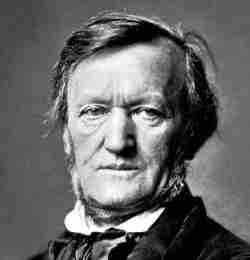
Richard Wagner was a German composer and theatre director best known for his music dramas which melded words, theatre and music into a single form. He had a special theatre built at Bayreuth in Bavaria, Germany for their performances. He was born on 22nd May 1813 in Leipzig, Germany and died on 13th February 1883 at the palace of Ca Vendramin on the Grand Canal in Venice, Italy aged 69.
Major Works
“The Flying Dutchman” (1843)
“Tannhäuser” (1845),
“Lohengrin” (1850),
“Tristan und Isolde” (1865),
“The Ring of the Nibelung” (1869–76)
“Parsifal” (1882)
Biography Timeline
1813: Richard Wagner was born on 16th August in Leipzig, Saxony, Germany in a house known as the red and white lion in the brühl. On 16th August he is baptised in the Thomaskirche in Leipzig. His father Carl dies on 23rd November.
1814: Maria Theresa, his elder sister dies aged four. His mother marries Ludwig Geyer on 28th August.
1817: He starts at the Karl Friedrich Schmidt school.
1820: He is looked after by Pastor Christian Wetzel at Possendorf and has piano lessons.
1821: Ludwig Geyer dies in September.
1822: He sees Carl Maria Weber’s opera “Der Freischutz” in Dresdenand he joins the Dresden Kreuz School, known as Richard Geyer.
1826: His family move to Prague but he stays with schoolfriends in Dresden.
1827: He visits his Uncle Adolf in Leipzig and starts at St Nicholas School there. He is confirmed in Dresden, under the surname Geyer.
1828: He enters the Nicolaischule in Leipzig in January as Richard Wagner. he attends harmony lessons with Christian Gottlieb Müller
1829: He sees Beethoven’s “Fidelio” in Leipzig. His first compositions begin at this time. Two piano concertos and a string quartet.
1830: He takes violin lessons and attends the Thomasschule in Leipzig. On 25th December his “Drum-beat” Overture is played at Leipzig.
1831: He writes Seven Pieces for Goethe’s “Faust.” He begins attending Leipzig University. He studies music with Christian Theodor Weinlig and writes Piano Sonata in b flat (opus 1).
1832: He composes the C Major Symphony. In September he stays with Count Pachta on his estate near Prague and has a brief infatuation with his daughter.
1833: He composes the text for the opera “Die Feen” (which isn’t performed until after his death). In May he stays with his brother Albert at Würzburg and becomes the Chorus Master there. He has A brief relationship with the soprano Thèrese Ringelmann.
1834: Back in Leipzig Wagner puts together the libretto for “Das Liebesverbot“ (The Ban on Love). He is appointed musical director of a travelling theatre run by Heinrich Bethmann and meets and falls in love with the actress Minna Planer in a theatre in Lauchstädt.
1835: He writes the music for “Das Liebesverbot“.
1836: “Das Liebesverbot” has its premiere on 29th March in Magdeburg but is not well received. Wagner marries Minna on 24th November in Könisberg-Tragheim.
1837: He becomes music director of Königsberg Theatre. Minna runs away during May, but they are reconciled later. Wagner is appointed musical director at Riga theatre in June. In July he starts sketching out “Rienzi” based on a novel he has read by Bulwer-Lytton. His sister Rosalie dies in November. Cosima Liszt is born at Como in Italy on 24th December.
1838: He completes the text of “Rienzi” and begins composing the music.
1839: Wagner and Minna escape their creditors in Riga and take a ship to London. Minna suffers a miscarriage. He meets Giacomo Meyerbeer in France in August. He composes the first version of his “Faust Overture”. He attends the premiere of Hector Berlioz’s “Roméo and Juliette” and is very impressed.
1840: He completes the “Faust Overture” and meets Franz Liszt. In June he sends Meyerbeer an early draft of “The Flying Dutchman”. He narrowly escapes debtors prison. He completes “Rienzi”.
1841: He completes “The Flying Dutchman”.
1842: He leaves Paris with Minna and goes to Dresden. He starts work on “Tannhäuser”. “Rienzi” is first performed in Dresden and is his first major success.
1843: The premiere of “The Flying Dutchman” is given in Dresden in January with the composer as conductor. In February he becomes the kapellmeister to the King of Saxony. He reads “German Mythology” by Jacob Grimm and begins composing words for “Tannhäuser“.
1844: He conducts “The Flying Dutchman” in Berlin where he meets Felix Mendelssohn. On 15th December Weber’s funeral is held in Dresden and Wagner composes and conducts the funeral march “Trauermusik” and delivers an oration at his graveside.
1845: “Tannhäuser” is completed in April and he begins work on “Die Meistersinger Von Nurnburg” and “Lohengrin”. “Tannhauser” has its premiere in Dresden on 19th October. He completes the first draft of “Lohengrin”.
1846: On the 5th April he conducts Beethoven’s Ninth Symphony at the Palm Sunday concert and it is a triumph. He meets the conductor Hans von Bülow for the first time.
1848: His mother dies on 9th January. He supports revolutionary activities in Vienna writing an address to the republican Vaaterlandsverein and travels there during July. He completes prose resume for the “Ring” entitled “Der Nibelung Mythus”.
1849: He has a brief affair with Jessie Laussot in Bordeaux in March. A revolt takes place in Dresden on 2nd May and he escapes on the 9th, wanted by the police as a revolutionary. He travels to Zurich in Switzerland via Weimar. he completes “The Art Work for the Future”.
1850: His elopement with Jessie Laussot to Greece is thwarted by her husband. In August he makes sketches for “Siegfried’s Tod” (Siegfried’s Death) which will eventually be used in the “Ring Cycle”. He publishes “Jewishness in Music” in September.
1851: He conceives the basic shape of the “Ring of the Nibelung Cycle”. He takes treatment at the Albisbrunn Hydrophathis establishment to eleviate his erysipelas.
1852: He begins writing the text for the “Ring“. In February he meets Mathilde Wesendonck. He suffers depression and contemplates suicide.
1853: In July he takes a health cure in St Moritz, Switzerland and has a visit from Liszt. He publishes fifty copies of the complete text of the “Ring Cycle”. On 10th October he meets the 15 year old Cosima Liszt in Paris and in November he begins composing music for “Das Rheingold”.
1854: Minna is ill and takes a cure at Lake Lucerne. He composes music for “Die Walküre” during the summer. In September Otto Wesendonck settles some of Wagner’s debts and begins to pay him an allowance. He has an idea for “Tristan und Isolde” in December.
1855: In March he begins conducting a series of eight concerts in London. He meets Queen Victoria and Prince Albert and also Hector Berlioz whilst there. Back in Zurich he works on “Tristan and Isolde” and thinks about a new project called “Parsifal”.
1856: In March he completes the score for “Die Walkure” and from September onwards he works on “Gotterdammerung“, “Siegfried” (parts of the “Ring Cycle”) and “Tristan and Isolde”. He works on a proposed Buddhist drama called “Die Sieger”.
1857: In August he ceases work on the“Ring Cycle” and it will be another eight years before he takes it up again. Hans and Cosima von Bülow on their honeymoon stay with the Wagners at Asyl a small house in the garden of the Wesendoncks villa on 29th August.
1858: He sees Hector Berlioz in Paris and discusses his “Les Troyens“. On 7th April his wife Minna intercepts a letter from Wagner to the poet Mathilde Wesendonck where he declares his feelings for her. He leaves for Venice in August and resumes work on “Tristan and Isolde”.
1859: Due to political pressure he leaves Venice for Lucerne where he completes “Tristan”. He meets up again with Minna in Paris in November where he settles. Otto Wessendonck buys the copyright of the four “Ring” scores for 6,000 francs.
1860: He receives a partial amnesty, allowing him to return to Germany. (except for Saxony) in September he begins rehearsals for “Tannhäuser” in Paris.
1861: The performance of “Tannhäuser” on 13th March in Paris is not a success due to interruptions from the Jockey Club. In May he is at a performance of “Lohengrin” in Vienna.
1862: He becomes separated from Minna who blames Mathilde Wesendonck. He receives a full amnesty and is allowed to re-enter Saxony.
1863: He undertakes a large concert tour throughout Europe including Russia and then settles in Vienna. He meets the von Bülows in Berlin in November and Wagner and Cosima become soul-mates.
1864: King Ludwig the Second ascends throne in Bavaria in March. Wagner leaves Vienna to hide from his creditors and he is invited to see King Ludwig in May and Cosima joins him in June. In October he is given lodgings overlooking Lake Starnberg near Munich by the King who says he wants to build him a festival theatre.
1865: A daughter, Isolde, is born to Cosima and Wagner on 10th April. The premiere of “Tristan and Isolde” takes place in Munich on the 10th June conducted by Hans von Bulow, Cosima’s husband. The full score of “Die Meistersinger” is completed.
1866: Minna dies in Dresden on 25th January. Cosima joins him in Tribschen, near Lucerne, Switzerland in March. By now the scandal over his relationship with Cosima has become common knowledge.
1867: Cosima gives birth to a daughter, Eva, on the 17th February. Hans von Bülow is appointed Kapellmeister to King Ludwig in April. Wagner returns to Munich in December.
1868: The premiere of “Die Meistersinger von Nurnberg” is successful in Munich on 21st June. Wagner meets Friedrich Nietzsche in Leipzig on 8th November.
1869: He resumes work on the “Ring Cycle”. In May Friedrich Nietzsche comes to Tribschen, the first of many visits. His son Siegfried is born on 6th June. “Das Rheingold” receives its premiere in Munich on 22nd October despite his own opposition. “Jewsihness in Music” is reprinted.
1870: “Die Walküre premieres in Munich on 26th June the same day as Cosima and Hans’ marriage is dissolved. He marries Cosima in the Protestant Church in Lucerne on 25th August and he writes the “Siegrfried Idyll” for her to be performed privately on Christmas Day.
1871: He completes the third part of the “Ring Cycle”, “Siegfried” in February. He announces that the first Bayreuth Festival will be held in 1873 on a site provided by the local council.
1872: Friedrich Nietzsche sends him a copy of his book “The Birth of Tragedy“. He lays the foundation stone for the Festspielhaus on 22nd May. Franz Liszt makes his first visit to Bayreuth in October and Cosima coverts to Protestantism.
1873: He begins work on the score for last part of “The Ring”. He begins the full score of “Gotterdammerung” but announces that the festival will be postponed in Bayreuth until 1875. Anton Bruckner visits him in September and asks for permission to dedicate his symphony to him.
1874: King Ludwig gives a loan towards the new building knowing he will never get the money back. The Wagners move into Wahnfried house in April. He finishes the score of Götterdammerung” on 21st November.
1875: He gives concert tours in Vienna, Budapest and Berlin.
1876: In February he composes the “Grosser Festmarsch” for the American Declaration of Independence Centenary. The first Bayreuth Festival finally takes place with “Das Rheingold” performed on 13th August, “Die Walkure” on 14th August, “Siegfried” on 16th August and “Gotterdammerung” on the 17th. Wagner meets Friedrich Nietzsche for the last time in December at Sorrento in Italy.
1877: He meets Queen Victoria at Windsor Castle, England during a tour. Profits of £700 for eight concerts at the newly opened Royal Albert Hall do little to relieve the losses of the festival. The text for “parsifal” is completed.
1878: The first edition of the Bayreuther Blätter journal is published. King Ludwig clears the debts of the Festival.
1879: He works on the text for “Parsifal”. His doctors advise him to seek rest in a milder climate and they move to the Bay of Naples in Italy.
1880: The first performance of the “Parsifal Prelude” is given for King Ludwig in Bavaria on 30th October. Wagner and he have their last meeting on the 12th and he returns to Bayreuth.
1881: “The Ring Cycle” is performed in Berlin in May. On 5th November the Wagners move to Palermo in Sicily.
1882: He completes the score of “Parsifal” in Sicily on 13th January. On the 15th he has his portrait sketched by Auguste Renoir. He has a major heart attack in March and returns to Bayreuth in May. The premiere of “Parsifal” takes place at Bayreuth on 26th July. The Wagners move to Venice in September, staying at the Palazzo Vendramin. Franz Liszt visits them there in December.
Richard Wagner dies of a heart attack on 3rd February 1883 in Venice, Italy and he was buried back at Wahnfried in Bayreuth, Bavaria, Germany on 18th February.
Influences
Wagner was influenced by the writings of Johann Wolfgang von Goethe, Heinrich Heine, the poet Ludwig Tieck and the philosophy of Arthur Schopenhauer and Ludwig Feuerbach. In music he owes a great debt to the spirituality and power of Ludwig van Beethoven as did many composers from Germany and beyond.
He developed opera from the Italian and French styles of Grand Opera to a new form which he described as “Music Drama” where he unites music, drama, poetry and theatrical staging in one complete package. In German this is often called Gesamtkunstwerk (total work of art). He felt that Grand Opera had sacrificed one or several of these parts over the earlier part of the century and unusually he wrote all the words for his operas himself. To create his new works he expanded the orchestra extensively, encouraged a new type of singing in his soloists and used innovative theatrical devices. He developed a new musical language, shifting the tonal range and wrote the so called “Tristan Chord” which was a revolution at the time as was his use of chromatism and the use of leitmotivs for individual characters. In all this he influenced opera music forever.
Such was his distinct style that future composers fell into two opposing camps, those that followed Wagner and those who followed the more traditional Johannes Brahms. His opera “Tristan and Isolde” is often considered as the start of modern music. His influence on modern music has been immense and he can be seen as a precursor to composers as diverse as Maurice Ravel and Benjamin Britten.
Modern film music too owes a lot to Wagner especially in the use of leitmotivs or themes for individual characters or pieces of action and the sweeping passion of many film scores is inherently Wagnerian.
Many writers have been influenced by his work too. An obvious example is J.R.R. Tolkien who was attracted to his mythology and legend and especially the idea of a Ring as conferring world power.
Further Information
List of compositions by Wagner.