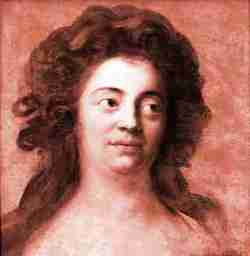
Dorothea Friederike Veit-Schlegel (nee Brendel Mendelssohn) was a German novelist and translator. She was born on 24th October 1764 in Berlin and died in Frankfurt on 3rd August 1839 aged 74.
Major Works
“Florentin” (1801)
“Gespräch über die Neueren Romane der Französinnen” (1803)
“Geschichte des Zauberers Merlin” (1804)
Biography
1764: Dorothea von Schlegel was born as Brendel Mendelssohn on 24th October in Berlin, Germany. Her father was the famous philosopher Moses Mendelssohn whose main income was as an accountant for a silk factory. Her mother was Frometa a well educated woman and Dorothea was the eldest daughter of six children. The family house was always full of poets, musicians, critics and philosophers from all over Europe and she lapped up all of their conversations. The composers Felix Mendelssohn and Fanny Mendelssohn were her nephew and niece.
1768: Birth of her sister Henriette.
1777: The two sisters and some friends of their own age develop a passion for avant-garde German literature counter to their strict Jewish upbringing.
1779: She is engaged to Simon Veit by her parents at the age of fourteen. (He is twenty-four).
1783: Dorothea marries Veit, who is a banker.
1790: Birth of their son Jonas.
1793: Birth of their son Philipp who would later become a painter. Dorothea engages in the literary salons of Berlin and helps found a secret society with Alexander von Humboldt, the naturalist, called the “Tugenbund”
1794: She starts officially calling herself Dorothea instead of Brendel.
1797: In July she meets the poet and critic Friedrich von Schlegel at a salon held by her friend Henriette Herz. Friedrich’s brother August Wilhelm Schlegel is already a distinguished professor at the University of Jena.
1799: On 11th January Dorothea finally divorces Simon Veit. Her husband is given custody of the older son Jonas whilst she has custody of Philip until he is thirteen and she moves to Jena with him having forfeited her right to live in Berlin. Her mother breaks off with her entirely and Dorothea has to live more modestly than she is used to sharing lodgings with Friedrich and his brother August Wilhelm and his wife Caroline Schlegel. To add to the scandal Friedrich von Schlegel has just published an explicit novel entitled “Lucinde” which is widely seen as a story about his affair with Dorothea. Friedrich earns some money by teaching transcendental philosophy at the university and the house becomes a magnet for the intellectuals of the day including Novalis, Ludwig Tieck and Friedrich Schelling.
1801: Her novel “Florentin” is published anonymously by Friedrich von Schlegel.
1802: Dorothea and Friedrich move to Paris from 1802. She begins translation work to earn some money and works on “Geschichte der Jungfrau von Orleans” although it is published under Friedrich’s name.
1803: Her brother Abraham and sister Henriette are living in Paris and Dorothea tells them she will leave Friedrich so that she can receive her share of the family’s inheritance before her mother dies. They do not believe her and refuse. She works on the translation of “Autobiographie der Margaretha von Valois” again published under Friedrich’s name.
1804: On 6th April Dorothea converts to Protestantism and she and Friedrich marry. Soon after they move to Cologne in Germany although Friedrich still has no official employment. She translates “Sammlung Romantischer Dichtungen des Mittelalters (Collection of Romantic Poems of the Middle Ages) in two volumes.
1805: She translates “Lother und Maller. Eine Rittergeschichte” (Lother and Maller. A Knight’s Tale) under Friedrich’s name.
1806: Her son Philipp returns to live with his father in Berlin and she is heartbroken.
1807: She works on translating Madame de Staël’s “Corinne” and “Geschichte des Zauberers Merlin”.
1808: Both Friedrich and Dorothea convert to Catholicism on 16th April in Cologne Cathedral. They continue to visit the literary salons including those of Madame de Stael.
1809: Friedrich is appointed to a position as Imperial Court Secretary at the military headquarters for Austria and the couple move to Vienna.
1810: Much to Simon Veit’s distress his two sons also convert to Catholicism. They eventually settle in Rome and become artists and Dorothea visits them several times. Philip becomes a member of “The Nazarenes” who are to influence the English Pre-Raphaelite Brotherhood.
1815: Following the Congress of Vienna after the defeat of Napoleon Bonaparte Friedrich serves as First Secretary of the Austrian legation to the Diet of Frankfurt.
1819: Simon Veit dies. Friedrich visits Rome with Clemens Brentano, Metternich and Friedrich von Gentz and meets up with Dorothea.
1820: The couple move back to Vienna.
1829: Friedrich von Schlegel dies and Dorothea moves to Frankfurt am Main in Germany where she lives in her son Philip’s house. Friedrich had left debts behind him but Dorothea’s brothers agree to support her. Abraham’s son Felix Mendelssohn is a great admirer of Dorothea and meets up with her regularly.
Dorothea von Schlegel died on 3rd August 1839 in Frankfurt and is buried in the Hauptfriedhof (Main Cemetery) in Frankfurt am Main.
Influences
Dorothea Veit-Schlegel as the daughter of the philosopher Moses Mendelssohn was surrounded by a family of intellectuals from the German enlightenment. She frequented the Berlin salons, some of which were organised by her mother, and talked with prominent figures such as her father’s friend the philosopher Gotthold Ephraim Lessing on biblical studies and Weimar classicism. She was well read and most probably attended the classes for young Jews that her father held at their house. Her mother however disapproved of her interest in literature as she was female.
Her marriage to the Jewish banker Simon Veit in 1783 was not a happy one. She had been betrothed at the age of fourteen and it was a marriage of convenience. Veit was in possession of a “letter of protection” from the Brandenburg government which gave him and his descendants rights of permanent residency which was not available to Jews in general at the time. During this period she continued to be active in the Berlin salon culture and was friends with Germaine de Staël, Ludwig Tieck, the poet and playwright Joseph von Eichendorff and the brothers Alexander and Wilhelm von Humboldt. She formed a secret society called the Tugendbund (Society of Virtue) with the aim of improving the intellectual, spiritual and moral development of its members.
In July 1797 she met the philosopher, writer, and literary critic Friedrich von Schlegel at the salon of her friend Henriette Herz and moved in with him causing a major scandal in polite society. She divorced in 1799 and went on to marry in 1804 converting to Protestantism before the ceremony. She later became a Catholic and her experiences with religious conversion became a major theme in her later writings. Although Friedrich Schlegel was a factor in her development, sharing ideas on philosophy, literature and religion, she also owed a great deal to Johann Wolfgang von Goethe in her style and interests. Many of her translations and other works were published under her husband’s name to give them more chance of be accepted at the time. In Jena besides Friedrich, his bother August and his wife Caroline Sclegel-Schelling were major influences along with their friend the poet Friedrich von Hardenberg known as Novalis.
She translated works from medieval and modern French, indulged in literary criticism and contributed articles to Friedrich’s journal “Europa”, and wrote the novel “Florentin”. She was particularly influential in her attention to the lives of women of her time and class and believed education was vital to expand their development. She also tackled the social constraints that prevent women from taking on certain roles that are open to men and as such has interested feminists in our own century.
Critics at the time thought that “Florentin” was a failed Bildungsroman because the central character does not mature or grow. More recently scholars have stated that this lack of development was a deliberate strategy to critique the ideals of self-development shown by her husband in his novel “Lucinde” and Novalis’s novel “Heinrich von Ofterdingen” of 1802. Modern day critics are realising the extent to which her thought differed from the male German Romantics.
Her translations from medieval French sources influenced the Heidelberg Romantics, including Ludwig Tieck, Achim von Arnim, Bettina von Arnim and the Brothers Grimm and in 1807 she translated “Corinne” by Madame de Staël (her husband’s patron) from the French.
Her family’s role in the emancipation of European Jewry meant she was attacked or ignored totally during the Third Reich in the twentieth century, however her reputation has since been rehabilitated.
Further Information
List of works by Dorothea von Schlegel.
Article from the Shelve/Hyman Encyclopaedia of Jewish Women.