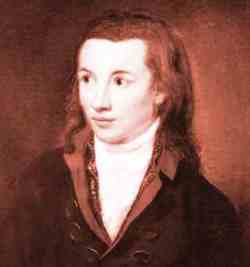
Novalis (Birth name Georg Philipp Friedrich Freiherr von Hardenberg) was a German aristocrat and poet, novelist, philosopher and mystic. He was born in Wiederstedt, Germany on 2nd May 1772 and died in Weissenfels, Germany on 25th March 1801 aged 28.
Major Works
“Blütenstaub” (1798)
“Glauben und Liebe” (Faith and Love) (1798)
“Die Christenheit oder Europa” (Christendom or Europe) (1799)
“Hymnen an die Nacht” (Hymns to the Night) (1800)
“Heinrich von Ofterdingen” (1802)
Biography Timeline
1772: Georg Philipp Friedrich Freiherr von Hardenberg was born on 2nd May in Wiederstedt, Germany. His father, Heinrich Ulrich Erasmus Freiherr von Hardenberg, was the manager of a salt mine and a member of the Moravian Church. His Mother, Auguste Bernhardine von Böltzig, was his father’s second wife. Both parents outlived him. The family descended from minor nobles in Lower Saxony and Hardenberg grew up on the family lands around the manor of Oberwiederstedt. He was educated at home and then went to the Lutheran grammar school in Eisleben.
1784: He moves to live with his uncle, Gottlob Friedrich Wilhelm von Hardenberg.
1790: He attends lectures at the university of Jena, the centre of German Romanticism at the time, and makes the acquaintance of Johan Wolfgang von Goethe and Johann Fichte, and becomes great friends with August Wilhelm von Schlegel, Freidrich von Schlegel, Ludwig Tieck, Friedrich Schelling, and Friedrich von Schiller as well as two of their wives Caroline Schlegel-Schelling and Dorothea Veit-Schlegel.
1791: His first publication is the poem “Klagen eines Jünglings” which appears in Christoph Martin Wieland’s publication Neuem Teutschen Merkur.
1794: He begins studying law in Jena, Leipzig, and Wittenberg and begins work on its completion. He falls in love with the twelve 12-year-old Sophie von Kühn whilst working in the Prussian civil service in Tennstedt.
1795: He and Sophie get secretly engaged. He begins work on his studies of the philosopher Johann Fichte.
1797: He attends the Academy of Freiberg to study mining which eventually leads to an administrative post at the salt mines in Weissenfels. Just after he starts his studies Sophie dies of tuberculosis. He has nursed her in her final days and is devastated at her death. With the help of his friends he eventually recovers and continues working on his interests in philosophy (particularly Immanuel Kant), medicine, biology and geology.
1798: He begins using the pen name Novalis at this period which harks back to an old family name but also indicates in his mind “the one who clears new ground”. He is famous for his philosophical fragments and two are published in the first issue of the Athenaeum journal edited by Friedrich von Schlegel. “Blütenstaub” (Pollen) are one hundred and fourteen fragments and is his attempt to unite philosophy with science and poetry in true Romantic style. The other is the controversial “Glauben und Liebe” (Faith and Love). The ethos of the Athenaeum writers was to establish a unified philosophical group through what they called Symphilosophie or a shared philosophising. About this time Novalis begins work on his idea for “Das Allgemeine Brouillon” (Notes for a Romantic Encyclopaedia), which like most of his other work was published posthumously. Later in the year he becomes engaged to Julie von Charpentier.
1799: In his essay “Die Christenheit oder Europa” (Christendom or Europe) he calls for a universal Christian church to restore itself to a time, in his opinion, before it was destroyed by the Reformation and the Enlightenment.
1800: He writes six joint prose and verse poems “Hymnen a die Nacht “(Hymns to the Night). From August he begins to cough up blood and after a major haemorrhage in November he is temporarily moved to Dresden for treatment.
1801: In January, he requests to be with his parents again and becomes a mine inspector at the saltworks at Weissenfels.
Novalis, or Georg Philipp Friedrich Freiherr von Hardenberg dies on 25th March 1801 at his parent’s home in Weissenfels, Germany probably of tuberculosis, although recent research suggests possible cystic fibrosis which was prevalent in his family. He was buried in Weissenfels’s Alter Friedhof (Old Cemetery). His mythical romance “Heinrich von Ofterdingen”, an idealised vision the romantic searchings of a young poet in the Europe of the Middle Ages, is published the following year.
Influences
Normally known as Novalis (meaning new Land), his pseudonym was taken from the name “de Novali” which used by some of Georg Friedrich Philipp Hardenberg’s ancestors. Although he studied mining for his family’s business his heart was in poetry and philosophy. In 1798 his works “Blütenstaub” (Pollen) and “Glauben und Liebe” (Faith and Love) show his desire to unite poetry, philosophy and science into an allegorical interpretation of the world. This has become known as magical idealism, from the type of literary prophet, he mentions in his notebooks, the Magischer Idealist (magical idealist). Magical idealism also covers health which he had learned from the works of the Scottish physician John Browns system of medicine which sees illness as a mismatch between sensory stimulation and internal state.
Philosophers who influenced him most were Baruch Spinoza, Johann Gottlieb Fichte and Johann Gottfried Herder but just as important were the writers he met in the town of Jena in eastern Germany, Friedrich von Schiller and Johann Wolfgang von Goethe. In Jena he also met with Friedrich Schlegel on a daily basis who introduced him to Goethe and their conversations often concentrated on both Fichte and Goethe. Fichte constructed an idealist metaphysics, which was further advanced by Friedrich Wilhelm Joseph von Schelling and later Georg Wilhelm Friedrich Hegel. In Novalis’s eyes not only humankind, but also nature is highly creative, producing an endless variety of different forms and should not be separated from the human world. He widely studied mysticism, particularly the works of Jakob Böhme, Kabala and Neoplatonism from the third century. In his essay “Die Christenheit oder Europa” (Christendom or Europe) in 1799 he calls for a universal Christian church to restore a Europe whose unity had been destroyed by the Reformation and the Enlightenment. This was controversial at the time as some felt it meant a return to Catholicism but in it he uses the phrase the “magic wand of analogy” to clarify how he meant to use history. His image of a blue flower from his unfinished Novel “Heinrich von Ofterdingen” became a widely recognised symbol of Romantic longing among the Romantics. In 1802 his “Spiritual Songs”, published posthumously, were incorporated into Lutheran hymnals.
Part of the problem with his influence on other people is that he lived a short life during which little original material was actually published. Some of his poetry was published later by Friedrich Schlegel and Ludwig Tieck but it was far from complete and later critics and writers have researched more and adapted their views including into the twentieth century. During the nineteenth century he was seen primarily as a passionate love-struck poet who mourned the death of his beloved and even Friedrich Schleiermacher described him as a poet who dreamt of a spiritual world beyond this one. In 1815 his friend August Cölestin Just published his biography he was criticised for describing his work as a mine inspector and magistrate. Thomas Carlyle, who had introduced him to the English speaking world and realised his philosophical relationship to Fichte and Kant, went on to emphasise him a mystic poet.
In 1842 George MacDonald recalls that his father travelled in the “north of Scotland” and took a job cataloguing the books in the library of a castle or mansion. The upshot of this is that his son became fascinated with the German literature he found there and in particular the works of Novalis whom he began to translate. In 1851 he translated “Spiritual Songs” and had them published at his own cost and sent as Christmas gifts to friends and family. Twenty-five years later his translations of “Hymns of the Night” were published commercially. This and his other work had an influence on MacDonald’s own writing especially the underground visions which he borrowed for his classic children’s novel, “The Princess and the Curdie”. Another writer who was influenced by him is the poet and playwright Maurice Maeterlinck, who regarded him as important for his religious and philosophical views as well as his poetry and compared him to Blaise Pascal. The artist Caspar David Friedrich was also influenced by his work.
In the twentieth century the religious angle to his work has led to several negative assessments of his work however Thomas Mann and Herman Hesse were influenced by him and the latter quotes a passage from “Pollen” in his novel “Glasperlenspiel” (The Glass Bead Game). More of his writings have been collected together than ever before to show his wide-ranging interests which also spread into politics and political economy.
The Hungarian philosopher Gyorgy Lukacs derived his concept of philosophy as transcendental homelessness directly from Novalis whom he quotes. The philosopher and occultist Rudolf Steiner lectured widely on Novalis and acknowledges his influence on his new religious movement of Anthroposophy. Martin Heidegger quotes his phrase “Philosophy is really homesickness, an urge to be at home everywhere” in the opening pages of his “The Fundamental Concepts of Metaphysics”. Andre Breton and the Surrealist poets and artists were profoundly influenced by Novalis and he mentions him in his study of art history “L’Art Magique”. The German artist Joseph Beuys was also inspired by him and took his aphorism “Everyone is an artist” directly from him. The author Jorge Luis Borges also refers to him frequently in his work.
Further Information
List of works by Novalis.