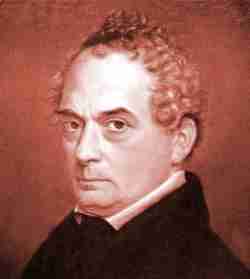
Clemens Brentano was a German poet and novelist who was a major figure in German Romanticism. He was born in Koblenz, Germany on 9th September 1778 and died in Aschaffenburg, Germany on 28th July 1842 aged 63.
Major Works
“Satiren und Poetische Spiele” (1800)
“Geschichte vom braven Kasperl und dem schönen Annerl” (The Story of Brave Casper and Fair Annie) (1817)
“The Dolorous Passion of Our Lord Jesus Christ” (pub 1833)
“Gockel, Hinkel and Gackeleia” (1838)
Biography Timeline
1778: Clemens Brentano was born on 9th September in the Ehrenbreitstein Fortress in Koblenz, Germany. His father Peter Anton Brentano a wealthy merchant from Frankfurt am Main of Italian heritage and his mother was Maximiliane von La Roche. His grandmother was the novelist Marie Sophie von La Roche and his sister was Bettina von Arnim, the writer and novelist. He was educated in Halle.
1785: His sister Bettina is born on 4th April 1785 in Frankfurt am Main.
1798: He moves to the University of Jena to study medicine on 5th June. He meets Johann Wolfgang von Goethe, Johann Gottlieb Fichte, Friedrich Schlegel and Ludwig Tieck during these early years.
1800: His early writings are published under the pseudonym “Maria Erstdruck”. He writes “Satiren und Poetische Spiele”(Satirical and Poetic Plays).
1801: He moves to Göttingen and takes philosophy classes at Georg August University and becomes friendly with the poet and novelist Achim von Arnim. He begins writing the novel “Godwi oder Das Steinerne Bild der Mutter” (Godwi or the Stonefigure of Mother).
1803: He marries the novelist Sophie Mereau on 29th October and is her second husband. He writes the musical drama “Die Lustigen Musikanten” (The Merry Musicians).
1804: He moves to Heidelberg and works with Achim von with Arnim on “Zeitungen fur Einsiedler” (Newpapers for Hermits).
1805: He collaborates with Arnim on the folk poems and songs “Des Knaben Wunderhorn” (The Boy’s Magic Horn) which proves very popular when published in several volumes between 1806 and 1808 and is then translated into English.
1806: His wife Sophie dies giving birth to their third child.
1807: He marries again, this time to Auguste Bussmann (whose half-sister, Marie de Flavigny would later become the companion of pianist and composer Franz Liszt).
1808: He lives in Berlin for most of the year.
1811: He moves to Bohemia.
1813: He moves to Vienna, Austria and writes the play “Aloys and Imelda”.
1814: He is divorced from his second wife Auguste.
1815: He writes the play “Die Grundung Prags”. (The Founding of Prague).
1817: He writes the play “Victoria und ihre Geschwister” (Victoria and her Siblings).
1818: He has now become tired of his unsettled life and joins the Roman Catholic Church. He withdraws from life and enters the Monastery at Dulmen in Westphalia becoming the secretary to the Catholic visionary, Sister Anne Catherine Emmerich. It is claimed she ate nothing but the Holy Eucharist and from 1802 onwards bore the wounds of Christ on the cross and full stigmata. Brentano sits at the foot of her bed taking her dictation.
1824: Sister Anne dies and Brentano prepares an index of the visions and revelations from her journal. (“The Dolorous Passion of Our Lord Jesus Christ” – published in 1833).
1831: He publishes “Die Barmherzigen Schwestern in Bezug auf Armen und Krankenpflege” (Care of the Poor and Sick by the Sisters of Mercy).
1833: He meets and falls in love with the Swiss painter Emilie Linder. He writes the long poem “Alhambra” dedicated to her.
1835: Linder paints his portrait.
1842: On 5th July he moves to his brother Christian’s home in Aschaffenburg after being taken ill.
Clemens Brentano died on 28th July 1842 in Aschaffenburg, Bavaria, Germany and was buried in the Old Town Cemetery in Aschaffenburg. Many of his works were published posthumously including “Romances of the Rosary and the Bitter Suffering of our Lord Jesus Christ” in 1833, “Romanzen vom Rosenkranz” in 1852 and “Rhine Fairy Tales” in 1885.
Influences
Clemens Brentano along with Achim von Arnim, whom he met while studying in Göttingen in 1801, were major representatives of the Heidelberg Romantics who were interested in popular German stories of the middle ages and emphasised emotion and imagination. They were influenced in particular by the Jena Romantics such as Novalis, Ludwig Tieck and Friedrich Schlegel and especially Johann Wolfgang von Goethe and Friedrich Schiller. Their major work together was a collection of folklore songs entitled “Des Knaben Wunderhorn” (The Youth’s Magic Horn) which they began in 1806. In 1808 they published the newspaper Zeitung für Einsiedler. (Newspaper for Hermits).
From 1809–11, Brentano lived in Berlin, where he was a founding member of the Christlich-Deutschen Tischgesellschaft (Christian-German Roundtable Society) and he wrote the manifesto which was disitinctly anti-Semitic in tone. In 1815 he began producing numerous religious works which supported political Catholicism, a movement started by the Catholic journalist Joseph Gorres. In 1833 he moved to Munich where Gorres was a professor and surrounded himself with like-minded intellectuals.
Brentano had an great interest in the visual arts and took lessons in architecture from Karl Friedrich Schinkel and dedicated the character of the architect, Bonascopa, to his friend in one of his stories and wrote a poem “To Schinkel” which paid homage to Berlin’s famous painter and city architect. In return Schinkel made many illustrations of Brentano’s works.
His poetry is characterised by its musicality, use of vivid imagery, and exploration of the emotions and he is considered a master of the German Romantic ballad. It is no surprise that many composers turned to his work for inspiration. Gustav Mahler produced his version of “Des Knaben Wunderhorn” and in 1918 Richard Strauss set six of his original poems to music as “Sechs Lieder”, Opus 68. (often called the Brentano Lieder). Brentano is also mentioned in Thomas Mann’s novel “Doctor Faustus”.
Nowadays his reputation rests solely on his poetry much of which was published posthumously and his religious writings have disappeared into obscurity.
Further Information
List of books by Brentano.