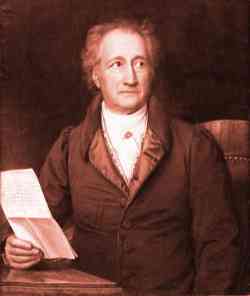
Johann Wolfgang von Goethe was a German poet, playwright, novelist, scientist, statesman, theatre director and critic hailed as one of Germany’s most important writers. Strictly from the “Sturm und Drang” (Storm and Stress) period nevertheless he was a major influence on the Romantic movement. He was born in Frankfurt, Germany on 28th August 1749 and died in Weimar, Germany on 22nd March 1832 aged 82.
Major Works
“The Sorrows of Young Werther” (1774)
“Faust” (Part I, 1808; Part II, (1832)
Biography Timeline
1749: Johann Wolfgang von Goethe was born on 28th August in Frankfurt am Main Germany. His father was a lawyer.
1765: He moves to Leipzig, Germany to study law even though he was more interested in literature.
1767: He publishes his first volume of poetry which is inspired by his love for Anna Katharina Schönkopf.
1768: He returns to Frankfurt. He takes up studying art, philosophy and science for his own interest.
1770: He returns to his law studies in Strasbourg. He publishes another volume of poetry inspired by his love for another woman called Friedericke Brion.
1772: He begins working as a lawyer in Wetzlar. During the summer he is inspired to write his first novel, “The Sorrows of Young Werther“. He also starts sketching out his idea for a drama based on Faust story.
1774: “The Sorrows of Young Werther is published. It is immediately a huge success and causes a wave of imitations of the character Werther and suicides amongst young men across Europe. Goethe is grouped with other writers who are part of the “Sturm and Drang” movement (Storm and Stress).
1775: He becomes an advisor to Grand Duke Karl August at the Ducal Court of Weimar. This is a busy life leaving him little time for creating works of literature. He falls in love with another young woman named Lili Schönemann and proposes to her but soon breaks off the engagement. In November he becomes friendly with Charlotte von Stein the wife of a colleague, a friendship which is to last for many years.
1786: He suddenly abandons his post and friends in Weimar and spends two years traveling in Italy under an assumed name. He is greatly impressed by the art of the Renaissance and the Classical period and considers becoming an artist himself.
1788: He finally returns to Weimar a new man and works on several plays and more poetry over the coming years. Friedrich von Schiller travels to Weimar to meet Goethe at his home and although the initial meeting was slightly frosty Goethe became impressed by Schiller’s work and the two became firm friends.
1790: He publishes the first volume of “Faust“.
1791: He is appointed director of the Weimar Court Theatre.
1792–93: He is often by the side of Grand Duke Karl August on his military campaigns against Napoleon Bonaparte.
1806: He marries Christiane Vulpius, after many years of living together. She works making artificial flowers in a local factory. The Prussian army is defeated by the Napoleon at the Battle of Jena on 14th October and his troops enter Weimar.
1808: Bonaparte has been an admirer of Goethe and awards him the French Legion of Honor.
1810: He continues his studies in various scientific fields and he publishes “On Colour“. This becomes an influential work on the subject during the next decades.
1811: The first volume of Goethe’s “Poetry and Truth” is published.
1812: He meets Ludwig van Beethoven in the Bohemian spa town of Teplitz. They did not get on as Goethe thought Beethoven “uncontrolled” and Beethoven thought that Goethe was too obsequious to the nobility. The second volume of “Poetry and Truth” is published.
1813: The third volume of “Poetry and Truth” is published.
1816: His wife Christiane dies.
1817: He finally finishes in the post of Director of the Weimar Court Theatre.
1823: He falls in love with the teenage Ulrike von Levetzow in the spa town of Marienbad. She turned down his proposal but it inspired Goethe to write three poems about his heartbreak including on called “To Werther”.
1831: He completes the second volume of “Faust” and the fourth volume of “Poetry and Truth” although both will be published posthumously.
Johann Wolfgang von Goethe died on March 22 1832 and was buried in the Weimarer Fürstengruft (Ducal Crypt) in Weimar on the 26th next to his friend and fellow poet Johann Friedrich von Schiller.
Influences
Goethe is a major figure in European literature on a par with William Shakespeare and as such has been very influential. He himself read Shakespeare avidly as well as the works of Jean Jacques Rousseau, Voltaire, Francis Bacon, Denis Diderot and the German art historian Johann Joachim Winckelmann. He was interested in philosophy and studied Immanuel Kant, Johann Gottfried von Herder and Gotthold Ephraim Lessing and in music he was fascinated by the work of Johann Sebastian Bach.
He met Herder in Strasbourg and the two became close friends and it was he who introduced him to Shakespeare, Homer and folk poetry. Goethe hosted a gathering at his parents’ house in October 1772 celebrating the first German “Shakespeare Day”. In his youth he was very much seen as a child of the Enlightenment but his novel “The Sorrows of Young Werther” of 1774 can be seen as the beginning of the Sturm und Drang period. The book became a sensation causing young men throughout Europe to attempt suicide and it became a favourite of one Napoleon Bonaparte whom he met in 1808 during the Congress of Erfurt and was impressed by. Goethe was always a career diplomat as well as a writer and later a proto-scientist. In fact in his long life he was active as a poet, novelist, dramatist, essayist, librettist, translator, biographer, diarist, critic, theatre director, art collector, painter and sculptor and was known to many great men of the day as a sympathetic conversationalist.
He became friends with Friedrich Schiller during his trips to Jena in Eastern Germany as well getting to know both August Wilhelm and Friedrich von Schlegel, Ludwig Tieck, Wilhelm Heinrich Wackenroder, Friedrich von Hardenberg (known as “Novalis”), Friedrich Schleiermacher and Johann Gottlieb Fichte. By 1827 he famously said “The age of world literature is at hand, and everyone must strive to hasten its approach”.
In science he was very influential and conducted experiments particularly on light, optics and colour theory but also on botany, climatology and human and animal biology. He always took an ecological approach studying subjects in the full round of nature which adhered him to the Romantics.
His influence went far beyond Germany particularly in the Anglo-American world. His champions in England were Mary Wollstonecraft and George Eliot and especially the Scot Thomas Carlyle who urged aspiring writers in Britain to adopt Goethe as a role model and called him “the soul of the century”. He wrote “Goethe” in 1828 and “Goethe’s Works” in 1832 amongst his many tributes. It was not all plain sailing however as after Carlyle’s translation of “Wilhelm Meister’s Apprenticeship” in 1824 the English literary historian George Saintsbury derided as “anthropological” interpretations and moralistic readings projected back onto the author. He became condemned for his love affairs and descriptions of carnal longing and also for encouraging suicide (“Werther”) and people exchanging their soul with the Devil for heightened experience (“Faust”). His pantheistic celebration of nature was deemed blasphemous by many in Victorian Britain. In America he was condemned for his acceptance of a knighthood in return for service to the autocratic prince of Saxe-Weimar.
Mary Wollstonecraft’s translation in 1790 “Elements of Morality, for the Use of Children” loosely based on the German text by Christian Gotthilf Salzmann was praised by Goethe. Her “Thoughts on the Education of Daughters” (1787) and “A Vindication of the Rights of Woman”(1792) owe a great deal to German thought. George Eliot scandalously eloped to Germany in 1854 with the still-married George Henry Lewes, who was writing the first biography of Goethe at the time, and had already been a notable reviewer and translator of other German writers. Whilst in Germany she wrote “The Morality of Wilhelm Meister” and “The Natural History of German Life”. She described Goethe as “eminently the man who helps us to rise to a lofty point of observation” and praised his “large tolerance”. Her contemporary Matthew Arnold called him the “Physician of the Iron Age” and “the clearest, the largest, the most helpful thinker of modern times”.
In the USA Margaret Fuller’s translated and made critical comments on German literature and became one of the most important literary and influential figures of the time. Ralph Waldo Emerson had begun his readings by stating that “the Puritan in me accepts no apology for bad morals in such as he”, however by 1850 in an essay he considered Goethe “a poet of prouder laurel than any contemporary”. He would also be impressed by his theories on evolution. Indeed his works and opinions made a deep impression on most of the writers and poets of the nineteenth century and “Faust” above all is still deemed the most important masterpiece of German literature.
Germaine de Staël in her book “Der Allemagne” of 1813 did much to cement his reputation as a pre-eminent German writer saying he had all “the chief characteristics of the German genius”. Later in 1889 Friedrich Nietzsche in his “Twilight of the Idols” described him as “the last German for whom I feel reverence” and an example of a healthy, fully-formed individual. Many of his non-fiction writings are philosophic and aphoristic in tone and influenced not only Nietzsche but Georg Wilhelm Friedrich Hegel, Arthur Schopenhauer, (who described “Wilhelm Meister’s Apprenticeship” as one of the four greatest novels ever written), Søren Kierkegaard and later the psycho-analyst Carl Jung. Albert Einstein in 1932 described him as “a poet without peer, and as one of the smartest and wisest men of all time”. He also influenced Thomas Mann and Rudolf Steiner.
His fascination with mineralogy mineral led to one of the iron oxides being named after him as Goethite and the inventor Nikola Tesla was influenced by “Faust” which he declared his favourite poem and was reciting it when he had the idea for the rotating magnetic field which later led to alternating current.
In music his words have been used by composers such as Mozart, Franz Liszt and Gustav Mahler.
Goethe believed that the two realms of man and nature are governed by the same universal laws of growth and direction and man should work for nature not against it. Thus endearing him to the sustainability cause. His most oft quoted phrase is “Whatever you can do, or dream you can, begin it”.
Further Information
Complete works of Goethe.