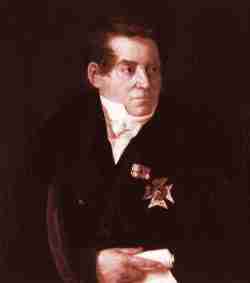
August Wilhelm von Schlegel was a German poet, translator and critic, and one of the leading influences within Romanticism which established in the town of Jena. He was born in Hanover, Germany on 8th September 1767 and died in Bonn, Germany on 12th May 1845 aged 77.
Major Works
“Ion” (1803)
“Rom Elegie” (1805)
“Poetische Werke” (1811)
“On the Theory and History of the Plastic Arts” (1827)
“Kritische Schriften” (Critical Works) (1828)
Biography Timeline
1767: August Wilhelm Schlegel was born on 8th September in Hanover, Germany. His father was Johann Adolf Schlegel a Lutheran pastor and poet and his mother was Johanna Christiane Erdmuthe (née Hübsh). He was educated at the Hanover Gymnasium.
1786: He attends the University of Göttingen where he studies theology and then classical philology under Christian Gottlob Heyne. Whilst a student he meets Wilhelm von Humboldt and Caroline Böhmer who encouraged him in his studies.
1790: His youngest brother, Friedrich Schlegel, joins him in Göttingen. They both study the works of Immanuel Kant and Johann Gottfried Herder amongst others.
1791: He finishes at Göttingen and moves to Amsterdam where he works as a private tutor to Willem Ferdinand Mogge Muilman, the son of a Dutch banker.
1796: He moves to the German university town of Jena to work as a literary critic after receiving an invitation from Friedrich von Schiller. His brother Friedrich follows him there. He marries Caroline Böhmer, now a widow. She helps Schlegel with his literary translations of Shakespeare Dante and Petrach. Their house becomes a meeting place for many famous figures from the Romantic period such as Johann Gottlieb Fichte, Novalis, Ludwig Tieck and Friedrich Schelling.
1797: He publishes a volume of poems.
1798: The brothers found the “Athenaeum” magazine after difficulties getting their works accepted in other journals. It includes critical articles about philosophical issues and literary works of the day and appears twice a year between 1798 and 1800. A particular target are the sentimental novels of August Lafontaine. A rift develops between Schiller and both brothers over their criticism of his work “Die Horen”. He also writes articles for the “Jenaer Allgemeine Litteratur-Zeitung”. His success at translating Shakespeare and Dante gains him an extraordinary professorship at the University of Jena.
1799: Caroline not only helps with the translations but also publishes articles in the Athenaeum under her own name such as “Die Gemalde”. She has since been credited with a greater importance in the formulation of Romantic ideas than was accepted at the time.
1801: Schlegel and Caroline separate and he moves to Berlin on his own where he lectures on literature and art at the University. He publishes a collection of joint essays with his brother Friedrich entitled “Charakteristiken und Kritiken”.
1802: His play “Ion” is performed in Weimar in January with the help of Johann Wolfgang von Goethe but is not well received.
1803: He divorces Caroline and she marries the philosopher Friedrich Schelling whom she had been having an affair with for some time. Schlegel publishes the two-volume work “Spanisches Theater” which includes translations of works by Pedro Calderón de la Barca.
1804: He publishes “Blumensträusse Italiänischer, Spanischer, und Portugiesischer Poesie” (Bouquets of Italian, Spanish, and Portuguese Poetry) with translations of woreks by Dante, Boccaccio, Miguel de Cervantes, and Torquato Tasso. Schlegel now becomes a constant companion to Madame de Stael and tutor to her children. He travels to Switzerland, Italy and France with her acting as a literary adviser.
1805: He gives a series of lectures in Vienna outlining his ideas.
1807: His essay “Comparaison entre la Phedre de Racine et celle d’Euripide” attacking French Classicism and expounding Romanticism gains a lot of negative attention in France.
1808: He delivers lectures on dramatic art and literature in Vienna. Madame De Staël and her children are with him on the visit.
1809: His Vienna lectures are published between 1809 and 1811 as “Vorlesungen über Dramatische Kunst und Literatur” (A Course of Lectures on Dramatic Art and Literature).
1810: He is ordered to leave the Swiss Confederation as an enemy of French literature.
1812: He travels to Moscow, St Petersburg and Stockholm with Madame de Staël and her fiancé Albert de Rocca and acts as secretary to Jean Baptiste Jules Bernadotte.
1816: An extended version of his “Course of Lectures” is published which have already been widely read in England, France Holland and Italy.
1817: Madame de Staël dies and he leaves her household.
1818: In August he marries Sophie Paulus, the daughter of the German theologian Heinrich Paulus in Heidelberg, however they only stay together for a few weeks and she doesn’t go with him to Bonn where he is appointed Professor of Indology, Literature and Art History. He lectures there until 1844.
1820: He begins publishing the academic journal “Indische Bibliothek” which continues until 1830.
1821: He becomes legally divorced from Sophie.
1823: He founds a special printing press for Sanskrit and makes the first complete translation of the “Bhagavadgītā” from Sanskrit into Latin.
1826: The seventeen-year old Felix Mendelssohn is inspired by Schlegel’s German translation of Shakespeare’s “A Midsummer Night’s Dream” and writes a concert overture on the theme. (Friedrich Schlegel’s wife Dorothea is the aunt of Mendelssohn).
1827: He publishes “On the Theory and History of the Plastic Arts”.
1828: His two-volume collection of critical writings “Kritische Schriften” appears.
1829: He publishes “The Rāmāyana”.
1832: He publishes “Reflections on the Study of the Asiatic Languages”.
1835: He becomes chairman of the organising committee to establish a monument to Ludwig van Beethoven in his birthplace, Bonn.
August Wilhelm Schlegel died on 12th May 1845 in Bonn, Germany three months before the official unveiling of the Beethoven monument. He was buried in the Alte Friedhof in Bonn.
Influences
August Wilhelm Schlegel was pivotal in defining and shaping the German Romantic movement which went on to influence the literary and artistic landscape of the period. His philosophy was originally influenced by reading works by Immanuel Kant which and was refined by Johann Gottlieb Fichte and then Friedrich Wilhelm Joseph Schelling. He was also influenced by his lecturers in philology at the University of Göttingen, including Christian Gottlob Heyne, Gottfried August Bürger, and Johann Joachim Eschenburg, and at this period he was also heavily influenced by the works of Johann Gottfried Herder. Later he read the authors Johann Winckelmann and Karl Theodor von Dalberg.
After a time as a private tutor in Amsterdam he finally arrived in the German town of Jena in 1798 where he lectured at the university. His brother Friedrich Schlegel lived in his house with him and his wife Caroline Schlegel-Schelling. All three became leading figures in German Romanticism and the Jena School. Between them they defined the principles of Romantic art and literature which emphasised imagination, intuition, beauty and the natural world. In Jena he was open to the views of other residents there such as Friedrich von Schiller, Johann Wolfgang von Goethe and Johann Gottlieb Fichte himself.
“Athenäum” the journal that he established with his brother Friedrich went on to become the organ of German Romanticism and featured articles by Friedrich Schleiermacher, Ludwig Tieck and Novalis alongside their own. Also, in Jena he began his long-planned translation of the works of William Shakespeare. He, with the help of his wife, translated seventeen plays and afterwards Ludwig Tieck and his daughter took over the mantle. Although some criticised his translations as being more by Schlegel than Shakespeare many others disagreed and they have become the standard German translations even in use today and are accepted as amongst the finest in the genre of German literary translations as a whole. He is widely regarded as making Shakespeare into a major figure in Germany and also for his re-evaluation in Britain where his ideas as a great world playwright superseded the accepted Samuel Johnson view of the Bard. He also translated works by Calderón de la Barca (“Spanisches Theater” 1803-09) which was very popular in Germany as well as Petrarch, Dante, Giovanni Boccaccio, Torquato Tasso and Miguel de Cervantes. He had a deep knowledge of the ancient classics and later in life moved to study the literature of ancient India.
In 1801 he went to Berlin to lecture on literature and art where he downplayed the legacy of classicism and the enlightenment and praised the spirituality of the Middle Ages. After his divorce he accompanied Madame de Staël on many of her travels in Germany, Italy, France and Sweden. In 1808 he gave a series of lectures in Vienna attacking French Neoclassical theatre traditions and praised Shakespeare and Romantic drama. These were translated into several languages and spread the ideas of Romanticism throughout Europe. In 1818 at the University of Bonn as Professor of Literature he founded Sanskrit studies in Germany and translated the “Bhagavadgītā” and “Rāmāyana”.
Critics at the time declared him unimportant as a poet but without parallel as a poetic translator and realised his mission of trying to understand the character of a particular work rather than a slavish literal translation. His plays such as “Ion” met with some success but were criticised for having a perfection of language over a lack of originality.
Both he and his brother have suffered from Heinrich Heine’s jibe that they were both “critics and interpreters rather than poets”, a view which held sway for many years after their respective deaths and some at the time even wondered if his ideas were indeed his own. This is in sharp contrast to the fact that his translations and lectures are still used to this day and most people credit him with giving the word “romantic” a particular significance and positive meaning.
Art is not a mere imitation or representation of nature but a product of a creative force lies at the heart of his German Romantic aesthetic. He argued that the comprehension of nature’s true essence is more an aesthetic contemplation, than scientific knowledge with the individual realising they are part of a larger unity. He believed that art is not beauty itself but it is only through art that man is capable of attaining such a wholeness. He felt to understand Romantic literature means to understand art as the eternal longing for the reconciliation between the subject and the universe, the finite and the divine. He also maintained that all works of art, and in particular, all theatrical works express of the idiosyncrasies of the country where they are produced. This is because the world as such only makes sense through or within a particular language. He was also amongst the first to state that two totally different works of art can be great, not only in spite of their differences, but because of them.
There is no doubt he had a great influence on others in Germany and internationally even though he worried that his efforts had fallen far short of his desire to inspire an artistic movement and define an epoch. His lectures and his concept of world literature as an organic whole have been very influential. Samuel Taylor Coleridge in England was impressed with his “Lectures on Dramatic Art and Literature” and as hinted before his ideas had a profound effect on the philosopher Friedrich Schelling. Schelling and George Wilhelm Friedrich Hegel used the Jena lectures as a basis for their “Lectures on the Philosophy of Art” from 1802 and “Lectures on Aesthetics” in 1818.
Despite his opposition to the publication of all his essays, his “collected works” were edited by E. Böcking and published in sixteen volumes between 1846 and 1848 and his letters were edited by J. Körner in 1930. Although prolific many have found his works unfocused and repetitive. A full-scale biography was published in 2016 and there has been a steady increase in articles about his work in the twenty-first century. The project to publish a complete critical edition of all of his lectures is ongoing and due to be completed by 2026.
Further Information
Gutenberg project’s list of works by Schlegel.