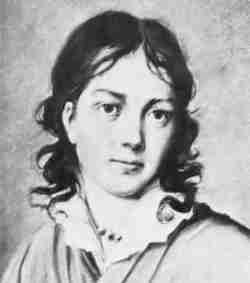
Bettina von Arnim (nee Elisabeth Catharina Ludovica Magdalena Brentano) was a German novelist, publisher, composer, singer, visual artist, and social activist. She was born on 4th April 1785 in Frankfurt, Germany and died on 20th January 1859 in Berlin, Germany aged 73.
Major Works
“Dies Buch gehört dem König” (This Book Belongs to the King) (1843)
“Ilius Pamphilius und die Ambrosia” (1848)
Biography
1785: Elisabeth Catharina Ludovica Magdalena Brentano, known to history as Bettina von Arnim was born on 4th April in Frankfurt am Main, Germany. Her father was an Italian merchant and her grandmother was the novelist Sophie von La Roche. Her elder brother was the poet Clemens Brentano.
1793: Her mother dies and she is sent to be educated at a convent school in Fritzlar.
1797: Her father dies and her half-brother Franz becomes her guardian although after a short while she moves to live with her grandmother Sophie von La Roche, in Offenbach am Main. Here she is allowed to use the extensive library and meets several literary and artistic people of the time in the house including Ludwig van Beethoven.
1801: She forms a friendship with Karoline von Günderrode after being introduced by her brother Clemens.
1806: Günderrode commits suicide by stabbing herself on the banks of the river Rhine after a failed passion for the philologist Georg Friedrich Creuzer and Bettina is distraught. Her brother suggests she seek solace in the works of Johann Wolfgang von Goethe and in particular his novel “Wilhelm Meisters Lehrjahre”. She begins a new friendship with Elisabeth Goethe, the mother of the poet.
1807: She meets Goethe in Weimar. She is 22 and he is 57 and her love for him is not requited although the two engage in a lasting correspondence. Her grandmother dies and Bettina then lives with a succession of other relatives including her sister Gunda and husband Friedrich von Savigny in Marburg. In April she travels with them dressed as a man in order to visit Goethe in Weimar. During the following months she helps her brother and Achim von Arnim find folksongs for their future work “Des Knaben Wunderhorn”.
1808: She studies singing, piano and composition in Munich.
1811: Her relationship with Goethe sours after a public argument with his wife. She marries Achim von Arnim in secret and the couple move to Berlin.
1812: She gives birth to her son Freimund and would go on to have six more children over the years.
1814: The family moves to an estate in Wiepersdorf.
1817: The couple arrange a mutual agreement for Achim to remain in Wiepersdorf whilst Bettina returns to Berlin.
1829: She meets Friedrich von Schlegel.
1831: Her husband Achim dies. She had put her literary career on hold during her marriage but begins to write again.
1835: She publishes “Goethes Briefwechsel mit einem Kinde” (Goethe’s Correspondence with a Child) supposedly based on correspondence between them complete with tales from his mother. Goethe was reported to have used her notes when writing his autobiography, “Dichtung und Wahrheit”.
1838: She pleads on behalf of Jacob Grimm and Wilhelm Grimm when they are dismissed by the University of Gottingen as part of the “Gottingen Seven”.
1840: She writes “Die Günderode” based on her conversations with Karoline von Günderode and discusses their Schwebereligion (floating religion).
1842: Her brother Clemens Brentano dies. Bettina meets Karl Marx.
1843: She publishes “Dies Buch gehört dem König” (This Book Belongs to the King) as the declaration of her political principles.
1844: She interviews many poor working families living in Silesia and publishes them under the title of “Armenbuch” (Book of the Poor). She also publishes “Clemens Brentanos Frühlingskranz” (Clemens Brentano’s Spring Wreath).
1846: She starts a lengthy dispute with the Berlin Magistrate to defend her actions in publishing Achim von Arnim’s and her own works privately and refuses to pay for citizenship.
1847: She writes on behalf of Ludwig von Mieroslawski who has been sentenced to death for his involvement in Poland’s independence struggle.
1849: She pleads against the death sentence for the former Storkow Mayor who had attempted to assassinate the King in 1844 and also tries to persuade the King to acquit the theologian Gottfried Kinkel, who is sentenced to life imprisonment for participation in the 1848 Revolution.
1852: She writes “Gespräche mit Dämonen” (Conversations with Demons) in which she stands up for the abolition of the death penalty and for the political equality of women and Jews.
Bettina von Arnim suffered a stroke from which she never finally recovered and died on 20th January 1859 in Berlin. She was buried next to her husband at the Schlosskirche, Wiepersdorf in Brandenburg, Germany.
Influences
Bettina von Arnim is one of the best-known female German writers of the nineteenth century and has been credited with initiating a distinctive tradition of women’s writing in that country. She grew up in a literary household where she met many famous names at her grandmother’s events and her brother Clemens introduced her to the works of the Romantische Schule (Early Romanticism). She read the novels of Ludwig Tieck and was quoting the poet Novalis from an early age. She met Friedrich Schleiermacher and became friends and was an acquaintance of Johan Wolfgang von Goethe, Jacob and Wilhelm Grimm, Ludwig van Beethoven and even Karl Marx. There is a theory that she might even have been the famous “Immortal Beloved” whom Beethoven wrote about in a letter. At salons she also met famous musicians, and politicians and heard about revolutionary ideas about women’s education, art, and politics.
Although seldom credited, she helped her brother Clemens and Achim von Arnim collect the folk songs for “Des Knaben Wunderhorn” between 1805 and 1808. In 1811 she married Achim and they settled in Berlin but it was only after his death in 1831 that she began her own career as a writer providing important contributions to the development of nineteenth-century literature and political theory. She was a social activist who advocated for the alleviation of poverty and the abolition of the death penalty. She originated a unique literary style developing the concept of female genius. She also stated the theory that the state is responsible for criminal behaviour in its citizens. Her critiques of established religion were influential among the Young Hegelians.
Her “Goethe’s Correspondence with a Child” in 1835 is her most work famous loosely based on her correspondence with Goethe and his mother between 1807 and 1811. It was harshly criticised for being unfaithful to their correspondence and she was criticised as a woman hungry for fame. Even as late as 1988 Milan Kundera’s novel “Immortality” depicts her as a scheming woman looking for a place in posterity. The book gives her ideas about language, music, love and female genius and shows how an individual becomes who she is and learns about herself through interactions with others. “Günderode”, her second work published in 1840 describes symphilosophy (i.e., doing philosophy together) and Bildung (cultivation or self-development) and this was later an influence on American Transcendentalism. The most widely-read of her political works, “This Book Belongs to the King” published in 1843 calls for the alleviation of poverty and the full emancipation of Jews.
By the 1850’s however, she was out of favour with the King of Prussia and her works began to be less influential even though her idea of the Volkskönig, or “People’s King as an ideal system of government eventually led Marx to identify capital as the mechanism for the subjugation of the working class. It is surprising that in light of the recognition of her work by the Young Hegelians and her association with the Silesian Weavers’ uprising of 1844 that her political writings are rarely considered as part of the development of Communism. Her friendship with Schleiermacher can be seen in some aspects of his book “Schwebereligion”.
Her unfinished notes were published as “Das Armenbuch” (The Poor Book) in 1962 but by and large she has been neglected by mainstream philosophy.
Further Information
List of works by Arnim.