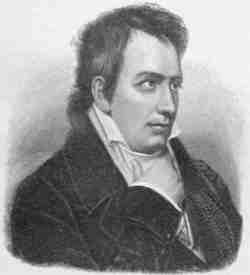
Ludwig Tieck was a German poet, fiction writer, translator, and critic. He was one of the founding fathers of the Romantic movement in the late 18th and early 19th centuries in Germany. He was born in Berlin, Germany on 31st May 1773 and died there on 28th April 1853 aged 79.
Major Works
“Die Geschichte des Herrn William Lovell” (1795)
“Volksmärchen von Peter Lebrecht” (1797)
“Dichterleben” (A Poet’s Life) (1826)
“Vittoria Accorombona” (The Roman Matron) (1840)
Biography Timeline
1773: Ludwig Tieck was born on 31st May in Berlin, Germany. His father was a craftsman and Ludwig was educated at the Berlin Gymnasium School where he learns Greek, Latin and Italian.
1775: His sister the poet Sophie Tieck is born.
1792: He leaves school and attends the Universities of Halle, Gottingen and Erlangen. He meets up with his school friend Wilhelm Heinrich Wackenroder in Gottingen and they both study literature together.
1794: He returns to Berlin and attempts to make a living by writing.
1795: He writes the novel “Die Geschichte des Herrn William Lovell” (The History of Mr William Lovell) in three volumes which concerns the self-destruction of a sensitive young intellectual. He also begins to contribute a number of short stories to the Straussfedern series published by a local bookseller.
1796: He writes the novel “Abdallah”.
1797: Tieck’s move more towards Romanticism is reflected in the series of plays and stories published under the title “Volksmärchen von Peter Lebrecht” (Folk Tales by Peter Lebrecht) which includes the supernatural “Der Blonde Eckbert”, “Ritter Blaubart” (Bluebeard) and the satire on Berlin literary life “Der Gestiefelte Kater” (Puss in Boots). “Der Blonde Eckbert” is particularly praised by the writers August von Schlegel and his brother Friedrich von Schlegel. He plans the novel “Franz Sternbalds Wanderungen” (Franz Sternbalds Wanderings) with Wackenroder and the five-act play “Karl von Berneck” set in the Middle Ages.
1798: His novel “Franz Sternbalds Wanderungen” about artistic life in the Middle Ages is published. He gets married.
1799: Tieck and his new bride settle in Jena, Germany where he meets regularly with August and Friedrich von Schlegel and the poet Novalis. He publishes a translation of Shakespeare’s “The Tempest” and starts translating Cervante’s “Don Quixote”. He publishes the satirical drama “Prinz Zerbino” and begins “Romantische Dichtungen” which includes the dramatic poem “Leben und Tod der Heiligen Genoveva, Leben und Tod des Kleinen Rotkäppchens”. (The Life and Death of the Holy Genevieve).
1801: He moves to Dresden and then lives for a while at Ziebingen near Frankfurt as well as spending some months in Italy.
1803: He publishes a translation of “Minnelieder aus der Schwäbischen Vorzeit” (Love Songs from the Schwabing Age).
1804: He publishes the comedy in two parts “Kaiser Oktavianus” set in the Middle Ages.
1811: He produces two volumes of Elizabethan dramas entitles “Altenglisches Theater” (Old English Theatre).
1812: He begins collecting his earlier stories and dramas under the title “Phantasus” which includes the stories. “Der Runenberg”, “Die Elfen”, “Der Pokal” and “Fortunat”.
1817: He visits England to collect material for his Shakespeare studies.
1819: He settles permanently in Dresden and establishes a reputation as a fine reader of the dramatic poets.
1822: He begins to publish more short stories including “Die Gemälde” (The Paintings), “Die Reisenden” (The Travellers), “Die Verlobung” (The Betrothal) and “Des Lebens Überfluss”. (Life’s Abundance).
1824: He publishes the short novel “The Country Society”.
1825: He begins work as a literary adviser and critic at the court theatre in Dresden. He translates “The Pictures” and “The Betrothal” by Bishop Thirlwall.
1826: He publishes “Dichterleben” (A Poet’s Life) about the early years of William Shakespeare and begins work on the unfinished novel “Der Aufruhr in den Cevennen” (The Rebellion in the Cevennes).
1827: Thomas Carlyle translates “The Fair-haired Eckbert” and other stories by Tieck into English in his book “German Romance”.
1834: He publishes “Der Tod des Dichters” (Death of a Poet).
1836: He finally completes work on “Der Junge Tischlermeister” (The Young Mastercarpenter).
1840: He publishes the novel “Vittoria Accorombona” (The Roman Matron) which includes references to his idol the Italian poet Torquato Tasso.
1841: He edits the translation of Shakespeare by August Wilhelm Schlegel which was produced with the help of his daughter Dorothea Tieck.
1842: Friedrich Wilhelm the Fourth of Prussia invites him to Berlin where he is given a pension for the rest of his life and becomes a major literary figure.
1845: A translation of “Vittoria Accorombona” is published in English.
1848: He publishes “Kritische Schriften”.
Ludwig Tieck died in Berlin on 28th April 1853. He was buried with full honours in the Dreifaltigkeitsfriedhof II cemetery in Berlin-Kreuzberg.
Influences
Ludwig Tieck was one of the early proponents of German Romanticism. His literary collection “Volksmärchen von Peter Lebrecht” of 1797 marks his transition to Romanticism, especially in one of the stories “Der Blonde Eckbert” which explores paranoia and the supernatural. In 1798 he and his school friend Wilhelm Heinrich Wackenroder planned the novel “Franz Sternbalds Wanderungen” which showed for the first time an enthusiasm for old German art amongst the Romantics. He settled in Jena in Germany the same year and became widely influenced by the writer Johann Wolfgang von Goethe, the brothers August and Friedrich Schlegel and the poet Novalis who all lived there. His exploration of old German folktales inspired other writers such as E.T.A. Hoffmann and Theodor Storm to explore similar ideas and helped embed Romantic themes into German literature.
Several satirical plays and dramatic poems followed which showed the influence of the seventeenth century Spanish poet and dramatist Pedro Calderón de la Barca. Tieck always had a great love for the works of William Shakespeare and in 1817 he travelled to England to collect material for a work on the Bard but it never got completed. He did, however, translate many of Shakespeare’s plays and was responsible for bringing them to a German audience for the first time. His translations of the work of Miguel de Cervantes also increased his popularity in Germany.
In 1822 a new series of short stories which included “Die Gemälde” and “Die Reisenden” proved very popular and in 1825 he was appointed literary adviser to the Court Theatre in Dresden and became the greatest living literary authority in Germany after Goethe. He gave many public readings from dramatic poets which helped broaden his fame throughout the country.
He was always open to adapting to new ideas but his influence on poetry is based solely on his earliest works. After that he was seen as an adviser or mentor to others. Many of his later novels were thinly veiled attacks on the “Young Germany” movement which was attempting to establish a democratic national German theatre although much of his work embodies Romanticism with its emphasis on emotion, individuality and being one with nature and rejected the ideals of the Enlightenment.
Tieck’s “Phantasus” helped inspire parts of Richard Wagner’s 1845 opera “Tannhauser” and another German composer Wilhelmine Schwertzell used some of his poems in her work and helped Wilhelm Grimm collect fairy tales.
Between the 1820’s and the 1850’s there was considerable interest in his work in England and the United states of America which tailed off after his death in both countries partially due to the rise of Realism. Thomas Carlyle in England translated some of his works and in America men such as George Bancroft and George Ticknor were enthusiasts. Ticknor travelled to Dresden in 1835 to meet him. A lot of Americans were primarily interested in his works on Shakespeare. Major American authors who were influenced by him were Washington Irving, Henry Wadsworth Longfellow and Nathaniel Hawthorne. Irving had actually met the German and admired his early tales. An anti-romantic trend began to develop from 1854 onwards in periodicals such as the “Athenaeum”, the “British Quarterly Review” and the American “The Atlantic Monthly”. Other American writers who had a passing interest in his work were Ralph Waldo Emerson, Henry Thoreau and Edgar Allan Poe whose “Fall of the House of Usher” shows a similar fantastic atmosphere.
Tieck, like many other German Romantics, disliked America for its philistinism and lack of an intellectual tradition at the time although Americans did not hold that against him and in the twentieth century there was an upsurge in academic interest in his works. Some critics have pointed to Tieck as a precursor of existentialist theatre and the Theatre of the Absurd of Thornton Wilder and Eugène Ionesco and point to his 1797 play “Puss-in-Boots” which took over a century to be picked up by Luigi Pirandello as ideas for his anti-theatre.
Further Information
List of works by Tieck.