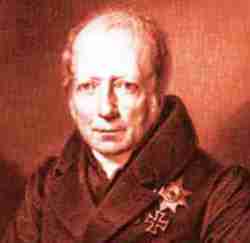
Friedrich Wilhelm Christian Karl Ferdinand von Humboldt was a Prussian philosopher, linguist, diplomat and government official and founder of the Humboldt University of Berlin. He was born on 22nd June 1767 in Potsdam in Germany and died on 8th April 1835 in Tegel, Berlin, Germany aged 67.
Major Works
“Ideen zu einem Versuch die Grenzen der Wirksamkeit des Staats zu Bestimmen” (The Spheres and Duties of Government) (1792)“The Aesthetische Versuche” (Essays on Aesthetics) (1799)
“Prüfung der Untersuchungen über die Urbewohner Hispaniens” (On the Early Inhabitants of Spain) (1821)
“The Heterogeneity of Language and its Influence on the Intellectual Development of Mankind” (1836)
“The Limits of State Action” (1850)
Biography Timeline
1767: Friedrich Wilhelm Christian Karl Ferdinand von Humboldt was born on 22nd June in Potsdam, Germany. His father was Alexander Georg von Humboldt a Major in the Prussian army from a noble family in Pomerania. After service in the Seven Years War he became Royal Chamberlain. Friedrich was educated at home with his brother Alexander. He later studied at the University of Jena where he met many of the German Romantics and became a lifelong friend of Friedrich von Schiller. (His correspondence with the poet was published in 1830).
1779: His father dies.
1791: In June he marries Caroline von Dacheröden and they go on to have eight children of which five survive into adulthood. He begins writing “The Limits of State Action” which he finishes in the following year but which is not published until 1850 after his death. In it he defends the liberties of the enlightenment.
1792: The section of “The Limits of State Action” dealing with education is published in December in the “Berlinische Monatsschrift” journal under the title “On Public State Education”. He becomes a major figure in the philosophical debate about the direction that national education should take which is at its height in Germany at the time. He publishes “Ideen zu einem Versuch die Grenzen der Wirksamkeit des Staats zu Bestimmen” (The Spheres and Duties of Government).
1799: He publishes “The Aesthetische Versuche” (Essays on Aesthetics).
1801: He is sent to Rome as Plenipotentiary Minister (one with full powers to sign contracts) on behalf of the Prussian Government where he becomes a patron of the arts and sciences and Caroline his wife holds many dinners and gatherings for local intellectuals.
1809: The Prussian King asks him to leave Rome to lead the Directorate of Education under Friedrich Ferdinand Alexander zu Dohna-Schlobitten. He does not reply for weeks as he wanted to become Minister of Education himself but eventually accedes. His wife does not return to Prussia with him. He is responsible for religious affairs and public education and founds the Friedrich Wilhelm University in Berlin (later renamed Humboldt University).
1810: He offers his resignation in April as he feels disappointed in not becoming the main Minister and is appointed to the Embassy in Vienna where he meets up with his wife once more.
1812: He becomes Ambassador to Austria.
1813: He is present at the Congress of Prague where he helps in getting Austria to ally with Prussia and Russia against Napoleon Bonaparte.
1815: He is one of the signatories at the Treaty of Paris at the end of the Napoleonic wars.
1817: He studies the Basque language and makes corrections and additions to “Mithradates” by Johann Christoph Adelung.
1818: He is present at the Congress of Aachen.
1819: He gives up working for the Prussian government, which he feels is becoming too reactionary, and dedicates himself to literature and study. He translates poems by the ancient Greek poets Pindar and Aeschylus into German.
1820: He is elected a member of the American Antiquarian Society.
1821: His two previous visits to the Basque region of Spain culminate in his work “Prüfung der Untersuchungen über die Urbewohner Hispaniens” (Researches into the Early Inhabitants of Spain by the help of the Basque language). He maintains that the Basques once inhabited all of Spain and some of France and that they were allies of the Berbers in north Africa.
1822: He is made a Foreign Honorary Member of the American Academy of Arts and Sciences.
1828: He publishes “Über den Dualis” (On the Dual) and becomes one of the precursors of the study of the metaphysics of language.
Friedrich Wilhelm Christian Karl Ferdinand von Humboldt died on 8th April 1835 in Tegel, Berlin, Germany and was buried in the family plot at Schloss Tegel (Also known as Humboldtschloss) Tegel, Reinickendorfin Berlin.
His life’s work, a study of the ancient Kawi language of Java, remained unfinished and was published by his brother Alexander in 1836 as “The Heterogeneity of Language and its Influence on the Intellectual Development of Mankind”. The introduction entitled Über die Verschiedenheit des Menschlichen Sprachbaues: und ihren Einfluss auf die Geistige Entwickelung des Menschengeschlechts” (On Language: The Diversity of Human Language-Structure and Its Influence on the Mental Development of Mankind) discusses language in the formation of human development. His poems and essays were published in 1852 and his correspondence with Goethe in 1876.
Influences
Friedrich Wilhelm von Humboldt was educated at home by various tutors and never finished his university studies at the universities of Frankfort (Oder) or Göttingen where he went to study philosophy, history and ancient languages at the Georg August University.
His father Alexander Georg became Chamberlain to Frederick William the Second from 1765 after being injured in the army. His mother the previously widowed Marie-Elisabeth von Holwede, had married his father the previous year.
After losing his job due to the divorce of the Prince his father takes the family to his estate at Tegel. The young lad had a close relationship with his brother Alexander and was inspired by his love of nature and the environment. From 1777 he learned several foreign languages and was fluent in Latin, French and Ancient Greek by the age of thirteen. Most of his education was based on Enlightenment principles, classical antiquity and German idealism, in particular Kantian critical philosophy, which was common at the time.
After university he travelled to Paris, Spain and Weimar, where he met Johann Wolfgang von Goethe and later Friedrich von Schiller whom he met at the University of Jena. He became great and lifelong friends with Schiller who influenced his aesthetic and humanistic views.
From there he joined the civil service having gained a reputation as a literary scholar and his first professional post was as Prussian envoy in Rome in 1803. Whilst in Rome he was a generous patron of the arts and sciences. His career would later take him to London and Vienna giving him a wide experience of European politics.
From 1809 back in Berlin he became Privy State Councillor and Director of the Section for Culture and Education in the Ministry of the Interior where he began to be involved in the reform of the Prussian education system where his mantra was self-education. He famously said “strictly speaking, you can’t educate anyone, you can only create the conditions for them to do it themselves”. Ever one for self-education himself he corresponded with intellectual figures such as Johann Gottlieb Fichte and Friedrich Schleiermacher. His study of Basque and Native American languages was helped by the Jesuit priest Lorenzo Hervás and transformed his philosophy of language. One of his most important acts was the founding the Friedrich Wilhelm University in Berlin (later named the Humboldt University) which became an early example of a research university.
He also reformed elementary education by improving the standards for teacher training and certification and standardised state examinations for all and created and designed curricula, textbooks and learning aids. All this effectively put Prussia on the map of the best education system in Europe. He felt that a good education was essential to the economic well-being of the state. Up to this point schools were typically under the jurisdiction of a town, patron or the church and quite haphazard. Despite this work he was unhappy with his subordinate role in the ministry under Friedrich Ferdinand Alexander zu Dohna-Schlobitten and resigned in 1810 only to be made ambassador to Vienna shortly afterwards where he met up once more with his wife.
In 1813 at the Congress of Prague he was instrumental in Austria joining forces with Russia and Prussia against Napoleon Bonaparte of France. In 1815 he was a signatory to the Treasty of Paris which ended the Napoleonic Wars and later attended the Congress of Aachen in 1818.
In 1819 he had become disillusioned with the reactionary nature of Prussian politics and devoted himself from then on to literature and study. His work as a philologist in the Basque region of Spain has had perhaps the biggest impact of all. His two visits there resulted in his book “Researches into the Early Inhabitants of Spain by the Help of the Basque Language” published in 1821. By examining place names he realised how extensive the Basque people were in Spain and in southern France.
He died while preparing his greatest work, on the ancient Kawi language of Java, but its introduction “The Heterogeneity of Language and its Influence on the Intellectual Development of Mankind” was published in 1836 completed by his brother Alexander and J. Buschmann. His view was the character and structure of a language expresses the inner life and knowledge of its speakers, and therefore languages must differ from one another in the same way as those who use them and that they were dynamic, ongoing and full of creative activity (energeia). His idea of Weltanschauung was expressed as the diversity of languages is not a diversity of signs and sounds, but a diversity of views of the world. His other language writings on a dozen tongues, poems and essays were published by his brother with the help of his daughter Gabriele in seven volumes from 1841 onwards.
Though little remembered today outside of Germany he was a major influence on the British philosopher John Stuart Mill particularly with his views about liberty directly impacting Mill’s famous work “On Liberty.” He has also influenced educational systems across the United States and Japan, and the development of modern linguistics and ethnolinguistics. Noam Chomsky frequently quotes Humboldt’s description of language as a rule-governed system meaning that an infinite number of sentences can be created using a finite number of grammatical rules. By contrast the Humboldt scholar Tilman Borsche has stated there are profound differences between von Humboldt’s view of language and Chomsky’s. More recently he has been credited as an originator of the linguistic relativity hypothesis (known as the Sapir-Whorf hypothesis) developed by the Americans Edward Sapir and Benjamin Whorf.
Further Information
List of works by Humboldt.