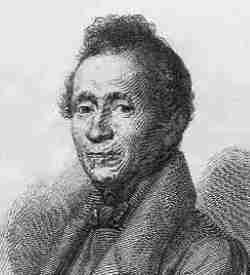
Joseph von Eichendorff was a German poet, novelist, playwright, anthologist, critic and translator. He was born in Lubowice, Poland on 10th March 1788 and died in Nysa, Poland on 26th November 1857 aged 69.
Major Works
“Novellen des Marmorbild”s (Novellas of a Marble Statue) (1819)
“Aus dem Leben eines Taugenichts” (Memoirs of a Good for Nothing) (1826)
“Gedichte von Joseph Freiherrn von Eichendorff” (1837)
“Robert und Guiscard” (1855)
Biography Timeline
1788: Joseph Karl Benedikt Freiherr von Eichendorff was born on 10th March in Lubowitz Castle near Ratibor, Prussia, Germany. (Now Raciborz, Poland). His father was Adolf Freiherr von Eichendorff an officer in the Prussian army and from a noble family. His mother was Karoline née von Kloche. Both he and his older brother Wilhelm were educated at home by their tutor Bernhard Heinke until 1801.
1798: He begins writing his diary which he continues for most of his life.
1801: He writes in his diary that on 19th June that his father travels to Breslau to escape from his creditors. Both brothers attend the Catholic Matthias Gymnasium in Breslau.
1804: His sister Luise Antonie Nepomucene Johanna is born. After their exams, both brothers attend lectures at the University of Breslau.
1805: Both brothers study law in Halle an der Saale near Jena. They both attend the theatre in Lauchstadt where the Weimar Court company perform plays by Johann Wolfgang von Goethe. He and his brother go on a tour of the Harz mountains.
1806: In October the University at Halle closes due to the occupation by Napoleon Bonaparte’s troops.
1807: He and his brother go to Heidelberg to complete their law studies at the university. He publishes his first poetry and meets Achim von Arnim. He falls in love with Katchen Forster.
1808: Both brothers complete their degrees and then travel to Paris and Berlin. In Berlin they meet Adam Muller, Clemens Brentano and Heinrich von Kleist. He publishes some of his poems in Ast’s “Zeitschrift für Wissenschaft und Kunst”, under the pseudonym Florens.
1809: He continues his studies in Berlin. His parents hope he will marry a wealthy heiress to clear their debts but he falls in love with and gets engaged to Aloysia von Larisch (Luise) the seventeen-year-old daughter of an impoverished Catholic noble family.
1810: The brothers travel to Vienna and pass the state diploma examination. Wilhelm gets a post in the Austrian civil service, while Joseph goes home to help his father with manage the family estate.
1813: When the Prussian war of liberation begins, he aims to enlist in the Lützowsche Freikorps to fight Napoleon, however he doesn’t have enough money to purchase a uniform, arms, or horse, and when he does hostilities are all but over. He writes one of his most famous poems “Das Zerbochene Ringlein” (The Broken Ring) based on his feelings of unrequited love for the nineteen-year-old daughter of a cellar man.
1815: He works for the Prussian Civil Service in Danzig and Konigsberg, He marries Aloysia von Larisch in St. Vinzenz church in Breslau and they have a son called Hermann. He publishes the novel “Ahnung und Gegenwart”. (Notion and Presence).
1818: Death of his father.
1819: He writes the novels “Ahnung und Gegenwart” (Premonition and Present), which is full of despair at the political situation and the need for a spiritual cure, and “Novellen des Marmorbild”s (Novellas of a Marble Statue) which is a supernatural fairy tale. His daughter Therese is born.
1822: His mother dies meaning the final loss of the family’s estates in Silesia.
1823: He publishes the dramatic text “Krieg den Philistern! Dramatisches Märchen in Fünf Abenteuern” (War on the Philistines! A Dramatic Fairytale in Five Adventures).
1826: He publishes “Aus dem Leben eines Taugenichts” (Memoirs of a Good-for-Nothing) which is often seen as a high point of Romantic fiction and concerns wanderlust and love where the son of a miller becomes a gardener at a Viennese palace and falls in love with a duke’s daughter.
1827: He publishes the dramatic text “Meierbeth’s Glück und Ende” (Meierbeth’s Fortune and Downfall”).
1828: He publishes the dramatic text “Ezelin von Romano“.
1830: He publishes the dramatic text “Der letzte Held von Marienburg“, (The Last Hero of Marienburg).
1831: He works for the Civil Service in Berlin.
1833: He publishes the novella “Viel Lärmen um Nichts” (Much ado about Nothing) and the dramatic text “Die Freier“, (The Suitors) .
1834: He publishes the novel “Dichter und ihre Gesellen” (Poets and Their Companions).
1837: He publishes the novella “Das Schloss Dürande” (Castle Dürande) set in the time of the French Revolution. He writes the poems “Gedichte von Joseph Freiherrn von Eichendorff” which become very popular and some are later to be set to music by Robert Schumann and Felix Mendelssohn.
1839: He publishes “Die Entführung” (the Abductio) in “Urania, Taschenbuch für das Jahr”.
1844: He retires from the civil service and devotes himself to writing. He works on a history of German literature and translates several Spanish works.
1847: He publishes “Über die Ethische und Religiöse Bedeutung der Neuen Romantischen Poesie in Deutschland (On the Ethical and Religious Significance of the New romantic Poetry in Germany).
1849: His brother Wilhelm dies in Innsbruck, Austria.
1851: He publishes “Der deutsche Roman des 18. Jahrhunderts in Seinem Verhältniss zum Christenthum” (The German Novel of the 18th century in its Relationship to Christianity).
1853: He publishes “Julian“, a story in verses.
1855: He writes the epic poems “Robert und Guiscard” and “Lucius“. His wife Aloysia dies causing him much distress.
1857: He publishes “Geschichte der Poetischen Literatur Deutschlands” (History of German Poetry).
Joseph Freiherr von Eichendorff died on 26th November 1857, in Neisse (now Nysa, Poland). He was buried in the Jerusalemer Friedhof, (Jerusalem Cemetery) Nysa, Opolskie, Poland next to his wife.
Influences
Joseph von Eichendorff was born into a family of Silesian nobility and had an idyllic childhood at Lubowitz Castle and formed a deep love for the German landscape. He then went on to study law at Heidelberg University in 1807. He published his first verse there and became acquainted with other Romantics such as Achim von Arnim and Clemens Brentano the joint authors of “Des Knaben Wunderhorn” (The Boy’s Magic Horn). As a youth he was a frequent visitor to the theatre and was also influenced by the poetry of Matthias Claudiuss and the works of Voltaire, in particular his 1723 epic poem “La Henriade” about the French King Henri the Fourth.
Brought up as a Catholic he was inspired by Joseph Görres, a leader in German Catholicism to continue in his faith and also participate in the resistance against Napoleon Bonaparte. During his studies in Berlin from 1809 onwards he met other leaders of the Romantic national movement and another major influence was the writer Friedrich von Schlegel. When the Prussian war of liberation broke out in 1813, he enlisted in the Lützowsche Freikorps and fought against Napoleon. The decline of the family’s estate during the Napoleonic Wars brought about a sense of nostalgia and longing into his writings.
He shared Schlegel’s view that the world was a naturally and eternally “self-forming artwork” and described nature as a “great picture book, which the good Lord has pitched for us outside.” Arnim’s and Brentano’s studies and interpretations of (folk song) also deeply influenced his own poetry. During the wars he wrote two of his most important prose works. The long Romantic novel “Ahnung und Gegenwart” (Premonition and Present), which shows a hopelessness and despair at the political situation and “Novellen des Marmorbilds” (Novellas of a Marble Statue), which he described as a fairy tale.
He normally published his poems first as integral parts of his novellas and stories, where they are frequently performed in song by one of the characters. His most famous novella “Aus dem Leben eines Taugenichts” (Good for Nothing) of 1826 for example contains fifty-four poems. He believed “the divining rod of poetry will lead the reader to the spiritual source that unites man and nature with God”. This novella is often considered a high point of Romantic fiction and Thomas Mann called it a “combination of the purity of the folk song and the fairy tale”. Most of his works often explore themes of wanderlust, homesickness and joy and melancholy in the lives of ordinary people. He is known for his lyrical simplicity. After the war he held posts in the Prussian civil service in Danzig, Königsberg and Berlin. In 1844 he retired to devote himself entirely to his writing and published a history of German Literature.
Many of his poems were set to music by Robert Schumann, in his song cycle “Liedererkreis”, Op. 39 and Felix Mendelssohn who used poems like “Nachtlied”. Johannes Brahms, Hugo Wolf, and Richard Strauss, were all influenced by his nature and traveling imagery for their own vocal works. The English composer Ethel Smyth chose him as the poet for her own set of German Lieder. Later Bruno Walter and Erich Wolfgang Korngold drew inspiration from his atmospheric texts. The latter composed his “6 Simple Songs” between the ages of fourteen and sixteen. His poems also inspired orchestral music, such as Reger’s “Eine Romantischer Suite” in 1912.
His simple, direct verse style and folksong-like rhythm helped influence later Romantic writers and the Biedermeier literary movements. His exploration of the wanderlust and a spiritual connection to the German landscape resonated with hikers and environmentalists from his own time right up until today.
Further Information
List of works by Eichendorff.