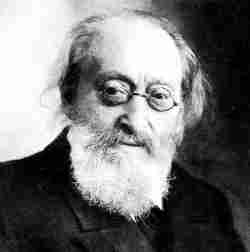
Max Bruch was a German Romantic composer, violinist, teacher, and conducter. He was born on 6th January 1838 in Cologne, Germany and died on 2nd October 1920 in Berlin, Germany aged 81.
Major Works
Violin Concerto No 1 (1866)
“Schön Ellen” (1867)
“Scottish Fantasy” (1880)
“Kol Nidrei (1881)
Biography
1838: Max Karl August Bruch was born on 6th January in Cologne, Germany. His father was August Carl Friedrich, a lawyer who became vice president of police in Cologne. His mother was Wilhelmine, nee Almenräder, a singer. He had one sister called Mathilde. He received early training from the composer Ferdinand Hiller and Bruch was taught French and English, amongst other things, by his father.
1847: He writes his first composition, a song for his mother’s birthday.
1849: He lives on a farm in Bergisch Gladbach which is owned by a man called Neissen who lives with his unmarried sister. Bruch has first music theory lesson is in Bonn from Professor Heinrich Carl Breidenstein who was a friend of his father’s.
1852: He writes a symphony at aged 14 and wins a scholarship which allows him to study in Cologne.
1858: His first opera, “Scherz, List und Rache” (Jest, Deceit, and Revenge) based on words by Johann Wolfgang von Goethe is first performed.
1859: He studies philosophy and art in Bonn.
1862: Bruch takes up a career as a teacher and conductor in Mannheim, Germany.
1865: He becomes the main conductor for orchestral and choral societies in Koblenz, Germany.
1866: One of his most famous works, the Violin Concerto No. 1 in G Minor is written.
1867: He conducts the orchestra in Sondershausen, Germany. Meanwhile he is still composing and completes a large-scale work for choir and orchestra “Schön Ellen” (Beautiful Ellen)
1870: He works in Berlin.
1872: He writes the oratorio “Odysseus”.
1873: He works privately on his own compositions in Bonn.
1878: He becomes a conductor in Berlin.
1880: He composes the “Scottish Fantasy” for violin and orchestra. He begins conducting the Liverpool Philharmonic Society for the next three seasons.
1881: He composes “Kol Nidrei” for cello and orchestra. Bruch marries the singer Clara Tuczek whom he had met on tour in Berlin in January. After the wedding the couple live in Sefton Park in Liverpool.
1882: Their daughter, Margaretha, is born in Liverpool.
1883: He conducts in Breslau until 1890. (now Wrocław in Poland).
1884: Their first son, Max Felix is born on 31st May in Breslau.
1890: He is appointed a professor at the Berlin Academy of Arts and teaches composition at the Berlin Hochschule fur Musik.
1911: He retires from the Berlin Höchschule.
1919: Death of his wife Clara on 26th August.
Max Bruch died in his home on 2nd October 1920 in Freidenau, Berlin Germany. He was buried next to his wife in the old St Matthaus churchyard at Schoneberg, Berlin.
Influences
Max Bruch’s music was primarily influenced by the German Romantic tradition of Felix Mendelssohn and Robert Schumann rather than the new progressive style as represented by Richard Wagner and Franz Liszt. He studied composition under the composer and conductor Ferdinand Hiller and at fourteen won the Frankfurt Mozart Foundation prize to study with Carl Reinecke and Ferdinand Breunung. All of these teachers emphasised formal structure, melodic balance and counterpoint and Bruch himself favoured absolute music.
His most famous work is his Violin Concerto No. 1 in G minor, Op. 26, composed in 1866. It remains to this day a major part of the standard Romantic violin repertoire but sadly he was naive at the time of composition and sold it to a publisher for a flat fee. So, his greatest success never generated any royalties for the rest of his life.
In 1858 he was sent on five years of travel to complete his musical education. The city of Leipzig, was dominated by the works of Mendelssohn and it is no surprise that his aforementioned violin concerto shows Mendelssohn’s influence, borrowing as it does from the maestro’s earlier concerto, including linking the movements together and skipping a major orchestral introduction. He was also indebted to the views of violin virtuosos in his compositions, in particular the legendary Hungarian violinist Joseph Joachim who helped him achieve the most effective technical sounds from the instrument. From Leipzig he travelled to Berlin where he met the conductor Hans von Bülow and Mannheim where his opera “Die Loreley” was staged in June 1863 and heard by Clara Schumann and Anton Rubinstein. All of them encouraged the young composer to continue.
He was also influenced by folk music which he believed should be a core inspiration for creating new works. During his work with the Liverpool Philharmonic Society between 1880 and 1883 he became acquainted with the traditional music of Scotland, Wales, and Ireland resulting in works like the “Scottish Fantasy” which was also inspired by the novels of Sir Walter Scott. “Das Feuerkreuz” (The Fire Cross) was also based on a Scott novel “The Lady of the Lake”. “Das Lied von der Glocke” (The Song of the Bell), is set to a text by Friedrich Schiller. His piece” “Kol Nidrei” for cello and orchestra is based on traditional Hebrew melodies. It is interesting that although he wasn’t Jewish the Nazi’s refused to play his music during the Third Reich as it was seen as Jewish inspired.
He fiercely resisted the “New German School” of Wagner and Liszt, who championed programmatic symphonic poems and the expansion of traditional harmony. He even went as far as dismissing conductors who played their music as “podium peacocks”. Although he would write over two hundred works in his 82 years and despite the fact that he was still alive when Gustav Mahler wrote his symphonies and heard Stravinsky’s “Rite of Spring” his music doggedly kept to the old forms.
During his lifetime he was renowned for his large-scale oratorios, most of them inspired by his strong nationalistic views being an avid supporter of the unification of Germany. The proliferation of choirs in Germany at that point helped his reputation enormously Unfortunately for him, he lived in the shadow of Johannes Brahms most of his mature life. He credited Brahms with far more originality than himself and interviewed in 1911 he predicted that “as time goes on Brahms will be more appreciated, while most of my works will be more and more neglected. Fifty years from hence he will loom up as one of the supremely great composers of all time, while I will be remembered chiefly for having written my G minor violin concerto”. Despite all this gloom he dedicated his First Symphony to Brahms which is Schumannesque in style.
Bruch was also a successful conductor and his concert programming covered all of the Schumann and Beethoven symphonies along with works by Hector Berlioz, Mendelssohn, Schubert, Mozart, Spohr, and some of his own music. Inevitably performances of his works began to disappear during his later years as his music was seen more and more to be old-fashioned and he became very bitter as he grew older. He was replaced by the more passionate styles of Pyotr Tchaikovsky, Gustav Mahler, Richard Wagner and Anton Bruckner.
From 1890 until he retired in 1911, he was professor of composition at the Berlin Music Academy with later composers such as Ralph Vaughan Williams and Ottorino Respighi notable among his pupils. Vaughan Williams is particularly indebted to him for his use of orchestration and melody. His interest in traditional and religious folk melodies as seen in “Kol Nidrei” is widely believed to have inspired Ernest Bloch’s Jewish-themed cello masterpiece, “Schelomo”. His insistence on emotional directness and instrumental craftsmanship also set a lasting high standard for later string players.
Further Information
List of compositions by Bruch.