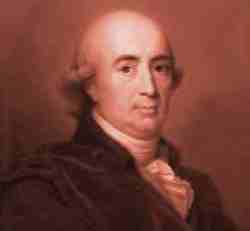
Johann Gottfried Herder was a German philosopher, theologian, poet, and literary critic. He was born on 25th August 1744 in Morag in Poland and died on 18th December 1803 in Weimar Germany aged 59.
Major Works
“Meiner Reise im Jahr 1769” (Journal of My Voyage in the Year 1769) (1769).
“Abhandlung über den Ursprung der Sprache” (Essay on the Origin of Language) (1772)
“Stimmen der Voelker in ihren Liedern” (Voices of the People in Their Songs) (1773).
“Ideen zur Philosophie der Geschichte der Menschheit” (Outlines of a Philosophy of the History of Man) (1784–91).
“Metakritik zur Kritik der Reinen Vernunft” (Understanding and Experience: A Metacritique of the Critique of Pure Reason) (1799).
Biography Timeline
1744: Johann Gottfried von Herder was born on 25th August in Mohrungen in East Prussia, Germany (now Morag, Poland). His family were quite poor and he taught himself to read from his father’s Bible.
1762: At 17 years old he attends the University of Königsberg in Germany (now Kaliningrad, Poland) where he is a student of the Francophobe Johann Georg Hamann who has a mystical view of life and the philosopher Immanuel Kant.
1764: He qualifies as a clergyman and goes to Riga in Latvia to teach and also produces his first major works of literary criticism.
1768: He publishes “On Thomas Abbt’s Writings” where he states that “a human soul is an individual in the realm of minds”.
1769: He travels by ship to the French port of Nantes and then continues on to Paris. In his diary entry “Journal Meiner Reise im Jahre 1769” (Diary of My Travels in the Year 1769) he predicts that Western Europeans will reject Christianity and go into decline whereas the Slav nations will not reject it and become the dominant power in Europe.
1770: He travels to Strasbourg where he meets Johann Wolfgang von Goethe who is influenced by his literary criticism and develops his own style thereafter. This is often seen as the beginning of the “Sturm und Drang” (Storm and Stress) literary movement.
1771: He is given the post of head pastor and court preacher at Bückeburg by Count Wilhelm von Schaumburg-Lippe.
1772: He publishes “Treatise Concerning the Origin of Language” and asks Germans to speak German without the influence of French. He also works on his theory of aesthetics.
1773: On 2nd May he marries Maria Karoline Flachsland in Darmstadt. He writes an important essay on William Shakespeare and publishes “Auszug aus einem Briefwechsel über Ossian und die Lieder alter Völker” (Extract from a correspondence about Ossian and the Songs of Ancient Peoples) which also contains contributions from Goethe and Justus Moser. In it he writes “A poet is the creator of the nation around him, he gives them a world to see and has their souls in his hand to lead them to that world”. He also promotes his concept of Volk (People) and collects folk songs which are published in “Stimmen der Voelker in ihren Liedern” (Voices of the People in Their Songs). The poets Achim von Arnim and Clemens von Brentano will later use some of this work as samples for “Des Knaben Wunderhorn” (The Boy’s Magic Horn). He also publishes “Von Deutscher Art und Kunst, Einige Fliegende Blätter” (Of German Art and Culture: A Brief Paper).
1774: He publishes “This Too a Philosophy of History for the Formation of Humanity” where he champions the individuality of people. His son Gottfried is born in Buckeburg.
1776: His second son August is born in Buckeburg. With Goethe’s influence he is appointed General Superintendent at the Court of Weimar and moves to the city. He becomes more interested in Classicism when working on his unfinished work “Outline of a Philosophical History of Humanity”.
1778: He publishes “On the Cognition and Sensation of the Human Soul”. His third son Wilhelm Ludwig Ernst is born in Weimar.
1779: His fourth son Karl Emil Adelbert is born.
1781: His daughter Luise is born.
1783: His fifth son Emil Ernst Gottfried is born.
1787: He publishes “Gott: Einige Gespräche” (God: Some Conversations).
1790: His sixth son Rinaldo Gottfried is born.
1793: He publishes the essay “Briefe zur Beförderung der Humanitat” (Letters for the Advancement of Humanity).
1794: He publishes the essay “Von der der Gabe Sprachen am Ersten Christlichen Pfingstfest” (Of the Gift of Languages on the first Christian Pentecost) and begins his series “Christliche Schriften” (Christian Writings) completed in 1798.
1799: He publishes “Metakritik zur Kritik der Reinen Vernunft” (Understanding and Experience: A Metacritique of the Critique of Pure Reason) where he criticises Immanuel Kant’s lack of understanding about the roles of language in reason arguing that language is the organ of Reason in contradiction to Kantian dualism of intellect and sensitivity. By now he sees Kant, whose as a threat to his own historical view of the world. The fact that he endorses the French Revolution angers his colleagues at the University and also causes a split in his friendship with Goethe.
1800: He publishes “Einige Gespräche über Spinozas System” (Several Discourses on Spinoza’s System) where he combines the views of the rationalists Leibniz, Spinoza and Anthony, Ashley Cooper, 3rd Earl of Shaftesbury. In “Kalligone” he further criticises Kant’s theory of aesthetic judgment.
1801: He publishes “Adrastea“, a treatise on history, philosophy and aesthetics. He emphasis the didactic purpose of poetry contradicting his earlier views on the autonomy of a work.
1802: He is ennobled by Maximilian (the Fourth) Joseph, the Elector-Prince of Bavaria, which allows him to use von before his surname.
Johann Gottfried von Herder died on 18th December 1803 in Weimar, Germany. He was buried in the Herderkirche (Herder Church) in Weimar.
Influences
Johann Gottfried Herder attached major importance to the concept of nationality and of patriotism and stated “he that has lost his patriotic spirit has lost himself and the whole worlds about himself”. He was influenced by a wide range of writers including the philosophers Immanuel Kant (who was his academic advisor), Johann Georg Hamann, Gottfried Wilhelm Leibniz and Baruch Spinoza along with William Shakespeare, Albrecht Dürer and the critic Johann Joachim Wincklemann
He claimed that true German culture was only to be discovered through folk songs and dances and folk poetry created by the “Volk” or ordinary people. He also believed that sensation is the source and basis of all our concepts and that history should encompass the spiritual, psychological, and cultural areas of humanity which led to the idea of “Volk” which can also be seen as the communal spirit of a people. To develop this concept, he published many letters and collected folk songs. The latter were published in 1773 as “Stimmen der Völker in ihren Liedern” (Voices of the Peoples in Their Songs). The poets Achim von Arnim and Clemens Brentano later used this work as samples for “Des Knaben Wunderhorn” (The Boy’s Magic Horn).
His work at Weimar reached its peak in 1785-97 with “Zerstreute Blätter” (Sporadic Papers) and the unfinished “Ideen zur Philosophie der Geschichte der Menschheit” (Outlines of a Philosophy of the History of Man) from 1784–91.
He is most remembered as a theorist of the Sturm und Drang movement and as a major influence on the young Johann Wolfgang von Goethe where he attempted to show that nature and history obey a uniform system of laws but man with his freedom too often works against nature as his reasoning is immature.
Herder and Goethe had a difference of opinion over the effects of the French Revolution and he was always unable to cope with the realisation that the Goethe was the more famous man and so they parted ways. His widow began compiling an edition of his collected works in 1805 two years after his death which ran to forty-five volumes and was completed in 1820.
Other people influenced by Herder were Georg Wilhelm Friedrich Hegel, both of the Brothers Grimm, the poets Novalis and Samuel Taylor Coleridge and the philosophers Friedrich Wilhelm Joseph Schelling, Friedrich von Schlegel and Friedrich Wilhelm von Humboldt.
His contributions to the fields of language, culture, and history left a lasting impact on modern thought and influenced people such as Friedrich Nietzsche, John Stuart Mill, Isaiah Berlin and Ludwig Wittgenstein. In the United States the theologian and Baptist Pastor Walter Rauschenbusch and the anthropologist Franz Boas were similarly indebted.
Further Information
List of works by Herder.