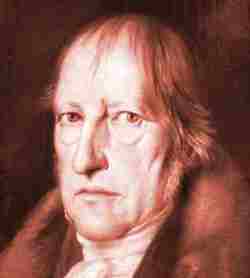
Georg Wilhelm Friedrich Hegel was an important German philosopher and is seen as one of the founding fathers of modern thought. He was born on 27th August 1770 in Stuttgart, Germany and died on 14th November 1831 in Berlin, Germany aged. He is one of the most founding figures in German idealism and one the most important influences on modern Western philosophy.
Major Works
“Phenomenology of Spirit” (1807) (sometimes known as “Phenomenology of Mind”)
“Science of Logic” (1812 and 1816)
“Encyclopedia of the Philosophical Sciences” (1817)
“Philosophy of Right” (1821)
Biography Timeline
1770: Georg Wilhelm Friedrich Hegel is born on 27th August, in Stuttgart, Germany. His father was Georg Ludwig Hegel a civil servant and his mother was Maria Magdalena Louisa Hegel (née Fromm).
1773: His sister, Christiane, is born in April. Hegel attends the Deutsche Schule.
1777: He enters the Stuttgart Gymnasium and studies classical history. He meets and becomes friends with Johann Holderlin.
1776: Birth of his brother Georg Ludwig in May.
1780: He takes the Landexamen.
1783: His mother dies of a fever on 20th September and Georg is also seriously ill.
1784: He goes up to the Obergymnasium.
1786: He writes “On Certain Differences between Ancient and Modern Poets”.
1788: He graduates from the Gymnasium in September.
1788: He begins a study of philosophy in October.
1790: He enrols in the Theological Faculty in the Stift where he later shares a room with Friedrich Schelling.
1792: Johann Gottlieb Fichte publishes “An Attempt at a Critique of All Revelation”.
1793: He writes an essay on “Folk Religion”. During the summer he visits Stuttgart and then sits his Konsistorialexam on 19th September. in October he becomes house tutor to K. F. son Steiger.
1795: He visits Geneva in May and writes “Life of Jesus and begins “The Positivity of the Christian Religion”.
1795: Friedrich Schelling publishes “On the Ego”.
1796: He goes on a long walking tour through the Bernese Alps in Switzerland and returns to Frankfurt in December.
1797: In January he works with Vogel a wine merchant. Friedrich Schelling publishes “Ideas for a Philosophy of Nature”.
1798: He translates and discusses Jean-Jacques Cart’s work which defends the freedoms of the Vaud against the Bernese aristocracy.
1798: He begins writing “The German Constitution” and completes“The Spirit of Christianity and its Fate”.
1799: His father dies in Stuttgart in January. Hegel now has enough money to contemplate going to university.
1800: He visits Mainz, in September then under French rule.
1801: In January he moves to Jena University.
1801: He publishes his first philosophical book “The Difference Between Fichte’s and Schelling’s Systems of Philosophy” and researches the orbits of the planets in the Solar System.
1802: He lectures on Natural Law and completes his German Constitution, which advocates a unified Germany under an Emperor. He also works with Friedrich Schelling editing the Critical Journal of Philosophy. He writes the “System of Ethical Life” often known as Realphilosophie One.
1803: He writes “The First Philosophy of Spirit” often known as Realphilosophie Two.
1805: He is appointed as an unpaid “extraordinary professor” in Jena.
1806: He lectures on the “Philosophy of the Human Spirit” and completes the “Phenomenology of Spirit”. Napoleon Bonaparte defeats the Prussians at the Battle of Jena–Auerstedt.
1807: Birth of his illegitimate son, Ludwig Fischer in February. In March he moves to Bamberg to become the editor of the Bamberger Zeitung newspaper. The “Phenomenology of Spirit” is published in April.
1808: He writes “Who Thinks Abstractly?” In November he is appointed Rector of the Gymnasium in Nuremberg.
1811: He marries Marie von Tucher in September.
1812: The first volume of the “Science of Logic” is published.
1813: His son Karl is born. The second volume of the“Science of Logic” published.
1814: Birth of his son Immanuel.
1816: The third volume of the “Science of Logic” is published and Hegel moves to become a professor at the University of Heidelberg.
1817: He publishes the “Encyclopedia of the Philosophical Sciences” and becomes joint editor of the Heidelberger Jahrbücher. He gives his first Lectures on Aesthetics.
1818: He moves to Berlin on 5th October and becomes a member of the Gesetzlose Gesellschaft.
1818: He passes over the guardianship of his sister, Christiane to his cousin in June.
1820: The “Philosophy of Right” is published in October.
1821: He moves to Dresden where he is dean of the philosophical faculty for a one-year. He gives his first Lectures on the Philosophy of Religion.
1822: Hallesche A. L. Zeitung publishes an attack on Hegel after they take exception to his preface to Hinrichs’s book on the philosophy of religion. Hegel fails to get the government to side with him in the dispute. He gives his first lectures on Philosophy of History and on the History of Philosophy. In October he visits the Netherlands.
1824: He visits Vienna and Prague and in November he writes to the Prussian police to intercede for Victor Cousin.
1826: He writes “On a Complaint on Account of a Public Slander of the Catholic Religion” and sends “Über die Bekehrten” (On the Converted) to the Berliner Schnellpost. In July he founds the Jahrbücher für Wissenschaftliche Kritik. He produces a new edition of the Encyclopedia of the Philosophical Sciences.
1827: He visits Johann von Goethe in Weimar. He publishes “On the Episode of the Mahabharata Known as the Bhagavad-Gita by Wilhelm von Humboldt” in the Jahrbücher für Wissenschaftliche Kritik.
1829: He is elected rector of the university. In September he visits the spa town of Karlsbad where he accidentally meets Friedrich Schelling and on his return he visits Goethe for a second time.
1830: He publishes his review of Goeschel’s “Aphorisms on Ignorance and Absolute Knowing” in the Jahrbücher für Wissenschaftliche Kritik and “On the Hegelian Doctrine or Absolute Knowing and Modern Pantheism – On Philosophy in General and Hegel’s Encyclopedia of the Philosophical Sciences in Particular” in the same journal. The Encyclopedia of the Philosophical Sciences reaches its third edition. On 25th June he gives a speech (in Latin) on the three hundredth anniversary of the Augsburg Confession.
1831: Hepublishes his review of “Ideal-realism” in the Jahrbücher für Wissenschaftliche Kritik and reprints “The Phenomenology of Spirit” without amendments. He writes “On the English Reform Bill”. In August he flies Berlin to Kreuzberg because of a cholera epidemic but returns in October for the new university term thinking it is all clear.
Georg Wilhelm Friedrich Hegel died on 14th November 1831 in Berlin. Although doctor’s said the cause death was cholera it is now thought likely he died from a gastrointestinal disease. He was buried on 16th November in the Dorotheenstady Cemetery in Berlin next to Johann Gottlieb Fichte.
Influences
Unsurprisingly Hegel was influenced by many previous philosophers and in particular the work of Immanuel Kant. He was well read in the ancients such as Plato and especially Aristotle and, from a later period, writings by Renee Descartes, Baruch Spinoza, Niccolo Machiavelli, Gottfried Wilhelm Leibniz and Montesquieu.
He also followed the work of theologians such as Martin Luther, the medieval German Catholic Meister Eckhart, Johann Georg Hamann and Johann Gottfried von Herder as well as the Dutch Writer Francois Hemsterhuis.
Influences nearer his own time were Jean-Jacques Rousseau, Johann Christian Friedrich Hölderlin and Friedrich Wilhelm Joseph Schelling and the Jena writers Friedrich von Schlegel and Johann Wolfgang von Goethe.
Throughout his life he was interested in cultural unity between the Judaic, Greek and Medieval worlds and how they could be adapted to the modern which puts him at the heart of Romanticism. He was also inspired by a doctrine of the Holy Spirit which he felt was at the centre of humanity and disagreed with Kant’s non-religious limitations on reason.
As a lecturer he cut an odd figure with an irregular even hesitant style of delivery but at certain times he could use a fascinating range of diction to entrance his audience. His philosophical system is an attempt to unify opposites such as spirit and nature, universal or small specifics or the ideal and real into one whole synthesis and to transcend existing philosophies. In such a way he has been interesting to believers and non-believers or conservative minded people and revolutionaries and his teachings on absolute idealism dominated courses at German universities for a long period and spread to France and Italy.
Politics was never far away from his world and he was greatly influenced by the French Revolution and the rise of Napoleon Bonaparte a character he greatly admired and stated “I saw the Emperor, this soul of the world, go out from the city to survey his reign. It is a truly wonderful sensation to see such an individual, who, concentrating on one point while seated on a horse, stretches over the world and dominates it”’. His Philosophy of History influenced German nationalism in the nineteenth century and laid the groundwork for Friedrich Nietzsche’s work and helped the development of existentialism, beginning with Soren Kierkegaard and continuing on to Jean Paul Sartre and Martin Heidegger.
During the nineteenth century he influenced Arthur Schopenhauer and later in England F.H. Bradley and others of the British Idealist school and he was also studied by Karl Marx for his theories of dialectical materialism. Some commentators have identified Right and Left Hegelians. The right were more conservative thinkers steeped in Protestant orthodoxy and the Left, sometimes known as Young Hegelians, became more influential worldwide with names such as Friedrich Engels, Ludwig Feuerbach and others of a Marxist bent including Marx himself. Their basic tenet was not just to describe the world but to change it.
Other philosophers in the twentieth century have acknowledged his influence including John Dewey, Bertrand Russell (who famously stated that Hegel was the most difficult philosopher to understand) and G.E. Moore. In France he has been associated with Alexandre Kojeve whose interpretation of the “master-slave dialectic” influenced the feminism of Simone de Beauvoir. Others include Jacques Derrida, Michel Foucault, Claude Levi-Strauss, Maurice Merleau-Ponty and Georges Bataille. In the USA he influenced Charles Sanders Peirce and American Pragmatism and the work of William James and John Dewey.
In theology his influence can be seen in the work of Karl Barth and Dietrich Bonhoeffer.
Further Information
Complete bibliography of Hegel.