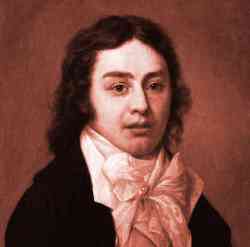
Samuel Taylor Coleridge was an English poet, philosopher, literary critic and theologian. He was a founder of the Romantic movement in Britain with his friends William Wordsworth and Robert Southey. He was born on 21st October 1772 in Ottery St Mary, Devon and died on 25th July 1834 in Highgate, London aged 61.
Major Works
“Christabel, Part 1”. (1797)
“Frost at Midnight”. “The Rime of the Ancient Mariner”. “Kubla Khan”. “Fears in Solitude”. (1798)
“Biographia Literaria”. (1817)
“On the Constitution of the Church and State”. (1830)
Biography Timeline
1772: Samuel Taylor Coleridge was born on 21st October in Ottery St. Mary, Devon, England. He was the the tenth and youngest child of the local vicar and his second wife. He was educated at Henry the Eighth Free Grammar School in Ottery St Mary and Christ’s Hospital. He then went up to Jesus College Cambridge.
1781: His father dies on the 6th October.
1782: He is sent to Christ’s Hospital School in London and meets his lifelong friend Charles lamb there.
1791: He enters Jesus College, Cambridge.
1793: On the 2nd December he enlists in the 15th Light Dragoons as Silas Tomkyn Comberbache to escape but is bought out of the army by his brothers.
1794: In June he meets Robert Southey for the first time and they plan a theory of Pantisocracy where all members of a community are given specific tasks. They plan to emigrate to North America and set up their group there. His first poems are published in the London newspaper the “Morning Chronicle” in July. In December he leaves Cambridge without completing his degree and goes on a tour of Wales.
1795: To earn some money he delivers a series of lectures at Bristol on politics, history, religion and the slave trade. He is introduced to the Fricker sisters by Southey who marries Edith. Coleridge moves to Clevedon in Somerset after his marriage to Sarah Fricker, Edith’s sister, on 4th October.
1796: He produces the radical political and philosophical journal called “The Watchman” between March and May. On the 16th April he publishes “Poems on Various Subjects”. His son Hartley is born on the 19th September. The Coleridge family move to a small cottage at Nether Stowey in Somerset on New Year’s Eve.
1797: The first proper meeting with William Wordsworth and his sister Dorothy takes place on the 5th June. Due to an accident with some scalding milk on 14th July Coleridge cannot go out walking with the Wordsworths and he writes the poem “This Lime Tree Bower My Prison”. Wordsworth and his sister rent Alfoxden House nearby. On the 13th November he begins writing “The Ancient Mariner”. In December he is employed as a writer for the “Morning Post” newspaper. Some of Coleridge’s poetry is published in the “Morning Post”. He finishes the first section of “Christabel” and writes his play “Osorio”.
1798: He gives sermons at the Unitarian Church in Shrewsbury as he is intent on taking up a life of religion, but he receives a life annuity of £150 from Tom Wedgwood (son of Sir Josiah Wedgwood) to dedicate himself to poetry. He meets William Hazlitt for the first time. In February he writes “Frost at Midnight”. His second son Berkeley is born on the 14th May. He writes “Kubla Khan” after awaking from an opium induced dream. (He needed to take laudanum for stomach and other pains). The poem was not completed as he was disturbed at Ash Farm by “a person on business from Porlock”. On 18th September Wordsworth and Coleridge finally publish their joint venture the “Lyrical Ballads”. (Wordsworth was not happy to see “The Ancient Mariner” included). Coleridge then leaves for Germany on a study tour with the Wordsworths hoping to increase his knowledge of language and philosophy.
1799: In April news reaches him about the death of his son Berkeley. He returns to England in July. In October he experiments with the effects of Nitrous Oxide (Laughing Gas) with Humphry Davy in Bristol. On the 26th October he meets Sara Hutchinson for the first time in the Lake District. In November he begins writing political essays for the “Morning Post”. In December the Wordsworths move to Dove Cottage, Grasmere in the Lake District.
1800: He begins translating Schiller’s “Wallenstein” whilst staying with Charles Lamb whilst the Coleridge family move to Greta Hall in Keswick, Cumbria. Derwent, his third son is born on the 14th September.
1802: He attends Humphry Davy’s lectures at the Royal Institution in London. In June he publishes “Poems”. In November he tours Wales with Tom and Sally Wedgwood. The Southey family moves in to Greta Hall in Keswick with Sarah Coleridge. His daughter Sara is born on 23rd December.
1804: In January he is ill once more in Grasmere and then returns to London. In July he moves to Malta for the good of his health and becomes Undersecretary to Alexander Ball, the British High Commissioner.
1805: On 18th January he is officially appointed as Acting Public Secretary in Malta and helps write laws and statutes for the country. On 21st September he leaves Malta and tours Naples, Rome, Florence, Pisa and Leghorn.
1806: In August he returns to England although still not in good health. He stays with the Godwins at 29 The Polygon, London and delivers a series of lectures on Shakespeare at the Corporation Hall in Fetter Lane London. Lord Byron is in the audience as well as William Godwin and his young daughter Mary (later to become Mary Shelley). He arrives back at Greta Hall in November. In December he leaves to live with Wordsworth and his wife Mary (Also Dorothy and Mary’s sister Sara Hutchinson) in Coleorton, Leicestershire.
1807: In January he hears Wordsworth read “The Prelude”. He meets Thomas de Quincey in Bristol in August.
1808: He becomes ill again and goes to live with the Wordsworths at Allan Bank in Grasmere, Cumbria.
1809: In August he produces “The Friend” a political and philosophical periodical.
1810: In March Sarah Hutchinson (known to him as Asra) tells him she has never loved him. In October he moves to London and has a breach with the Wordsworths over a statement by Montague about Wordsworth’s opinion of his work.
1812: In February he makes his last visit to the Lake District. In May he begins a series of lectures on drama at Willis’s Rooms in London. Charles Lamb helps heal the rift with Wordsworth.
1813: A successful run of his play “Remorse” begins at Drury Lane, London on 23rd January.
1815: He moves with Doctor Morgan to Calne in Wiltshire. In July he writes the “Biographia Literaria”.
1816: On the 16th April he enters Moreton House on Highgate Hill, London, the house of Doctor James Gillman and his wife who try to control his addiction to opium.
1818: He lectures in London in January on judgment, culture, European literature, etc. In December he lectures on the history of philosophy, Shakespeare, Milton, Dante, Spenser and Cervantes.
1819: On the 11th April he meets John Keats whilst out walking on Hampstead Heath.
1824: He is elected a Fellow of the Royal Society of Literature.
1828: In June he tours the Netherlands and the Rhineland in Germany with Wordsworth and his daughter Dora.
1831: He is visited by the philosopher John Stuart Mill. He attends meetings of the British Association in September.
1833: In June he visits Cambridge for the British Association meetings and on 5th August he is visited by Ralph Waldo Emerson.
Samuel Taylor Coleridge died on 25th July 1834 in Highgate, London from heart failure. He is buried in St Michael’s Church, Highgate. (He was reburied indoors on 6th June 1961 after his initial resting place, near the chapel buildings of Highgate School, became derelict. John Masefield then poet Laureate was at the ceremony).
Influences
Coleridge was famous for reading widely and devoured the works of William Shakespeare, John Milton and Robert Burns as well as those by the philosophers Immanuel Kant, Baruch Spinoza, Giambattista Vico, Emanuel Swedenborg and the German Romantic Friedrich Wilhelm Joseph Schelling. As a schoolboy he was impressed by the sonnets of the Reverend William Lisle Bowles who struck him as “tender” yet “manly”. His interests were wide reaching and although he later wanted to be a preacher for the Unitarian Church, he gave that up to the attraction of studying and writing. Such was his brilliance both in print and as a speaker that he attracted patronage from a wide variety of wealthy men which gave him time to spend on his studies.
It was his meeting with William Wordsworth whom he idolised as a great poet and their subsequent production of the “Lyrical Ballads” in 1798 that established him and Romanticism in Britain. He was a notorious long-distance walker and would go on many journeys in the Quantock Hills of Somerset with Wordsworth and his sister Dorothy or in the Lake District where he would climb the fells on his own laying claim to being the first rock climber in Britain. Nature and the environment were his muse.
He would later influence the poetry of Percy Bysshe Shelley and John Keats and later generations such as Alfred Lord Tennyson, Robert Browning, Christina Rossetti and Algernon Swinburne. Other writers such as Thomas de Quincy and Thomas Carlyle owe him a debt.
He was responsible for importing the new German critical philosophy of Immanuel Kant and Friedrich von Schelling into Britain and his London lectures of 1811 onwards on topics such as Shakespeare drew great crowds.
He was also an influential critic and writer for London newspapers and wrote reviews of the gothic novelist Ann Radcliffe giving them a wider readership and a revival of gothic literature. Mary Shelley, whose 1818 novel “Frankenstein” has never been out of print, knew Coleridge well and heard him read “The Rime of the Ancient Mariner” out loud when she was a child.
Coleridge was also a theologian and a major figure and writer in Anglicanism and was widely quoted by others. He called for major reforms in the church’s practices. His political views went from being a radical believer in the French Revolution to being critical of the Terror and its aftermath. He later became more conservative in the mould of Edmund Burke. The Liberal John Stuart Mill was fascinated by his ideas on institutions and their social function, social stability, national education and the common law tradition.
In the twentieth century he has been quoted by many authors including C.S. Lewis in “The Screwtape Letters” and by Douglas Adams in “The Hitchhiker’s Guide to the Galaxy”.
Further Information
Please see Britain Unlimited’s Samuel Taylor Coleridge page for further information.
Collected works of Coleridge.