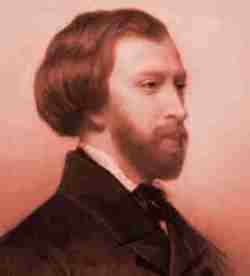
Alfred Louis Charles de Musset-Pathay was a French dramatist, poet, and novelist. He was born on 11th December 1810 in Paris, France and died on 2nd May 1857 in Paris, France aged 46)
Major Works
“La Quittance du Diable” (1830)
“Les Caprices de Marianne” (1833)
“Le Chandelier” (1835)
“La Confession d’un Enfant du Siècle” (The Confession of a Child of the Century) (1836)
“Histoire d’un Merle Blanc” (The White Blackbird) (1842)
Biography Timeline
1810: Alfred Louis Charles de Musset-Pathay was born on 11th December in Paris, France. His family were upper-class but not rich and his father worked for several government departments. His mother social held parties and dinners at their home which had a profound effect on the young writer and he would act out performances from stories he had read.
1819: He goes to the Henry the Fourth Lycee (school) aged nine.
1826: He writes the poem “À Mademoiselle Zoé le Douairin” whilst still at school.
1827: He wins the Latin essay prize in the Concours General for high achieving school students. Paul Foucher, Victor Hugo’s brother in law introduces him to the Cenacle (literary salon) run by Charles Nodier from the Bibllioteheque de L’Arsenal (Library).
1828: He writes the poem “Un Rêve” (A Dream) and “L’Anglais Mangeur d’Opium” which was an adaptation of Thomas De Quincey’s “Confessions of an English Opium Eater“.
1829: After several attempts at careers such as medicine (where he disliked dissection), the law, teaching English and the piano he finally decides to become a full-time writer. He publishes his first collection of poems “Contes d’Espagne et d’Italie” (Tales of Spain and Italy).
1830: He is now known not only as a writer but also as a dandy and acerbic wit. During the July Monarchy he is appointed librarian of the French Ministry of the Interior and has good relations with King Louis Phillippe. He writes the play “La Quittance du Diable” (The Devil’s Quittance) which is a flop and his future plays are published but not performed until 1847. He publishes his first collection of poems “Contes d’Espagne et d’Italie” (Tales of Spain and Italy).
1831: He writes the poem “La Coupe et les Lèvres” (The Cup and the Lips).
1833: He begins a love affair with the novelist George Sand which lasts until 1835. The anonymous lesbian erotic novel “Gamiani, or Two Nights of Excess” is believed to be written by him and modelled on Sand. He is also well known for his visits to brothels and is believed to be the anonymous client who assaulted the author La Mogador (Celeste de Chabrillan). He publishes the play “Les Caprices de Marianne” (The Moods of Marianne).
1834: He publishes the play “Lorenzaccio” set in sixteenth century Florence about Lorenzo de’ Medici.
1835: He writes the poems “La Nuit de Mai” (May Night) and “La Nuit de Decembre” (December Night) and publishes the play “Le Chandelier” in the “Revue des Deux Mondes”.
1836: He publishes the poems “La Nuit d’Août” (Autumn Night) and “Chanson de Barberine” (Barberine’s song). His autobiographical novel about his affair with George Sand “La Confession d’un Enfant du Siècle” (The Confession of a Child of the Century) is also published.
1837: He completes “Nuits” (Nights) again about his love for Sand. He publishes the play “Un Caprice” (A Whim).
1840: He writes the poem “Tristesse” (Sadness). He becomes involved in the debate about the Rhine Crisis caused by the prime minister Adolphe Thiers (his former boss when he was Minister of the Interior). Thiers demands that France should own the left bank of the river Rhine as it had done during the days of Napoleon Bonaparte.
1841: He writes the poem “Souvenir”.
1842: He publishes the novel “Histoire d’un Merle Blanc” (The White Blackbird).
1843: “Un Caprice” is performed for the first time at the French theatre in St Petersburg, Russia then at the Mikhaylovsky Theatre and finally in France on 27th November at the Comedie Francaise in Paris where it is a huge success.
1845: On 24th April, he is awarded the Legion d’Honneur along with Honore de Balzac.
1848: During the 1848 revolution he is dismissed from his post as librarian by the new minister Alexandre Ledru-Rollin. “Le Chandelier” is first performed in August at the Theatre Historique in Paris.
1849: He writes the play “On ne Saurait Penser a Tout” (We Cannot Think of Everything).
1851: He writes the poem“Faustine”. “Les Caprices de Marianne” (The Moods of Marianne) is first performed in Paris at the Comedie Francaise in June.
1852: After failed attempts in 1848 and 1850 he is finally elected to the Academie Francaise.
1853: He is appointed librarian of the Ministry of Public Instruction.
1855: He writes the play “L’Ane et le Ruisseau” (The Donkey and the Stream).
Alfred Louis Charles de Musset-Pathay died in his sleep of heart failure on 2nd May 1857, probably brought on by alcoholism. He was buried in Pere Lachaise cemetery in Paris.
Influences
Alfred de Musset was a sickly but passionate individual and like many of his generation he was hugely influenced by Johann Wolfgang von Goethe’s novel “Die Leiden des Jungen Werthers” (The Sorrows of Young Werther) where Werther became a prototype for the Romantic nihilist. Other critics have likened him also to Goethe’s Faust due to his Faustian craving for knowledge. He was born into an educated, upper-class family where he read widely and acted out old romances. Much of his output concerned love and suffering. His other early influence was Lord Byron which can be clearly seen in his 1830 collection “Contes d’Espagne et d’Italie” and his later political works. In 1836 in his autobiographical novel “La Confession d’un enfant du siècle” he went so far as to call Byron a “father figure”. He wrote his first poem “À Mademoiselle Zoé le Douairin” aged sixteen in 1826.
Other major influences were contemporary French writers such as Victor Hugo, Alfred de Vigny and Charles Nodier and he was a frequent visitor to the “Cénacle”, their literary salon. He was also widely read in earlier literature and counted William Shakespeare, Friedrich von Schiller and Molière (Jean-Baptiste Poquelin) amongst his favourites. He became known for his outrageous behaviour and dandyism as a youth and has come to be seen as a “child of the century”. In that post-Napoleonic era his generation were filled with disillusionment with established society and existential angst and his “mal du siècle” (sickness of the century) shaped his work and worldview. In 1871 Henry Wadsworth Longfellow reflected back on him as an eighteen year old describing him as “laughing and mocking, coldly ironical, a charming story-teller, a pitiless jester”
One of the major influences on his life and work was his dramatic love affair with the novelist George Sand. He wrote the series of poems entitled “Nuits” (1835–1837), now considered to be among the masterpieces of French Romanticism, during this period and referred to it in his autobiographical novel “La Confession d’un Enfant du Siècle”.
His career as a dramatist began in 1830 with “La Nuit Venitienne” and although it was a failure by 1847 he had begun to have successes at the Comédie-Française and later became the most performed playwright of the nineteenth century. Like his friend Théophile Gautier he became respectable in late middle age even received the Légion d’Honneur and was eventually elected to the Académie Française. Sadly, his health began to decline steadily from the 1840’s onwards.
His reputation declined somewhat after his death with the poet Arthur Rimbaud being highly critical of his work saying that he did not accomplish anything because he “closed his eyes” before the visions. However by 1915 when the manager Emile Fabre took over the Comédie-Française in Paris he was the subject of a major reappraisal and is now seen as on a par with illustrious names such as Moliere, Corneille, Racine and Victor Hugo.
Henri Gervex’s painting “Rolla” of 1878 was based on a poem by him but was rejected by the jury of the Salon de Paris for immorality. Several films have been influenced by him such as Jean Renoir’s “La Règle du Jeu” (The Rules of the Game) inspired by the play “Les Caprices de Marianne” and in 1999 Diane Kurys’ “Les Enfants du Siècle” was based on the romance between Musset and Sand. Many composers have used his poetry and plays for their musical works in the nineteenth and early twentieth centuries. Highlights have been Georges Bizet’s opera “Djamileh” of 1871 based on the story “Namouna”, Jacques Offenbach’s opera “Fantasio” of 1872 and Giacomo Puccini’s opera “Edgar” of 1889 based on the play “La Coupe et les Lèvres”. Ruggero Leoncavallo wrote a symphonic poem “La Nuit de Mai” in 1886 using his poetry and the British-American Rebecca Clarke’s Viola Sonata of 1919 uses lines from “La Nuit de Mai.” As late as 2007 Céline Dion recorded a song called “Lettre de George Sand à Alfred de Musset”.
Further Information
List of works by Musset-Pathay.