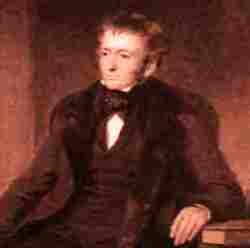
Thomas de Quincey was an English author most famous for writing “Confessions of an English Opium Eater”. He was born on 15th August 1785 in Manchester, England and died on 8th December 1859 in Polton, Midlothian, Scotland aged 74.
Major Works
“The Confessions of an English Opium Eater” (1821)
“Walladmor” (1825)
“On Murder Considered as one of the Fine Arts” (1827)
“Lake Reminiscences” (1834–40)
“The Logic of Political Economy” (1844)
Biography Timeline
1785: Thomas De Quincey was born on 15th August at 86 Cross Street, Manchester, England and was the fifth child and second son (of eight children) of Thomas, a successful and wealthy linen merchant and his wife Elizabeth Penson. He was educated at schools at Salford, Bath and Winkfield then Manchester Grammar School which he ran away from aged 17. He later went to Worcester College, Oxford but failed to take his degree.
1793: His father dies.
1796: He is taken by his mother to live in Bath and enters the Grammar School. His mother takes the name “De Quincey.”
1799: He goes to Winkfield School, Wiltshire where he reads Wordsworth and Coleridge’s “Lyrical Ballads“, which he describes as “the greatest event in the unfolding of my own mind.”
1800: He wins a prize for his translation from Horace’s Twenty-Second Ode.
1802: He runs away from school and tours Wales without the blessing of his mother and his uncle. He finally ends up penniless living in London with a prostitute called Ann.
1803: He returns to his family. He writes a fan letter to Wordsworth and the two begin a correspondence. He enters Worcester College, Oxford.
1804: He first starts using opium at Oxford when he uses it for relief from neuralgia. He meets Charles Lamb for the first time.
1807: He meets Samuel Taylor Coleridge for the first time in Bath and gives him £300 which he pretends is a loan. He travels as an escort to the Lake District with Sara Coleridge and her two sons whilst Coleridge is lecturing in London. He finally meets Wordsworth in Grasmere.
1808: He works with Coleridge on his lectures for the Royal Institution on Poetry and Principles of Taste. He runs away from Oxford during his final examinations and does not receive his degree.
1809: He rents Dove Cottage, Grasmere after it was vacated by Wordsworth and Coleridge so that he could be near the two poets.
1812: He enters the Middle Temple in London briefly to study for the Bar (as a lawyer). He starts a series of illnesses which meant he took stronger and stronger doses of laudanum (opium in solution, usually of brandy).
1816: Birth of his son, called William Penson, with Margaret Simpson a farmer’s daughter (known as Peggy) and he becomes estranged from the Wordsworths due to his erratic behaviour.
1817: He is still taking opium daily. He marries Peggy and he moves into her home Nab Cottage in the Lake District.
1818: He has to earn a living as a journalist and is appointed the Editor of the local Tory newspaper the Westmoreland Gazette.
1819: He is sacked as Editor of the Gazette. He writes a review of Percy Bysshe Shelley’s“The Revolt of Islam” for Blackwood’s Magazine.
1821: He moves to London where he writes for Blackwood’s Magazine and the London Magazine. He publishes his most famous work “Confessions of an English Opium Eater” in serial form.
1825: He stops writing for the London Magazine.
1826: He goes to Edinburgh with his wife and family of eight children.
1831: He is imprisoned for his debts.
1833: De Quincey is convicted four more times for debts and takes refuge in the Holyrood debtor’s sanctuary.
1834: He is convicted five times more for debts.
1837: After the death of his wife, Peggy, he is convicted ten times for debts. He begins taking laudanum more and more frequently. Hartley Coleridge, the son of Samuel Taylor Coleridge, moves into Nab Cottage with him and is to remain there until he dies in 1849.
1843: He moves back to the Edinburgh area.
1850: His works begin to be brought out in book form by publishers both in Britain and the United States.
Thomas de Quincey died on 8th December 1859 at Polton, Midlothian (near Edinburgh), Scotland and was buried in Saint Cuthbert’s (West) Churchyard in Edinburgh next to his wife and two of his children.
Influences
De Quincey did well at his schools in Manchester and Bath and could speak ancient Greek fluently. He was so convinced of his superiority to his teachers that he decided to leave early and go in search of the poet William Wordsworth and present himself to him. He had been an admirer of Wordsworth and Samuel Taylor Coleridge’s “Lyrical Ballads” when it was published in 1798 and so in November 1802, aged just seventeen, he set off in search of the great man, but short of money he ended his journey in London without meeting him. He would wander the streets of London and called Oxford Street his “stony-hearted step mother”. He slept at night in the doorways of churches. Here he would meet a prostitute called Ann who treated him like a brother and helped him survive. She would later appear in “Confessions of an English Opium-Eater” in 1821 where he recalls her noble actions.
In 1807 he decided on another attempt to meet Wordsworth and this time met both of the authors and became a constant acquaintance. After Wordsworth moved from Dove Cottage, Grasmere in the Lake District in 1809, De Quincey began to rent the house and stayed there off and on until 1833. At first, he was their disciple and modelled his Romantic views on theirs but the publication of his “Lake Reminiscences” in “Tait’s Magazine” between 1834 and 1840 greatly upset both Wordsworth and the other writers of the Lake school. It needs to be said that he was constantly in debt and would take on all sorts of writing jobs to pay his way and he would think nothing of making up fictitious details of real crimes to make them more saleable. In general, his writing style was lush and vivid and diverts into the realms of philosophical ideas which he makes accessible to his readers. He wrote a good number of essays and was an accomplished literary critic. His best-known and influential essay is “On the Knocking at the Gate in Macbeth” published in the “London Magazine” in October 1823, which is full of psychological insight. Indeed, his general exploration of the inner workings of the human mind and a fascination with dreams and the subconscious influenced later writers, including Edgar Allan Poe and Sigmund Freud. After his wife’s death in 1837 he became more solitary and eccentric and often retreated for long periods into opium dreams. His influence on the development of the essay as a form however is significant and they are still studied to this day.
One of Poe’s early tales covered an anonymous city walker and “The Purloined Letter” of 1844 show a direct link to De Quincey and there is evidence that Charles Dickens read and admired both authors. In Paris Charles Baudelaire read avidly and translated both authors too and was fascinated by the poetry of the city world in all its corruptions and eccentricities. Other writers directly influenced by him were Nikolai Gogol and twentieth century writers such as Aldous Huxley, William Burroughs and the Argentinian Jorge Luis Borges.
In music Hector Berlioz loosely based his “Symphonie Fantastique” on “Confessions of an English Opium-Eater” describing the artist’s inner struggle with himself. The Italian film director Dario Argento used “Suspiria” as an inspiration for his “Three Mothers” trilogy and the American modern artist Shelby Hughes created work under the pseudonym “Dequincey Jinxey” particularly in her work “Jynxies Natural Habitat” of 2009.
Further Information
For more information see Britain Unlimited’s page on de Quincey here.
Gutenberg project’s list of works by de Quincy in order of popularity.