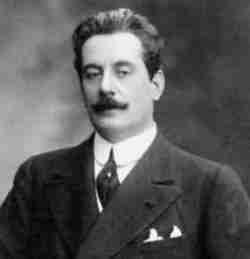
Giacomo Puccini was an Italian composer known primarily for his dramatic operas. He is regarded as the successor to Guiseppi Verdi. He was born in Lucca on 22nd December 1858 and died on 29th November 1924 in Brussels, Belgium aged 65.
Major Works
“Manon Lescaut” (1893)
“La Bohème” (1896)
“Tosca” (1900)
“Madama Butterfly” (1904)
“Turandot” (1924)
Biography Timeline
1858: Giacomo Puccini was born in Lucca, Italy on 22nd December. His father was Giacomo Antonio Domenico Michele Secondo the Maestro di Cappella of the Cathedral di san Martino in Lucca and from a long line of musicians. His mother was Albina Magi. He was the sixth of nine children.
1864: His father dies but as Puccini is only six years old he is thus too young to take over his father’s position as Maestro di Cappella but he receives a musical education in the choir at the Cattedrale di San Martino and later as secondary organist. He also attends the seminary of San Michele in Lucca.
1876: He hears his first opera, “Aïda” by Giusseppi Verdi.
1880: He receives a diploma from the Pacini School of Music in Lucca and moves to Milan to study at the music Conservatory where he composes his mass. A grant from Queen Margherita and money from his uncle allow him to stay there for three years where he shares a room with the composer Pietro Mascagni.
1883: He writes the “Capriccio Sinfonico” as a thesis composition for the Conservatory which impresses his teachers. It is performed by students on 14th July. Puccini and Ferdinando Fontana agree to write an opera for a competition sponsored by the Sozogno music publishing company. Although it does not win “Le Villi” is performed at Teatro dal Verne in Milan on 31st May. Giulio Ricordi the music publisher is so impressed with it that he commissions a second opera.
1884: He sets to work on what will become “Edgar”. During the autumn Puccini begins a relationship with a married woman called Elvira Gemignani in Lucca who was in an unhappy marriage.
1885: “Le Villi” is revised into two acts and is performed at La Scala Milan on 24th January.
1886: Elvira gives birth to their son Antonio in Monza as she had left Lucca to avoid the gossip. She and her children go to live with Puccini.
1887: “Edgar’s” primary composition is completed.
1888: Orchestration of “Edgar” is completed.
1889: “Edgar” premieres at La Scala, Milan on 21st April but receives a poor reception. Ricordi his publisher was told by friends that Puccini was a failure and a liability especially after he had eloped with his former piano student Elvira, however Ricordi stays with him and continues his allowance. Mascagni’s “Cavalleria Rusticana” wins this year’s opera competition. Puccini sees a play by Victorien Sardou called Tosca.
1891: From now onwards Puccini spends most of his free time at Torre del Lago just south of Viareggio and about fifteen miles from Lucca.
1893: His next opera “Manon Lescaut” receives its premiere at the Teatro Regio in Turin on 2nd February. The Casa Ricordi board of directors were considering ending Puccini’s financial support however this performance is a triumph with critics and public and they continue to support him.
1894: “Manon Lescaut” receives its London Premiere.
1896: His next commissioned opera is “La Bohème” based on a book by Henri Murger “La Vie de Boheme”. It is premiered in Turin with Arturo Toscanini conducting.
1900: “Tosca” is first performed at the Teatro Costanzi in Rome and is taken to Covent Garden in London. Puccini acquires land on the lake at Torre del Lago where he has a villa built (now known as the Villa Puccini).
1903: On 25th February Puccini, is seriously injured in a car crash on the journey from Lucca to Torre del Lago during the hours of darkness. The car is driven by a chauffeur and Elvira and Antonio are flung clear only sustaining minor injuries. A local doctor and an accomplice save him but he has to receive treatment for months during which he is found to have diabetes. Elvira’s husband Narciso dies the day after the car crash from injuries received from a jealous husband.
1904: Puccini and Elvira are now able to marry and legitimise their son Antonio. His next opera “Madama Butterfly” is a flop when it premieres at La Scala in Milan on 17th February which he puts down to inadequate rehearsals. He withdraws the opera and revises it completely for a second performance in Brescia during May.
1906: He falls in love with Blanke Lendvai, the sister of the Hungarian composer Ervin Lenvai whilst in Budapest with “Madama Buttefly”. They write love letters to each other until 1911. He had previously had affairs with several singers of his performances.
1907: He travels to New York to perform “La Boheme”. After changing it several times this fifth revision is usually seen today as the standard version.
1909: His wife Elvira, publicly, but falsely, accuses their maid Doria Manfredi of having an affair with Puccini. Doria commits suicide but the autopsy confirms she had died a virgin. Elvira is given five months in prison for slander but Puccini pays off the Manfredi family and she doesn’t need to attend. (Recent documents have shown that Puccini was actually having an affair with Doria’s cousin Giulia).
1910: “La Fanciulla del West”, based on a play by the American David Belasco, receives its premiere at the Metropolitan Opera in New York on 10th December. Enrico Caruso is one of the stars.
1911: He starts an affair with German aristocrat Baroness Josephine von Stangel, which lasts for six years.
1912: His publisher Giulio Ricordi dies and this puts an end to Puccini’s most productive period.
1914: He starts work on an operetta, “La Rondine”.
1916: He completes the score of “La Rondine”.
1917: “La Rondine” receives its premiere at the Grand Theatre de Monte Carlo on 27th March.
1918: “Il Trittico” is produced at the Metropolitan Opera in New York which is essentially three one act operas, “Il Tabarro”, Suor Angelica” and the comedy “Gianni Schicchi”.
1919: He is commissioned to write music to an ode by Fausto Salvatori honouring Italian war victories during the First World War. “Inno a Roma” (Hymn to Rome) is performed on 1st June in Rome at a gymnastics competition. This work became popular with the Fascists.
1920: He begins work on “Turandot”.
1921: Pollution from the local peat works forces Puccini to move to Viareggio, a few miles north of Torre del Lago.
1923: Puccini was famous for not being interested in politics at all but the Fascist Party in Viareggio make him an honorary member and send him a membership card. He meets Benito Mussolini, then Italian Prime Minister, in November and December seeking support to establish a national theatre at Viareggio. He had always heavily smoked cigars and begins to complain of sore throats.
1924: He is named Senatore a Vita, a position for cultural figures to talk directly to Government. Doctor’s diagnose throat cancer and recommend experimental radiation therapy available in Brussels. Both Puccini and Elvira are unaware of the severity of his condition and doctors only share the news with his son Antonio.
Giacomo Puccini died on 29th November 1924 in Brussels, Belgium of heart attack the day after surgery. He was buried temporarily in Toscanini’s family tomb in Milan and in 1926 his son had his remains moved to a new chapel built inside the villa Puccini at Torre del Lago, Italy.
(The final two scenes of “Turandot” are completed by the composer Franco Alfano and it premieres at La Scala Milan in 1926 and contains probably one of the most famous arias of all “Nessun Dorma”).
Influences
Puccini’s own music was heavily influenced by Giuseppe Verdi and Richard Wagner and he used Wagner’s idea of Leitmotifs (repeated tunes or phrases) to represent particular characters. His uncle Fortunato Magi was responsible for seeing that he had a musical education and he received a diploma from the Pacini School of Music in Lucca in 1880 under his tutor Carlo Angeloni. At the age of fourteen he played the organ in several churches in Lucca. Despite not winning a competition with his first opera “Le Villi” (The Fairies) it was staged at the Teatro Dal Verme in Milan on 31st May 1884. In the following year he performed excepts at a private party at which the publisher Giulio Ricordi was present and the two would later work as business partners and friends. Besides Verdi and Wagner he was aware of the music or Georges Bizet, Jules Massenet, Claude Debussy, Richard Strauss and Igor Stravinsky amongst others and was not averse to quoting their themes or ideas at least in part. He drew inspiration from different countries with “Madama Butterfly” based in Japan, “Turandot” in China and “La Fanciulla del West” In the USA. The world was becoming easier to communicate with, with the Suez Canal opening in 1869 and the first motor car being sold in 1886. Personal experience developed many aspects of Puccini’s characters and plots and several scholars have remarked on the similarities between “La Bohème” and Puccini’s own life as a young man in Milan. He was very poor himself before his first major success with “Manon Lescaut” which brought him fame and fortune. He put his formula for success down to “Poetry, more poetry, ardent affections, flesh, searching, almost surprising drama and a fireworks finale”.
Besides being a Romantic many music historians refer to him as a member of the Giovane Scuola (Young School) who came after Verdi and which included other luminaries such as Pietro Mascagni and Ruggero Leoncavallo. He is also a notable exponent of the Verismo style (Realism) with stories of everyday modern life and he consciously attempted to renew his style to keep pace with new trends but did never fully accepted modernism and continued the use of the aria in most of his works. He was quite simply the most successful Italian Opera composer of his generation and by the time of his death in 1924, he had earned $4 million from his compositions. This fame has not diminished in the twenty-first century. He is performed in third place worldwide after Verdi and Mozart with “La Bohème”, Tosca, and “Madama Butterfly” amongst the ten most frequently performed operas worldwide.
However fame has not been universal and many critics have decried him for his popularity and claimed his music was insufficiently sophisticated or difficult even going as far as to say “he willingly stops himself at minor genius, stroking the taste of the public, obstinately shunning too-daring innovation”. “The Cambridge History of Twentieth-Century Music” dismisses his music as “conservative”. Benjamin Britten famously said to Dmitri Shostakovich that he thought Puccini’s operas were dreadful to which Shostakovich replied “No, Ben, you are wrong. He wrote marvellous operas, but dreadful music”. During his lifetime younger Italian contemporaries such as Alfredo Casella, Ildebrando Pizzetti and Gian Francesco Malipiero hated him as a conservative who wrote “safe”, sentimental works calculated to appeal to the bourgeoisie. Musicologists Fausto Torrefranca and later Adolf Weissmann described his works as “effeminate”, “contaminating” and “manipulative” which has continued in many academic circles even today. Writing commercial music and crowd pleasers was very much out as far as the Modernists were concerned.
,Many others howeve, saw him as a gifted an original composer including Maurice Ravel, Igor Stravinsky and Arnold Schoenberg. After the original failure of “Madama Butterfly” he rewrote it and then changed to a more adventurous style with “La Fanciulla del West” (The Girl of the Golden West) using “modern” techniques such as unresolved dissonances and angular rhythms and the later “Gianni Schicchi” is full of Stravinskian rhythms. When Puccini died the score of “Turandot” was unfinished as he struggled with a convincing ending for his anti-heroine. The opera owes much to Stravinsky’s “Le Sacre du Printemps” (which Puccini heard at its first performance in 1913) and “Petrushka”. By the 1920s critics in Italy began to divide Puccini’s oeuvre into two stylistic groups. The first up to and including “Madama Butterfly” and the second more discomfiting works thereafter.
Puccini is typically seen as representing the end of a nineteenth century tradition but many feel he began a new modern tradition as heard in the works of Leos Janáček, Erich Wolfgang Korngold, Carl Orff and Luciano Berio. Theatre and film music have been influenced by him from Rodgers and Hammerstein to John Williams and the Puccini estate has even had to sue musicians including Al Jolson and Andrew Lloyd Webber for copying Puccini too literally.
Further Information
List of compositions by Puccini.