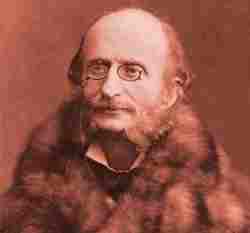
Jacques Offenbach was a German-born French operetta composer, cellist and impresario. He was born on 20th June 1819 in Cologne, Germany and died on 5th October 1880 in Paris, France aged 61.
Major Works
“Orphée aux Enfers” (Orpheus in the Underworld) (1858)
“La Belle Hélène” (1864)
“La Vie Pariesenne” (1866)
“La Périchole” (1868)
“The Tales of Hoffmann” (1880)
Biography Timeline
1819: Jacques (Jacob) Offenbach was born on 20th June in the Großer Griechenmarkt, Cologne, Prussia, Germany. His father was Isaac Juda Eberst a bookbinder and then a cantor at the Cologne Synagogue who had been born at Offenbach am Main and was known as “Der Offenbacher”. His mother was Marianne, née Rindskopf and Jacob was the seventh of ten children.
1825: He is taught to play the violin by his father aged six.
1828: His father is now the permanent cantor and can afford to give his son lessons in the cello with Bernhard Breuer.
1833: In November his father enrols him as a cello student at the Paris Conservatoire which was far more tolerant to Jews. He also takes his other son Julius to join and they both change their names to the French forms as Jacques and Jules respectively. His father is unable to find employment in Paris and returns to Cologne.
1834: Jules is a diligent student and later becomes a violin teacher and conductor. Jacques does not like the strict discipline of Luigi Cherubini’s Conservatoire and fails to study and is struck off the register on 2nd December.
1835: He gets a job as a cellist with the Opera-Comique in Paris but is constantly playing pranks during performances and is docked his pay. However, he continues to take cello lessons with Louis-Pierre Norblin and composes his own music. Wirth the help of Friedrich von Flotow he plays at fashionable Salons in Paris to earn money. He falls in love with Hérminie d’Alcain the daughter of a Spanish general at the Comtesse de Vaux’s salon but is not in a financial position to propose to her. He gives concert tours in France and Germany to expand his earnings and performs with Franz Liszt in Cologne.
1840: Death of his mother.
1844: He marries the seventeen-year-old Herminie on 14th August after converting to Catholicism and then embarks on a tour of England where he meets Felix Mendelssohn and performs before Queen Victoria and the Tsar of Russia at Windsor Castle.
1846: In April he gives a concert at which he includes seven operatic items composed by himself.
1848: The outbreak of the 1848 Revolution puts his operatic career on hold and he and his wife and new daughter go to Cologne to escape.
1849: He returns only to find the salons still closed down and returns to the orchestra of the Opera-Comique. He then becomes conductor of the Théâtre Français.
1850: Death of his father.
1853: He begins writing operettas but the Opera Comique are not interested in staging them, however the composer, and impresario Florimond Ronger, known as Herve encourages him.
1855: The one-act opera “Oyayaye ou La Reine des Iles” (Oyaayiye or The Queen of the Islands) is staged at Herve’s theatre the Folies-Novelles on 26th June and is a success. Meanwhile he abandons hope of the Opera-Comique and decides to start his own theatre. The Bouffes-Parisiens opens in the Salle Lacaze in the Champs-Elysees in July when the city is full of visitors for the 1855 Great Exhibition. By law it is limited to three characters in any piece. The comedy “Les Deux Aveigles” (Two Blind Men) is the most popular performance of the season. He moves to the Salle Choiseul later in the year where four performers are allowed and in December he produces “Ba-ta-Clan”.
1856: In May he produces “L’Impresario” for the Mozart celebrations but despite his this success he remains on the verge of bankruptcy.
1858: The Government lift licensing restrictions on performers and he is able to present his first full length operetta. In October his most famous work “Orphée aux Enfers” (Orpheus in the Underworld) is performed with set designs by Gustav Dore, expensive costumes and a large chorus and orchestra.
1859: His next work is “Genevieve de Brabant” which is less of a success but is popular in England and the USA, where one of the duets becomes the basis of the US Marine’s Hymn.
1860: He is granted French citizenship and holds a command performance for the Emperor Napoleon the Third in April. He also performs his only ballet “Le Papillon” (The Butterfly) at the Paris Opera. “Barkouf” (Barkouf, or a Dog in Power) is given at the Opera—Comique but it is not a success.
1861: Due to new legislation in March his company is prevented from using two theatres and the Salle Lacaze is discontinued. He is appointed a Chevalier of the Legion d’Honneur. He goes on a summer tour to Vienna in Austria and even performs on the cello for the Emperor Franz Joseph. However, his production of “Le Pont de Soupirs” (The Bridge of Sighs) is a failure in Berlin.
1862: His only son, Auguste is born, the last of his five children. He resigns as the director of the Bouffes-Parisiens but continues to write for them.
1864: He produces operettas at Ems in Germany and an opéra-ballet “Die Rheinnixen” (The Rhine Spirits) in Vienna. He then returns to Paris to produce the serious opera “La Belle Helene” at the Varieties Theatre.
1866: He produces “La Vie Parisienne” (Parisian Life) and “Barbe Bleue” (Bluebeard) which are both successes.
1867: He produces “La Grande-Duchesse de Gérolstein”, a satire on militarism and it is his greatest success. Next is “Robinson Crusoe”.
1868: He produces “La Périchole”, “Le Chatuea a Tot” (The Castle has everything) and “Lile de Tulipatan” (The Island of Tulipatan).
1869: He produces “Les Brigands”.
1870: He returns from Ems and Wiesbaden just before the outbreak of the Franco-Prussian war but then moves his family to safety in San Sebastian in Spain. After the French defeat at Sedan and the removal of Napoleon the Third he is out of favour as he is seen as too close to the old regime.
1871: He returns to Paris.
1872: He produces the satire “Le Roi Carotte” (The Carrot King) there in January. The Gaiety Theatre in London also puts on a series of his works to enthusiastic audiences.
1873: He becomes the director of the Théâtre de la Gaîté in July and “La Jolie Parfumeuse” (The Happy Parfumier) is performed there.
1874: A revival of “Orpheus in The Underworld” proves popular but loses money and his lavish version of “Geneviève de Brabant” is less popular.
1876: He tours the United States of America which proves profitable and allows him to pay off most of his debts. His attempt to pass of a Sunday concert in Philadelphia as “Sacred Music” however is not given the go ahead. He returns to France in July and begins working on “Les Contes Fantastiques d’Hoffmann” (The Tales of Hoffman).
1878: He produces “Madame Favart” about the actress Marie Justine Favart.
1879: He produces “La Fille du Tanmbour-Major” (The Drum Major’s Daughter). He is now suffering from gout and has to be carried into the theatre in a chair.
Jacques Offenbach died of heart failure on 5th October 1880 in Paris, France. He was given a state funeral and was buried in the Montmartre Cemetery. “The Tales of Hoffman” was unfinished at his death and finally performed in February 1881 at the Opera-Comique orchestrated by Ernest Guiraud. (He often parodied other composer’s work. Some saw the funny side such as Adolphe Adam, Giacomo Meyerbeer and Daniel Auber but others such as Hector Berlioz and Richard Wagner did not).
Influences
Jacques Offenbach was the seventh of ten children born to a father who was a synagogue cantor, teacher, and composer in Cologne. He learned the violin and cello as a child along with his brother Julius and engaged in family music making developing his early fluency in melody and rhythm. He then entered the Paris Conservatoire aged fourteen but was so bored he only stayed for one year.
Soon afterwards he took up a post as a cellist in the Opéra Comique in Paris which exposed him to the standard French light-opera repertoire, its staging, pacing, and orchestration and he was influenced by a number of composers and librettists at the time. The current tradition combined spoken dialogue with catchy and popular songs. He was also exposed to the vaudeville and Boulevard theatre with revues and comedies which helped him with his later comic timing. He was also influenced by Italian Opera Buffa with its rapid and farcical plots with energetic company ensembles.
By 1838, he gains entry to Paris’ salons and writes lightweight pieces, waltzes, and polkas which are popular with the flaneurs, habitual café dwellers, and even rents out a theatre and begins to produce small comedy shows with his own music.
During the 1840s he toured to London and Cologne as a virtuoso cellist and played alongside Franz Liszt and under the baton of Felix Mendelssohn.
Despite his appointment as conductor at the Théâtre Français in 1850 he was unable to get any of his larger stage works performed until in 1858. During the Paris Universal Exhibition of 1855 he rents a small music hall but it is limited by government decree to producing one-act works with three characters or fewer and no chorus. With a moderate success he transfers to a new theatre in the winter.
His first piece of comic writing is “Oyayïae, ou La Reine des îles” (Oyayïae, or the Queen of the Isles) and is in a different vein to his previous works and is written in the new burlesque style initiated and encouraged by Hervé. Due to the relaxation of theatre laws he has a great success with “Orpheus in the Underworld” in 1858 at his theatre called Théâtre des Bouffes-Parisiens which in the nineteenth century was often referred to as the Salle Choiseul. It runs for 277 performances and becomes the work that defines the Second Empire of Louis-Napoleon. It also becomes a prototype for his subsequent large-scale satirical works in which he lampooned political figures and contemporary society. Other hits follow such as “La Belle Hélène” of 1864 set in the Trojan War whose success spread from Paris throughout Europe and especially in London and Vienna. Much of his success also relied on the writing of his librettists and especially Ludovic Halévy who consistently produced witty material and found interesting subjects for treatment.
He became relatively wealthy on the back of his popularity and creating nearly one hundred witty, satirical stage works but he was always a poor businessman and his theatre was almost permanently in the red. Nertheless he became known as the “father of the operetta”. Gioachino Rossini gave him the playful nickname of the “Mozart of the Champs-Élysées”.
He becomes famous in Vienna in 1865 with Geistinger’s production of “Die Schöne Helena”, and has further triumphs with “Barbe-Bleue” in 1866, “La Grande-Duchesse de Gérolstein” in 1867 and “Les Brigands” in 1869. Johann Strauss the Son is tempted by the huge success of the operettas in Paris and Vienna to try writing his own works which begin with “Der Fledermaus”. Offenbach’s burlesque style works are also popular in London and the United States of America.
The Franco-Prussian War of 1870–71 marks a profound shift in popular taste after the defeat and fall of the Emperor and he loses money on his new productions and is eventually forced into bankruptcy. He is even accused of being a German spy due to his birthplace. His music becomes almost forgotten and he is forced to make a tour of the United States of America the make some money.
Back in France he tries to get into the major grand opera houses with little success. His final attempt is “Les Contes d’Hoffmann” (The Tales of Hoffmann) which has since become one of the most significant French operas of the nineteenth century. Sadly he died during rehearsals for the premiere and it had to be completed by Ernest Guiraud who also puts on the first performance at the Opèra-Comique. It is the big success the composer had always hoped for.
During his lifetime and in the obituaries musical critics were scathing about his music but were completely at odds with the public appreciation and indeed pastiches of his work were performed in Germany, France and elsewhere in Europe for several decades after his death.
He influenced many nineteenth and twentieth century composers of light opera. Besides Johann Strauss there were the works of Gilbert and Sullivan in Great Britain, who even copied him by starting their own theatre (the Savoy), and Franz von Suppé in Austria. There is evidence that there was a two-way influence between Offenbach and Gilbert and Sullivan. “The Pirates of Penzance” is highly similar to “Les Brigands” and Offenbach’s “Maître Péronilla” of 1878 bears an uncanny resemblance to the song “My name is John Wellington Wells” from Gilbert and Sullivan’s “The Sorcerer” of 1877. The musicologist Micaela Baranello has stated that Franz Lehárs operettas have a strong Offenbachian element and Kurt Weil in the twentieth century has described his own “Der Kuhhandel” (Cattle Trading) as “an operetta influenced by Offenbach”. In America he influenced John Phillip Sousa and his contemporary David Brabham, who was known as “the American Offenbach” and later Alan Jay Lerner said that Offenbach “was indeed the father of us all”.
He also had an influence on some later French composers. Francis Poulenc wrote that Emmanuel Chabrier was a great admirer and he wasn’t above imitation himself in “Les Mamelles de Tirésias” (The Breasts of Tiresias).
The philosopher Friedrich Nietzsche called him an “artistic genius” and Claude Debussy, Modest Mussorgsky and Nikolai Rimsky-Korsakov loved his operettas. In 1980 the Musical Times stated the early critics who said his music would not survive for long were entirely wrong, and how wrong they were.
Further Information
List of compositions by Offenbach.