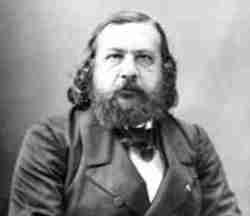
Theophile Gautier was a French poet, novelist, journalist, and art and literary critic. He was born on 30th August 1811 in Tarbes, France and died on 23rd October 1872 in Neuilly-sur-Seine, France, aged 61.
Major Works
“Mademoiselle Maupin“ (1835).
“Avatar” (1856).
“Emaux et Cammes” (Enamels and Cameos) (1852).
“Jettatura” (1857).
“Histoire de l’art Dramatique en France Depuis Vingt-cinq Ans” (The History of Drama in France for Twenty-Five Years) (1858).
“Dernières Poésies” (1872).
Biography Timeline
1811: Théophile Gautier was born on 31st August in Tarbes in southwestern France. His father was Jean-Pierre Gautier, a government official and his mother was Antoinette-Adelaïde Cocard.
1814: The family move to Paris where he is educated at the College Louisle-Grand for three months before being taken ill and then at the College Charlemagne. He meets Gerard de Nnerval at school and they became lifelong frinds.
1826: He begins writing poetry but he spends much of his life as a journalist.
1830: His first love was painting but he soon decides his main vocation is poetry and his “Poésies” a collection of 42 poems is published but sells no copies and is withdrawn. Nerval had introduced him to Victor Hugo and when Hugo’s play “Hernani” is first performed in Paris, Nerval and Gautier attend to give their support against the vocal critics in the audience. Hugo becomes a major influence on him. Meanwhile due to the 1830 Revolution his family fall on hard times and have to move out to one of the cheaper suburbs of Paris. Towards the end of the year he attends “Le Petit Cénacle” (The Little Upper Room), in the studio of Jehan Du Seigneur, where he meets Alexandre Dumas Pere, Alphonse Brot and Nerval. The group soon gets a reputation for eccentricity and extravagance.
1831: He writes the long narrative poem “Albertus”. It tells the story of an ugly witch who transforms into a beautiful maiden and Albertus the painter is smitten and sells her his soul. The newspaper “Le Figaro” features a number of works by the young generation of Romantic artists in the group called the “Jeunes-France”.
1832: “Albertus” is published. He begins to espouse the doctrine art for art’s sake.
1833: In “Les Jeunes-France: Tales Told with Tongue in Cheek”, he satirises his own extravagances as well as those of other Romantics.
1835: The novel “Mademoiselle de Maupin” is published, which expresses his artistic views and causes a debate in literary circles due to his disregard of conventional morality and his insistence that beauty transcends everything. It is a story about the French opera star who often went into society disguised as a man. The preface preaches art for art’s sake saying that “everything useful is ugly”.
1836: He writes weekly columns for the newspapers “La Presse” and “Le Moniteur Universel”. He publishes the short story “La Morte Amoureuse” (The Dead Lover) about a female vampire and “Les Grotesques” about some obscure earlier writers who were forerunners of Romanticism.
1837: He writes the play “Une Larme du Diable” (The Devil’s Tear) in the form of a medieval mystery play after a previous trip to Belgium. “Eldorado, ou Fortunio” is serialised in the newspaper “Le Figaro” and published in book form a year later.
1838: His pessimism is apparent in the narrative poem “La Comédie de la Mort” (The Comedy of Death).
1840: He visits Spain which inspires some of his later poetry. He writes music criticism for local nespapers and is a friend to the composer Hector Berlioz who sets some of his poems to music in “Les Nuits d’Eté”.
1841: He works with Jules-Henri Vernoy de Saint-Georges on the story for Adolphe Adam’s ballet “Giselle” which is premiered by the Ballet de l’Academie Royale de Musique at the Salle Le Peletier in Paris on 28th June. He falls in love with the principal ballerina Carlotta Grisi who rejects him and then he has a long-term relationship with her sister, the singer Ernestina, and they have two daughters together.
1843: He writes “Voyage en Espagne” (Journeys in Spain).
1845: The poem “España” and the prose “Voyage en Espagne” are published. “España” is often seen as the transition point between the two phases of Gautier’s work. He also publishes the play “Le Tricorne Enchanté” (The Magic Hat) which is set in the seventeenth century.
1846: He writes the plays “La Juive de Constantine” and the satire “La Fausse Conversion” (The False Conversion). Neither are performed in his lifetime.
1847: He writes the comedy phantasy “Pierrot Posthume”.
1848: Due to the 1848 Revolution he writes almost one hundred articles for newspapers. In his “La République de l’Avenir” he welcomes the new republic and individual liberty.
1851: He is appointed Editor of “Revue de Paris” and continues writing for “La Presse” and “Le Moniteur Universel” although he is humiliated to earn a living by journalism and not poetry.
1852: He publishes the poetry anthology “Emaux et Cammes” (Enamels and Cameos) considered one of his finest and “Arria Marcella” about ancient Pompeii. He tours the Middle East
1855: He finishes writing for “La Presse”.
1856: He is appointed the Editor of “L’Artiste”.
1858: He writes “Histoire de l’art Dramatique en France Depuis Vingt-cinq Ans” (The History of Drama in France for Twenty-Five Years) in six volumes and “Trésors d’Art de la Russie” (Treasures of Russian Art). He also writes the novel “Le Roman de La Momie” (Story of the Mummy) set in Ancient Egypt.
1862: He is elected the chairman of the Societe Nationale des Beaux-Arts which has amongst its committee members Eugène Delacroix, Eduard Manet and Gustave Dore.
1863: He finally publishes “Captain Fracasse” which he had planned over twenty years before. Set in the days of King Louis the Thirteenth it is a type of fairy tale.
1865: He is admitted into the prestigious salon held by Princess Matthilde Bonaparte, the cousin of the Emperor Napoleon the Third.
1867: He publishes “Voyage en Russie” (Journey to Russia). He is rejected by the Academie de France and on two future occasions before finally being accepted as a member at his third attempt.
1868: Princess Matthilde offers him the financially rewarding post of librarian which also gives him access to the Court.
1870: During the Franco-Prussian War he returns to Paris after hearing of the Prussian advance on the city. He remains with his family during occupation and the Commune de Paris.
1872: He publishes the poetry collection “Dernières Poésies”.
Theophile Gautier died on 23rd October 23 1872 of heart disease at Neuilly-sur-Seine, France. He was buried in the Cimetiere de Montmartre in Paris. (His “Histoire du Romantisme” (History of Romanticism) and “Portraits Contemporains” (Contemporary Portraits) which describes his friend Honore de Balzac, are published posthumously in 1874).
Influences
Théophile Gautier became influenced in Romanticism by reading Victor Hugo’s work, both poetry and literary criticism, and through his school friend Gérard de Nerval. Nerval had introduced him to Hugo and he became a fervent supporter and participated in the debate around the premiere of Hugo’s “Hernani”. He attended the event wearing a striking old fashioned red doublet. It was Hugo who encouraged him to take up literature at the time when he had ambitions as a painter. He was also influenced by Nerval’s own poetry and philosophy.
He was a great lover of the visual arts and became a passionate art critic specialising in the work of particularly of Jean-Auguste-Dominique Ingres, Eugène Delacroix, and Francisco Goya. He also played a role in the acceptance of Gustav Courbet although he was not altogether passionate about his style.
A lot of his poetry makes allusion to classical Greek and Roman art and Renaissance paintings.
He was a prolific and highly influential critic, not only of art but also literature and music and his reviews did much to further the careers of Honoré de Balzac and Charles Baudelaire. Many of his contemporaries held his work in high regard including Gustave Flaubert, Charles Augustin Sainte-Beuve and the writers Edmond and Jules Goncourt and he became a major influence on the development of French literature in general.
He was a mentor and friend to Charles Baudelaire and his influence can clearly be seen in the latter’s “Les Fleurs du Mal” which he dedicated to Gautier.
He was an avid traveller and his journeys to Spain in particular furnished him with much material for his poetry and prose such his collections of poems “Espana” in 1845 and his travel writings “Voyage en Espagne” of the same year.
His poem “Variations on The Carnival of Venice” had a great admirer in the English poet Robert Browning and several years later Oscar Wilde was to quote lines from it in his “The Picture of Dorian Gray”. In the twentieth century T.S. Eliot quoted the line “Tra-la-la-la-la-la-laire” in his “Burbank with a Baedeker: Bleistein with a Cigar” and Philip Larkin borrowed the main idea in “For Sidney Bechet”.
In his final years he became the close friend of the French princess Mathilde, who gave him the post of her librarian to ease his financial worries.
Further Information
Complete list of works by Gautier from the Internet Archive.