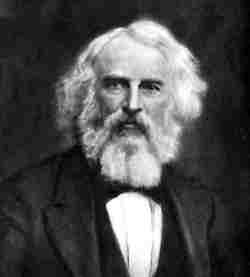
Henry Wadsworth Longfellow was an American poet and educator and was one of the fireside poets from New England. He was born in Portland, USA on 27th February 1807 and died in Cambridge, Massachusetts, USA on 24th March 1882 aged 75.
Major Works
“Poems on Slavery” (1842)
“The Song of Hiawatha” (1855)
“Paul Revere’s Ride” (1863)
“Christmas Bells” (1864)
Biography Timeline
1807: Henry Wadsworth Longfellow is born on 27th February in Portland Oregon, USA and was educated at the Portland Academy and Bowdoin College in Brunswick.
1820: He publishes his first poem “The Battle of Lovell’s Pond in the local newspaper the Portland Gazette.
1825: He graduates from Bowdoin College.
1826: He goes on a study tour of Europe.
1829: He becomes a teacher at Bowdoin College.
1831: He marries Mary Potter.
1835: “Outre Mer” is published. Longfellow returns to Europe with some friends but Mary sadly dies in Rotterdam, Netherlands.
1836: He meets Frances Appleton. He returns Cambridge Massachusetts to become a professor at Harvard.
1839: “Voices of the Night” and “Hyperion” are published by Longfellow.
1843: He marries Fanny Appleton.
1844: Their first child Charles is born, the first of their six children.
1847: He publishes “Evangeline: A Tale of Acadie”.
1854: He retires from teaching.
1855: He publishes “The Song of Hiawatha”.
1861: His wife Fanny dies.
1863: He publishes “Tales of a Wayside Inn”
1867: He publishes his translation of Dante’s “Divine Comedy”.
1868: He has an audience with Queen Victoria at Windsor Castle, Windsor, England on 4th July. She described him in her diaries as “a fine looking, intelligent and pleasing old man”.
Henry Wadsworth Longfellow died from peritonitis on 24th March 1882 in Cambridge, Massachusetts. He is buried with both of his wives at Mount Auburn Cemetery in Cambridge.
Influences
Longfellow was the most famous American poet and writer of his generation and by 1874, he was earning $3,000 per poem (tens of thousands today). Early reading and discussions at the Peucinian Society about contemporary writing encouraged him to become a writer despite his father wanting him to go into the law. He was originally influenced by Dante Alighieri and then the English Romantics, especially John Keats and he was an avid reader of Charles Dickens. A trip to London to meet Thomas Carlyle introduced him to the works of Johann Wolfgang Goethe, Friedrich Schiller and the writings of the other German Romantics which had a profound influence on him.
He gave poetry a much higher standing in America than it had enjoyed before his time and in his best-known poems often taken from Native American historical events such as “The Song of Hiawatha” he taught Americans about their roots becoming an American icon himself in the process. His popularity spread throughout Europe and he was translated into Italian, French and German during his lifetime.
He influenced America’s artistic and popular culture and inspired artists and composers, and his poems were read and recited widely and some of his phrases passed into common parlance such as “Ships that pass in the night” or “Footprints on the sands of time”. Places, schools and products were named after him or his characters. During the 1870s, schoolchildren celebrated his birthday as if it were a national holiday.
His greatest popular success came with his 1847 romance “Evangaline, A Tale of Acadie” and his celebrity assured him critical respect in the closing decades of the nineteenth century and the beginning of the twentieth despite much criticism. In 1858 ten thousand copies of “The Courtship of Mile Standish” were sold in London in a single day. Edgar Allan Poe however criticised him of plagiarism particularly of Alfred Lord Tennyson but this was not upheld by others. Walt Whitman and Ralph Waldo Emerson maintained he lacked originality and Whitman said he imitated European forms and the critic Margaret Fuller wrote Longfellow was “artificial and imitative” and “lacking in force”. Towards the end of his life he was seen simply as a poet for children. However in 1884, Longfellow became the first non-British writer to have a commemorative bust placed in Poet’s Corner in Westminster Abbey in London and remains the only American represented there to this day.
His pupil Thomas Wentworth Higginson praised his contribution to American literature “enriching and refining it and giving it a cosmopolitan culture, and an unquestioned standing in the literary courts of the civilized world” and Longfellow was well known for helping aspiring writers either personally or through correspondence such as Emily Dickinson. His personality, particularly that presented by his brother Samuel in his biography, as a gentle, placid, poetic soul also became part of the problem for more radical writers.
His popularity declined rapidly after his death and into the twentieth century but later poets such as Robert Frost, Robert Lowell and Howard Nemerov have been kinder about his reputation than any of the critics or academics. As late as 2020 Nicholas A Basbanes defended Longfellow as “the victim of an orchestrated dismissal that may well be unique in American literary history” in his book “Cross of Snow: A Life of Henry Wadsworth Longfellow”.
Further Information
Chronological list of complete poems by Longfellow