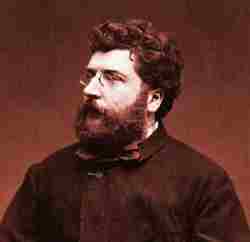
Georges Bizet was a French composer best known for his operas. He was born on 25th October 1838 in Paris, France and died on 3rd June 1875 in Bougival, France aged 36.
Major Works
“The Pearl Fishers” (1863)
“Roma Symphony” (1869)
“L’Arlésienne” (1872)
“Carmen” (1873)
Biography Timeline
1838: Georges Bizet was born on 25th October in Paris, France. Although he was registered as Alexandre he was baptised as “Georges” on 16th March 1840. His father, Adolphe Bizet, was a singing teacher but had formally been a wig maker. His mother was Aimée Delsarte a talented pianist from a highly musical family.
1848: He shows an aptitude for the piano early on and his parents enter him for the Paris Conservatoire aged nine even though the normal minimum was ten years old. The normal rules are waived by Joseph Meifred and he enters the Conservatoire on 9th October. He wins the first prize in solfège during his first six months. Guillaume Zimmerman gives him private lessons in piano, counterpoint and fugue. There he meets Charles Gounod, Zimmermans son-in-law and Camille Saint-Saens a student.
1850: His first preserved composition is two songs for soprano.
1851: He wins the Conservatoire’s second prize for piano.
1852: He wins the first prize for piano.
1853: He joins Fromental Halevy’s composition class.
1854: Two of his songs “Petite Marguerite” and “La Rose et l’abeille” (The Rose and the Bee) are published. He prepares a four-hand piano version Gounod’s Symphony in D which inspires him to write his own Symphony in C the following year. (never published).
1856: He competes for the Prix de Rome but he is not successful. He then enters an opera competition for young composers organised by Jacques Offenbach. The prize is awarded jointly to Bizet and Charles Lecocq. Bizet becomes a regular guest at Offenbach’s Friday evening parties where he meets Gioachino Rossini on one occasion.
1857: For his Prix de Rome entry, Bizet, chooses the cantata “Clovis et Clotilde” by Amédée Burion. Bizet is awarded the prize after a ballot of the members of the Academie des Beaux-Arts overturned the judge’s initial decision. The prize is a financial grant and study periods abroad including Rome. For this he has to compose a new work each year of the five. He sets off for Rome in December.
1858: On 27th January he arrives at the Villa Medici which houses the French Académie in Rome. He completes a Te Deum for the Rodrigues Prize but it is not popular with the judges. During the winter he works on his first opera “Don Procopio”. Despite it not being the required religious music, he was praised for the entry. After this Bizet completes only one further work in Rome, the symphonic poem “Vasco da Gama” although he had considered five opera projects and two symphonies.
1859: He travels widely in Italy and visits Naples and Pompei. He begins work on a symphony based on his experiences. This would later be published as the “Roma Symphony” in 1869.
1860: He is granted permission to stay in Italy into a third year, rather than going to Germany. In September while in Venice he hears his mother is gravely ill and he heads home to Paris.
1861: On 13th March he attends the Paris premiere of “Tannhauser” by Richard Wagner at which the Jocley-Club de Paris stage manage a riot. Despite this Bizet is impressed with the music and is called a Wagnerite despite not being unduly influenced by him. At a dinner party in May he plays on sight one of Franz Liszt’s most difficult pieces in the presence of the composer. His mother dies in September and one of the pieces he submitted to the prize committee is a funeral march.
1862: Bizet fathers a child with the family’s housekeeper, Marie Reiter.
1863: The Opéra-Comique is obliged to stage the works of Prix de Rome laureates and “La Guzla de l’Emir” starts rehearsals but Bizet withdraws it as Count Walewski commissions him to write a three-act opera on the condition that it is his first publicly staged work. The result is “Les Pecheurs de Perles” (The Pearl Fishers). The premiere is on 30th September but the critics do not like it, although Hector Berlioz praises the work. Finding he cannot make a living from composing he takes on pupils and arranges other composers works. He briefly becomes a music critic for “La Revue Nationale et Étrangère” under the pen name of Gaston de Betzi.
1865: Since 1862, he has been working on the opera “Ivan IV” about the Russian Tsar Ivan the Terrible although The Opera in Paris rejects it.
1866: In July he signs a contract with Carvalho, for “La Jolie Fille de Perth” (The Fair Maid of Perth) roughly based on a work by Walter Scott.
1867: After several problems with casting and putting on a performance “La Jolie Fille de Perth” receives its premiere on 13th December at the Théâtre de l’Athénée. Press reaction is more favourable than that for any of Bizet’s other operas but it still only runs for eighteen performances. He completes his “Roma symphony” but several competition entries, including those for the Paris Exhibition of 1867 are unsuccessful and his “La Coupe du Roi de Thulé” is not placed in the first five for an opera competition.
1868: He is very ill with abscesses in the windpipe.
1869: The “Roma Symphony” receives its first performance on 28th February at the Cirque Napoléon to mixed revews. On 3rd June Bizet marries Geneviève Halevy, the younger daughter of the composer Fromental Halevy. He had met her in 1867 but the family disapproved of the penniless young Bizet however they finally relented.
1870: He considers plans for at least six new operas and begins to work on two including “Clarissa Harlowe” from Samuel Richardson’s novel “Clarissa”. Work stops abruptly in July due to the outbreak of the Franco-Prussian war. Bizet enlists in the National Guard along with fellow composers and artists. He refuses to leave Paris.
1871: He revises the “Roma Symphony” and composes the “Jeux d’enfants Suite” (Children’s Games). Despite the armistice in January a period of civil unrest follows and dissidents take over the Paris Commune. No longer safe Bizet and his wife escape to Compiegne and Le Vesinet for the two months of the Commune. Life returns to normal in June and he returns to take up the post of chorus master at the Opera. However, in November it is given to Hector Salomon instead. On 10th July Geneviève gives birth to the couple’s only child, Jacques. Bizet composes incidental music for the play “L’Arlesienne” which is performed on 1st October. The critics dismiss the music as too complex for popular taste but undaunted Bizet forms most of it into a four-movement suite which proves to be more popular. He again suffers from problems with his throat.
1872: “Djamileh” is performed at the Opéra-Comique in May but is a shambes. In June he writes that he has been commissioned to write music for a three-act opera on “Carmen” a short novel by Prosper Merimee. In the winter he prepares a revival of Charles Gounod’s “Roméo et Juliette at the Opéra-Comique.
1873: In the summer the Opéra-Comique’s management suspends work on “Carmen” as they feel the story is too risky. Bizet then starts composing “Don Rodrigue”, loosely based on the tale of “El Cid”, but on the night of 28th October the Opéra burns down and the project is set aside never to be completed.
1874: The co-director of the Opera-Comique Adolphe de Leuven resigns in protest at the “Carmen” project however the work still proceeds and Bizet finishes the score in the summer. Rehearsals begin in October but many in the orchestra have difficulties playing the music and the chorus declare it impossible to sing. The Opéra-Comique management wants to change certain aspects of the performance but relent when the leading singers threaten to resign. Bizet again suffers with throat problems.
1875: The premiere of “Carmen” at the Opéra-Comique in Paris takes place on the 3rd March. By chance this is the same day as Bizet is appointed a Chevalier of the Legion d’Honneur. Jules Massenet, Camille Saint-Saens and Charles Gounod are all in the audience. Geneviève is not present due to an abscess in her right eye. Most of the press are hostile, particularly about an amoral seductress being the main character. The public are only marginally more impressed and Bizet thinks he has another failure on his hands. Depressed he becomes ill again in May. He goes to his holiday home at Bougival to recuperate but on 1st June he contracts a fever followed by an assumed heart attack. He seems to recover.
Georges Bizet died on 3rd June 1875 in Bougival, outside Paris, France of “a cardiac complication of acute articular rheumatism”. Over 4,000 people were present at his funeral on 5th June, at the Eglise de la Sainte-Trinite in Paris. Charles Gounod gave the oration at his burial in Pere Lachaise Cemetery. (a special performance of “Carmen” was held at the Opéra-Comique that evening and the press which had condemned the work so violently now declared Bizet as a master).
Influences
Bizet himself stated that “Mozart’s music affects me too deeply and makes me really unwell. Certain things by Gioachino Rossini have the same effect, but oddly enough Beethoven and Meyerbeer never go so far as that. As for Haydn, he has sent me to sleep for some time past”. Although his father had taught him music since the age of four he was trained in composition by Fromental Halevy as a young man and his earliest songs were published in 1854. He was then influenced by Charles Gounod and completed his first symphony and transcribed four-hand piano versions of two of Gounod’s works, his opera “La Nonne Sanglante” and Symphony in D.
Whilst in Rome he began to study works by Robert Schumann, Felix Mendelssohn and Carl Maria von Weber. Back in Paris he was a regular at Jacques Offenbach’s parties, where he met several other musicians and was particularly impressed by Gioachino Rossini whom he described as “the greatest of them all, because like Mozart, he has all the virtues”.
In May he played some of Franz Liszt’s piano pieces by sight at a dinner party and the older composer was astonished by his virtuosity.
His most famous work, the opera “Carmen” was based on an 1847 short story by Prosper Mérimée. Bizet never travelled to Spain, so he had to rely printed anthologies of traditional Spanish folksongs as source material to get the Spanish flavour he needed. Due to its depictions of proletarian life, immorality, and lawlessness it was controversial as nothing quite like it had been seen in French opera houses before. Critics were hostile and the paying public were generally indifferent.
Not everyone felt the same. Pyotr Ilyich Tchaikovsky loved Bizet’s work and saw “Carmen” on a trip to Paris with his brother Modest who stated later that “Rarely have I seen my brother so excited by a theatre spectacle”. Tchaikovsky himself was of the opinion that “Carmen” would become the most popular opera in the world”. Bizet’s death three months to the day after the first performance further intensified his fascination. Richard Wagner also praised him as a new composer and Johannes Brahms saw the opera twenty times and publicly stated that he was prepared to walk to the ends of the earth to embrace “Carmen‘s” creator.
After his early death many of his manuscripts were lost or revised by other composers, so much so it can be difficult to know what is the original Bizet score. Even “Carmen” was turned into a Grand Opera by replacing its dialogue with recitatives written by Ernest Guiraud. Few of his works were performed after his death until there was a renewed interest in the twentieth century. “Les Pêcheurs de Perles” (Pearl Fishers) was performed in Italian at the Metropolitan Opera in New York in November 1916 with Enrico Caruso in the lead role. “Carmen” has been a staple in every opera house ever since its first performances in Vienna in 1875 and London in 1878. Had he not died young he would have continued as a “verismo” composer (one with stories from real life) and that mantle was taken over by Giacomo Puccini.
Bizet’s wife was indifferent to his music and made no attempt to popularise it after his death and even gave away some of the manuscripts, however when she died in 1926, she established a fund in her will for a Georges Bizet prize, to be awarded annually to a composer under forty years of age who had “produced a remarkable work within the previous five years.
Some of his orchestral works were revived by the British Broadcasting Corporation during the 1950’s. Emmanuel Chabrier and Maurice Ravel were also influenced by him.
Further Information
List of compositions by Bizet.