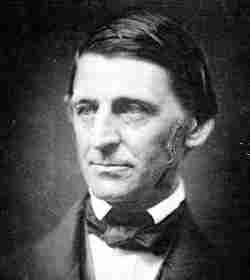
Ralph Waldo Emerson was an American essayist, lecturer, philosopher, abolitionist, and poet who was a major player in the transcendentalist movement of the mid-19th century. He was born in Boston, USA on 25th May 1803 and died in Concord, Massachusetts, USA on 27th April 1882 aged 78.
Major Works
“Nature” (1836)
Emerson published his essays “First Series” which contain his most influential work “Self-Reliance“. (1841)
“Poems” (1846)
“Representative Men” (1850)
“The Conduct of Life” (1860)
“Society and Solitude” (1870)
Biography Timeline
1803: Ralph Waldo Emerson was born on 25th May in Boston, Massachusetts, USA to William Emerson and Ruth Haskins Emerson
1811: His father dies on 12th May from stomach cancer.
1812: He goes to Boston Latin School
1817: He attends Harvard College although he did not do exceptionally well at school.
1821: He begins teaching at a “school for young ladies”. held in his mother’s house.
1822: He publishes his first article, in “The Christian Disciple”.
1826: He preaches his first sermon in Samuel Ripley’s pulpit
1827: His health his poor and he sails to South Carolina and St. Augustine in Florida seeking a cure.
1828: He gets engaged to Ellen Tucker.
1829: He is ordained as junior minister of Second Church (Unitarian) in Boston and marries Ellen on 10th September.
1831: His wife Ellen dies of tuberculosis.
1832: He resigns from the Second Church in October. He takes a trip to Europe visiting Italy, France, England and Scotland.
1833: He meets Samuel Taylor Coleridge, William Wordsworth and Thomas Carlyle in England. He gives his first lecture entitled “The Uses of Natural History” at the Masonic Temple in Boston on 5th November. An article on Coleridge is published in “The Christian Examiner” during the year which provides the first American recognition of the claims of Transcendentalism in which Emerson and Thoreau are to become major figures.
1834: He moves to Concord where he lives with Ezra Ripley, his step-grandfather.
1835: He lectures on “Biography” from January to March. On 14th September he marries Lydia Jackson.
1836: “Nature” is published on 9th September and Emerson helps found the Transcendental Club. His son Waldo is born on 30th October.
1837: He gives “The American Scholar” address at Harvard to seniors, one of whom is Henry David Thoreau.
1838: Andrews Norton attacks his views as “the latest form of infidelity”.
1839: His daughter Ellen is born on 24th February. Elizabeth Peabody opens a bookshop that becomes the meeting place for Transcendentalists.
1840: He begins writing for “The Dial” a publication edited by Margaret Fuller.
1841: His “Essays” are published in March. Thoreau moves into Emerson’s home. His daughter Edith is born on 22nd November.
1842: His son Waldo dies on 27th January. Emerson gives a lecture in New York and meets Henry James. He becomes the Editor of “The Dial”. He visits a Shaker Community with Nathaniel Hawthorne in September.
1844: His son Edward is born on 10th July. Emerson’s “Essays: Second Series” is published on 19th October and sells many copies. He delivers an address entitled “Emancipation in the British West Indies” which is the first public statement against slavery.
1845: Henry David Thoreau moves into self-built cabin on land belonging to Emerson at Walden Pond.
1846: “Poems” is published in December.
1847: He makes a second trip to England and France to give lectures and sees Thomas Carlyle and William Wordsworth.
1850: “Representative Men” is published. Margaret Fuller Ossoli drowns at sea off Long Island, New York on her return from Italy on 19th July.
1851: He gives an address on the Fugitive Slave Law in May.
1853: His mother dies at his home on 16th November.
1854: He meets Walt Whitman in New York City in December.
1856: He publishes “English Traits”.
1859: His brother Bulkeley dies on 27th May.
1860: “The Conduct of Life” is published.
1862: In February he meets Abraham Lincoln. Henry David Thoreau dies on 6th May and Emerson gives the funeral oration.
1863: He writes the “Boston Hymn” based on Lincoln’s Emancipation Proclamation.
1865: His daughter Edith marries William Hathaway Forbes.
1866: He is given an honorary doctorate at Harvard College.
1867: “May Day and Other Pieces” is published.
1868: His brother William dies on 13th September.
1870: He publishes “Society and Solitude” in March.
1872: His house catches fire in July.
1872: He makes his third trip to Europe in October. He visits Thomas Carlyle for the last time and then moves on to Egypt while house is being repaired.
1874: He publishes “Parnasus”.
1875: “Letters and Social Aims” is published.
1876: He lectures at the University of Virginia.
1881: In February he reads a paper at Massachusetts Historical Society on the death of Thomas Carlyle.
Ralph Waldo Emerson died in Concord, Massachusetts, USA on 27th April 1882 and was buried in Sleepy Hollow.
Influences
Emerson was highly influenced by his Aunt Mary Moody Emerson as a young boy. She was well read and was described by her nephew as “the best writer in Massachusetts.” Emerson himself was also a voracious reader of biography, philosophy, history, literature and poetry much of which he read in his Aunt’s collection. Later in life he copied out some of her letters into four of his notebooks and developed his own library.
As a young man he was influenced by the Ancients such as Plutarch and especially Plato whom he reread several times and based his philosophy on him. He also read the works of Isaac Newton, and the philosophers, George Berkeley, Immanuel Kant and Georg Wilhelm Friedrich Hegel.
He was very much inspired by the Romantics both in Britain and in Germany. He met William Wordsworth in England and was a great lover of his poetry much of which he learned by heart. His reading of Samuel Taylor Coleridge’s “Aids to Reflection” helped him merge the ideas of Plato and his contemporaries with more modern thinkers and helped him understand the power of self.
He was also taken by the works of the German writer Johann Wolfgang von Goethe and in particular his views on science and nature. Emerson wrote “Goethe teaches courage”. Other writers he read were Michel de Montaigne, the Polish poet Adam Mickiewicz and the Scotsman Thomas Carlyle who became a friend and correspondent and whose “State of German Literature” introduced Emerson and others to Transcendentalism. He was particularly influenced by Emanuel Swedenborg whose concept that God is in everything appealed strongly and encouraged him to write about the relationship between the natural, scientific and divine worlds. He also read the works of the French philosopher Victor Cousin who inspired a life-long interest in Asian philosophy. Via him he came to the Bhagavad Gita and later the Vedanta.
As a lecturer and orator, Emerson became known as the Sage of Concord and influenced many other students and writers. He was the leader of the New England Transcendentalists which included Henry David Thoreau and the minister and Transcendentalist Theodore Parker described Emerson’s great ability to influence and inspire others. Some writers have seen a direct influence on the work of Emily Dickinson although it is not known if the two ever met. In “The American Religion” the critic Harold Bloom describes him as the prophet of the American Religion. Many writers have also pointed to his influence on the philosopher Friedrich Nietzsche.
Emerson influenced Thoreau’s career and encouraged him to write and publish his works and was also an inspiration for the American philosopher William James and Walt Whitman. On the other side of the coin writers such as Herman Melville, Nathaniel Hawthorne and Henry James have been described as Emersonions in denial and T.S. Eliot went further by describing him as an “encumbrance”. Emerson fell out of favour after the First World War but was then taken up again in the 1960’s by the likes of the poets Robert Frost, Hart Crane and Wallace Stevens.The first full scale criticism of his work. George Searle Phillip’s “Emerson, His Life and Writings” was published in London in 1855 and his first biography appeared in 1881, “Ralph Waldo Emerson” by George Willis Cooke.
Further Information
List of works by Emerson.