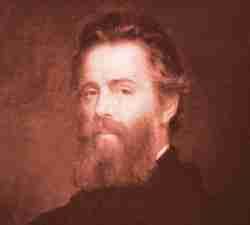
Herman Melville was an American novelist, short story writer, and poet of the American Renaissance period. He was born in New York City, USA on 1st August 1819 and died there on 28th September 1891 aged 72.
Major Works
“Typee” (1846)
“Omoo” (1847)
“Moby-Dick; or, The Whale” (1851)
“Enchanted Isles” (1854)
“Israel Potter: His Fifty Years of Exile” (1855)
Biography Timeline
1819: Herman Melville was born on 1st August in New York City. His father Allan was a merchant importing dry goods from Europe and spent much of his time there. His mother was Maria nee Gansevoort. On 19th August Melville was baptised at home by a minister of the South Reformed Dutch Church reflecting his mother’s Dutch heritage. Melville was the third of eight children and lived in a comfortable house with servants although his father lived beyond his means and borrowed heavily.
1824: He begins his schooling aged five. The Melville family move to a newly built house at 33 Bleecker Street in Manhattan.
1826: He contracts scarlet fever.
1829: His older brother Gansevoort and he transfer from the New York Male High School to Colombia Grammar and Preparatory School in September.
1830: His father opens a fur business in Albany, New York. His mother’s family end their financial support for the Melvilles and his father begins to run up debts. Melville moves to the Albany Academy where he reads widely in history and literature.
1831: Melville and his siblings leave school to work in the family fur and cap business as their father can’t afford the school fees. Melville holds down several other positions to help the family finances such as teaching at local schools and working on his uncle’s farm.
1832: His father begins to show signs of delirium and he dies on 28th January. His mother seeks consolation in her faith and in April she is admitted as a member of the First Reformed Dutch Church and gives her children a religious upbringing. His uncle, Peter Gansevoort, gives Melville a position as a clerk in the New York State Bank where he is a director. His paternal grandfather dies on 16th September but his mother only receives $20 dollars as she finds her husband has already spent the remainder of her inheritance.
1834: In May the family move to another house in Albany. His uncle’s skin preparing factory burns down and he has to lay many of his workers off. Melville is pulled out of the bank to man the family’s cap and fur store.
1835: Whilst still working in the store, Melville enrols in Albany Classical School and joins the local Young Men’s Association for Mutual Improvement which his brother Gansevoort had become a member of the year before.
1836: In September he enrols on a Latin course at the Albany Academy and takes part in the local debating society.
1837: Due to the financial “Panic of 1837” the business hits a crisis and both Melville and his brother are withdrawn from the Academy due to lack of funds. Gansevoort begins studying law in New York City and Herman gets a teaching position at Sikes District School near Lenox, Massachusetts.
1838: He is elected president of the Philo Logos Society, which his uncle Peter Gansevoort allows to use Stanwix Hall for no rent. Melville publishes two letters in the “Albany Microscope” about issues discussed in the debating society. In May, the family move to a house in Lansingburgh. His first known published essay appears in the “Democratic Press and Lansingburgh Advertiser” entitled “Fragments from a Writing Desk”.
1839: He teaches at Greenbush, New York but leaves after one term as he is not paid. Melville, now aged twenty, takes a job as a cabin boy on the merchant ship the St. Lawrence traveling from New York City to Liverpool in England which leaves on 31st May.
1840: On his return in the summer he and his friend James Murdock Fly go to Galena in Illinois to see if his Uncle Thomas can help them find work. Unsuccessful they return home in the autumn after a long tour in the west.
1841: Herman and his brother then go to New Bedford, and Herman signs up for a whaling voyage aboard a new ship, the “Acushnet”, in January. Melville sleeps in the forecastle with twenty others whilst Captain Valentine Pease and the skilled men sleep aft. Whales are found in March near the Bahamas and whale oil is sent home via Rio de Janeiro. On 15th April the Acushnet rounds Cape Horn without catching any more whales. On 7th May off the coast of Chile they are lucky and board more oil. On 24th October the ship crosses the equator heading north.
1842: They land at the Galápagos Islands on 6th January. No more whales are captured and on 23rd June the ship anchors at Nuka Hiva in the Marquesas Islands. Melville and his shipmate Richard Tobias Greene decide to jump ship only to be captured by the Typee cannibals. They are finally rescued by the Australian whaler ship “Lucy Ann” when it arrives a month later. This ship is bound for Tahiti but a mutiny takes place on board and Melville is briefly jailed in the Calabooza Beretanee (English Jail). In October he and crew mate John B Troy escape Tahiti and travel to the Island of Eimeo where they spend a month and then on to Moorea. In November he becomes a harpooner on the “Charles and Henry”, a ship from Nantucket.
1843: He is discharged from the ship in the Hawaiian Islands. In April he works as a clerk and bookkeeper in a store in Honolulu and then in August he enlists in the US Navy and works on the ship “United States” through the Pacific.
1844: In October after being discharged from the Navy Melville finally returns to his mother’s house wanting to write about his many adventures.
1845: His first manuscript “Typee” is rejected by US publishers as they refuse to believe it is true but his brother Gansevoort, now working for the American Legation in Troy, New York, sends it to British Publishers.
1846: “Typee” is published in February by John Murray in London and it becomes a best seller almost immediately. Due to this success it is published separately in New York in March.
1847: He tries to find a job working for the government in Washington but is unsuccessful. He marries Elizabeth Shaw on 4th August. She is the daughter of the chief justice of Massachusetts and a family friend. Her father had turned him down at first but then relented. They avoid a church wedding due to Melville’s new-found celebrity. The couple move to New York City and live with his younger brother, mother, and four sisters. He publishes his next novel “Omoo” which is equally successful and he begins his third book of adventures.
1848: “Mardi and a Voyage Thither” is published in London and in New York.
1849: On 16th February Malcolm, their first child is born. He meets Nathaniel Hawthorne who becomes a friend and constructive critic. Melville begins to write two more novels, “Redburn: His First Voyage” and “White-Jacket” which he later claims were simply for the money and the prestige. They are moderately successful when they published.
1850: “White Jacket” is published in January in London and in March by Harper in New York. The earliest surviving mention of “Moby-Dick” is in a letter in May to a fellow author Richard Dana junior. During August he spends time with literary friends including Nathaniel Hawthorne and Oliver Wendell Holmes. He writes a review of Hawthorne’s latest work in “The Literary World” entitled “Hawthorne and his Mosses”. In September he borrows money from his father in law to buy a farm in Pittsfield, Massachusetts which he calls “Arrowhead” due to the articles dug up on the land.
1851: “The Whale” is published in London in October and in November in the United States as “Moby Dick.” Despite his high hopes for the novel literary critics are not impressed and the book does not sell well. Their second child Stanwix is born on 22nd October.
1852: His financial security now goes downhill. His psychological romance “Pierre, or the Ambiguities”, based on his own childhood is also badly received and in September the newspaper “The Daybook” prints an attack on him with the headline “Hermann Melville Crazy”.
1853: He now turns to writing short stories and poetry, publishing them in “Putnam’s Monthly Magazine”. Their first daughter Elizabeth is born on 22nd May. He finishes work on the “Isle of the Cross” and cannot find a publisher for his next novel “Israel Potter” which is then serialised in “Putnam’s” followed by fourteen other stories over the coming months.
1854: He writes “Enchanted Isles”.
1855: Their child Frances is born on 2nd March. In December “The Piazza Tales” collection is published by Putnam’s new owners Dix and Edwards.
1856: He visits Nathaniel Hawthorne in November in Liverpool in England, who is now a US Consul, and then sets off on a grand tour of Europe, the Mediterranean and the Holy Land.
1857: On 1st April Melville publishes his last full-length novel, “The Confidence Man” which again receives poor reviews. He begins giving a series of lectures in Italy on Roman statuary, the South Seas and anecdotes about his travels.
1860: He boards the clipper “Meteor” bound for California with his brother Thomas at the helm and they arrive back in New York in November. He submits his poetry for publication but it is not accepted and the manuscripts have now been lost.
1863: He buys his brother’s house at 104 East 26th Street in New York City.
1864: He visits the Virginia battlefields of the American Civil War.
1866: He becomes a customs inspector for New York City. He publishes “Battle-Pieces and Aspects of the War” which is a collection of 72 poems. This work does not sell well and he begins to suffer from nervous exhaustion.
1867: His son Malcolm dies at the age of 18 from a self-inflicted gunshot wound. No one knows if it is accidental or deliberate. In May his wife’s brother Sam tries to get her to leave him and declare to a court that he is insane, however she refuses.
1876: His poem “Clarel: A Poem and Pilgrimage in the Holy Land” is published after he has spent years writing it. Only 350 copies are bought and the unsold copies are burnt.
1884: His wife Elizabeth receives a legacy that enables him to buy books and prints.
1885: In December several of his wife’s other relatives support them financially.
1886: On 22nd February their younger son Stanwix dies of tuberculosis in San Francisco.
1888: He still writes poetry and prints “John Marr and Other Sailors” privately for friends and family.
1889: He becomes a member of the New York Society Library.
1891: He publishes “Timoleon” and starts work on “Billy Budd, Foretopman” about a sailor falsely accused of involvement in mutiny which is incomplete at his death.
Herman Melville died on 28th September 1891 in New York of a heart attack. He is buried in the Woodlawn Cemetery in the Bronx in New York City.
Influences
Herman Melville left school early but was an eager reader and like to teach himself new ideas for most of his life. He read the works of William Shakespeare, Miguel de Cervantes, John Milton particularly in “Paradise Lost”, Dante Alighieri, Daniel Defoe, Voltaire, the philosopher Michel de Montaigne and the Portuguese poet Luis de Camões. He was an avid reader of Shakespeare and was particularly influenced by some of the sombre passages in “Measure for Measure” and “King Lear” which made him realise that the transcendental views about human goodness of Ralph Waldo Emerson, whom he had heard lecture, were not completely true.
There are many religious allusions in his writings which show his knowledge of the Bible which he read thoroughly as a youth. Later he admitted there was a divine creative force in the universe but did not generally agree that the universe was “good” or believe in a Christian God which puts man above all other creation.
He was also influenced by the English Romantics including “Childe Harold’s Pilgrimage” by Lord Byron, Samuel Taylor Coleridge, William Blake, Percy Bysshe Shelley and his wife Mary. Another English writer who made a great impression on him was Thomas Carlyle and he also read the German polymath Johann Wolfgang von Goethe.
Amongst other American writer’s his friendship with Nathaniel Hawthorne and admiration of his work influenced his decision to widen the scope of “Moby Dick” from a purely adventure novel to something more spiritual. He also dedicated the work to Hawthorne. There are numerous letters written between Melville and Hawthorne which state their friendship and love for each other but there was nothing to suggest there was any sexual attraction. Other American writers who influenced his work were Edgar Allan Poe, Henry David Thoreau, James Fenimore Cooper, Walt Whitman and Owen Chase who had published an account in 1821 about his experiences of whaling and a shipwreck.
His style has been called “unceasingly allusive” and his descriptions of life out at sea are very detailed however “Moby Dick” wasn’t recognised as a literary masterpiece until the twentieth century and it sold poorly in his lifetime. It was criticised for its mad English and ravings. However, its combination of vivid action, and symbolic philosophy has had an enormous influence on the American novel ever since. Whilst he was still alive his best known work was “Typee” a fictional account of life in Polynesia. Also a poet he did not publish anything until 1866 in his late forties and he wasn’t even seen as a poet at all until the until the twentieth century. By 1876 all of his books were out of print.
Together with his friend, Nathaniel Hawthorne however they helped to give American literature with its own character and provided a break from European social realism. His story “Bartleby the Scrivener” has been considered as a precursor to existentialist and absurdist literature even though it wasn’t popular at the time of its writing. In 1998 the Algerian-French writer Albert Camus stated in the “French Review” magazine that Melville, rather than Kafka, was one of his main influences. Other writers who have been influenced are W.H. Auden, Normal Mailer, Philip Roth as well as Jack Kerouac and other member of the Beat generation particularly for his avoidance of conventionality. From 1982 the publishers Library of America began issuing his works in honour of his major place in American literature but even they did not publish his complete poetry until 2019.
Further Information
List of books by Melville in chronological order.