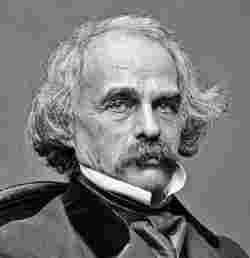
Nathaniel Hawthorne was an American novelist and short story writer. His works were often moral or religious in nature. He was born in Salem, Massachusetts, USA on 4th July 1804 and died in Plymouth, New Hampshire, USA on 19th May 1864 aged 59.
Major Works
“The Scarlet Letter” (1850)
“The House of the Seven Gables” (1851)
“The Blithedale Romance” (1852)
“The Marble Faun” (1860)
Biography Timeline
1804: Nathaniel Hathorne (later Hawthorne in his twenties) was born on 4th July in Salem, Massachusetts, USA. His father was Nathaniel Hathorne, a U.S. Navy captain and his mother was Elizabeth Manning. Nathaniel was their second child.
1808: His father Nathaniel dies of yellow fever in Dutch Suriname. His mother moves the family to live with relatives in Salem. His uncle Robert Manning oversees the boy’s education.
1813: In November he becomes lame after an accident in a bat and ball game and is bedridden for a year.
1816: The family board with farmers before moving to a new home built for them by uncles Richard and Robert Manning in Raymond, Maine.
1819: He is sent back to Salem to go to school and complains of homesickness from his mother and sisters.
1820: He distributes seven issues of his magazine “The Spectator” amongst his family which includes poems, essays and schoolboy humour.
1821: He is sent to Bowdoin College in Brunswick, Maine. He meets Franklin Pierce on the way there (who is later to become US President) and the two become friends. At school he meets Henry Wadsworth Longfellow.
1825: He graduates from Bowdoin and moves in with his family in Salem and retreats from the world, takes his meals alone and spends his time writing.
1828: His first published work, a novel entitled “Fanshawe”, based on his experiences at school, is published anonymously in October. He pays for it himself but it does not sell well. He also publishes a few pieces in the local newspaper the Salem Gazette.
1832: He publishes a collection of short stories called “Roger Malvin’s Burial”.
1836: He becomes editor of the “American Magazine of Useful and Entertaining Knowledge” and lives with the poet Thomas Green Fessenden in Boston.
1837: He publishes the short story collection “Twice Told Tales”.
1839: In January he starts work as a Weigher and Gauger at the Boston Custom House. He contributes short stories to several magazines including “Young Goodman Brown” and “The Minister’s Black Veil”.
1841: He courts Mary Silsbee and Elizabeth Peabody but then sets his heart on Elizabeth’s sister Sophia who is an artist and transcendentalist. He leaves his job and joins Sophia’s community at Brook Farm in Roxbury Massachusetts in order to save enough money to marry her and finds inspiration there for his novel “The Blithedale Romance”. The marriage takes place on 9th July in Boston. The couple move to the Old Manse in Concord, Massachusetts where he meets a neighbour Ralph Waldo Emerson.
1842: The Poet Ellery Channing visits them at the Old Manse and helps him recover the body of the teenage Martha Hunt from the river.
1844: Their first child, a daughter called Una, is born on 3rd March.
1845: In October the Hawthornes move to Salem.
1846: Their son Julian is born. In April he is officially appointed the Surveyor for the District of Salem and Beverly and Inspector of the Revenue for the Port of Salem. His work leaves him little time for writing.
1848: Hawthorne, a Democrat, loses his post after the Presidential Election when a new administration takes over. He writes a letter of complaint to the “Boston Daily Advertiser” which becomes a source of much discussion in political circles. He gets another job as corresponding secretary of the Salem Lyceum where he meets Henry David Thoreau.
1850: He publishes “The Scarlet Letter” ,which is a thinly alluded satire on his work at the Customs House. It becomes a sensation and is one of the first mass-produced books in America. The family move to a farmhouse at Lenox, Massachusetts in March. In July his mother dies which affects him terribly and he falls into a depression. In August he meets the novelist Hermann Melville and the two become friends. Melville has already written a review of Hawthorne’s “Mosses from an Old Manse” in the Literary World magazine.
1851: In May their daughter Rose is born. He publishes “The House of the Seven Gables”. He also publishes “A Wonder Book for Girls and Boys”. Hermann Melville dedicates his “Moby Dick” to Hawthorne.
1852: In May they return to Concord and live at Hillside. He writes “The Life of Franklin Pierce” for Pierce’s political campaign. He publishes “The Blithedale Romance” about the Brook Farm utopian community and“The Snow Image, and Other Twice-Told Tales”.
1853: Franklin Pierce becomes President of the United States and offers Hawthorne the job as US Consul in Liverpool, England, then regarded as a prestigious position. The family move to live in Rock Ferry on the Wirral side of the River Mersey. He publishes the story stories “Tanglewood Tales”.
1857: When Pierce’s administration falls he is out of a job but decides to stay on in England. They go on a much-needed holiday touring France and Italy.
1860: The family return to Concord.
1861: At the outbreak of the American Civil War he joins the publisher William D Ticknor on a visit to Washington DC and meets Abraham Lincoln.
1862: He writes about his experiences in Washington in the essay “Chiefly About War Matters”.
1863: In December his novel “The Marble Faun” is published.
1864: On 19th May he publishes “Our Old Home” about his time in Europe. His health is suffering and he experience severe stomach pains. He tours the White Mountains with Franklin Pierce in the hope of a cure.
Nathaniel Hawthorne died in his sleep on 19th May 1864, in Plymouth, New Hampshire. He was buried on Author’s Ridge in Sleepy Hollow Cemetery in Concord, Massachusetts, USA. Pallbearers included Henry Wadsworth Longfellow, Ralph Waldo Emerson, and Oliver Wendell Holmes. His wife Sophia and daughter Una were originally buried in England but were moved to Sleepy Hollow in June 2006.
Influences
Nathaniel Hawthorne grew up within a Puritanical family background and this coloured his later writings particularly in relation to the importance of community relations. Whilst he was at college he was fond of British authors and especially Edmund Spenser, John Bunyan and Sir Walter Scott. Amongst American writers he read were James Fenimore Cooper, and William Gilmore Simm. All of these authors helped him formulate his own exploration of human experience and morality.
He suffered a temporary paralysis during his youth and studied at home under Joseph Emerson Worcester where they read many literary classics and Enlightenment authors. Later when he attended Bowdoin College in 1821 he began to write his poetry and an early novel.
He became a member the Transcendentalist movement by choice, which endeavoured to transcend the plainly materialistic world and he was highly influenced by his neighbours Ralph Waldo Emerson and Henry David Thoreau as well as being interested in the social and cultural movements of his time. Several of his works, such as “The Scarlet Letter” and “Young Goodman Brown”, went on to explore the hypocrisies of a Puritan society. He wrote “The Scarlet Letter” in a mere six months after the death of his mother.
The Salem witchcraft trials of 1692/3 had a major effect on his views of the complex relationship between humans, nature, and religion and in particular showed him the evil side of human nature. He added a ‘w’ to his surname because his great-great grandfather, Jon Hathorne, was one of the judges during the trials and he wanted to distance himself from that ancestor. Much of his writing centers around the New England area before the American Civil War and is full of moral metaphors and he became considered part of the Dark Romantic movement. Although many of his books include religious sentiments he never belonged to any religious organisation.
His writings were also influenced by the rapid development of a capitalist economy in the United States which necessitated significant changes to the social structure. Unusually for a man of the time he has been described as a feminist as he showed not only men’s attitudes to women but also women’s struggles against male fantasies.
During his lifetime his writings were well received after a slow start and critics and readers praised his sentimentality and moral purity. He was never, however, rich from his efforts. Today he is regarded as one of the greatest fiction writers of nineteenth century America. Many other writers at the time were influenced by him. Herman Melville in particular dedicated “Moby Dick” to him in 1851 and Henry James and William Faulkner were fascinated by his symbolic method and his exploration of the darker side of human experience. He has been seen as one of the founders of psychological realism. Edgar Allan Poe wrote reviews of “Twice-Told Tales” and “Mosses from an Old Manse” and stated “The style of Mr. Hawthorne is purity itself”. His tone is singularly effective—wild, plaintive, thoughtful, and in full accordance with his themes … We look upon him as one of the few men of indisputable genius to whom our country has as yet given birth”. ” The Quaker poet John Greenleaf Whittier wrote that he admired the “weird and subtle beauty” in Hawthorne’s tales.
Other writers who were influenced by him were Henry David Thoreau, H.P. Lovecraft, Robert Louis Stevenson, Henry James, the realist William Dean Howells and in the twentieth century John Updike, Robert E. Howard and John Irving.
The great twentieth century critic Harold Bloom said that only Henry James and William Faulkner challenged Hawthorne’s position as the greatest American novelist and saw his greatest works as “The Scarlet Letter” and “The Marble Faun” along with a few of his short stories.
In psychology the Hawthorne Effect, named after him, is used to describe a type of modified human behavior exhibited when individuals become aware of being observed. Douglas McGregor’s Theory X and Theory Y management styles were also influenced by the works of Hawthorne as was Abraham Maslow’s Hierarchy of Needs.
Further Information
List of books by Hawthorne.