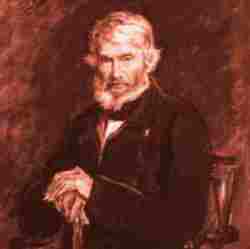
Thomas Carlyle was an influential Scottish essayist, historian, and philosopher of the Victorian era. He was born in Ecclefechan, Scottish Borders on 4th December 1795 and died in London on 5th February 1881 aged 85.
Major Works
“The Life of Schiller” (1825)
“Sartor Resartus” (1833-4)
“The French Revolution”. (1837)
“Chartism” (1839)
Biography Timeline
1795: Thomas Carlyle was born on 4th December at Ecclefechan in Dumfriesshire, Scotland. He was the son of a poor Calvinist stone mason and the oldest of nine children. He was educated at Annan Grammar School and then Edinburgh University studying Mathematics and divinity.
1814: He becomes a teacher of mathematics at Annan Academy. He becomes interested in German literature and philosophy.
1818: He returns to Edinburgh University to study law after undergoing a spiritual crisis when he gave up his Christian faith. He writes articles for the “Edinburgh Encyclopedia”.
1821: He meets the writer Jane Baillie Welsh who was later to become his wife.
1823: His first major work is published in “The London Magazine” about the “Life of Schiller”. (Friedrich von Schiller)
1826: He marries Jane Baillie Welsh, a doctor’s daughter and writer.
1828: He moves to live on his wife Jane’s estate at Craigenputtock, near Dumfries to live more frugally. He settles down to writing works on social philosophy.
1829: “Signs of the Times” is published in the Edinburgh Review”.
1831: He takes a long time to find a publisher for “Sartor Resartus” which is a mixture of novel and autobiography about the value of clothes and human values. Eventually it is taken up by Fraser’s Magazine. He meets John Stuart Mill for the first time.
1832: The American writer Ralph Waldo Emerson visits him in Scotland.
1834: He moves to Chelsea in London where he is to spend the rest of his life. He starts writing his major work “The French Revolution”. He becomes a member of a literary circle that included the essayists Leigh Hunt and the philosopher John Stuart Mill.
1835: Unfortunately Mill’s servant uses the manuscript of the first volume of “The French Revolution” to start a fire.
1836: Emerson helps him publish “The French Revolution” in America.
1837: He completes and publishes both volumes of “The French Revolution” in England.
1838: He publishes “Sartor Resartus” in England. He forms a hatred of Democracy.
1840: He begins giving a series of lectures on heroes, Chartism and history.
1841: He gives a series of lectures “On Heroes, Hero-Worship, and the Heroic in History”.
1845: “The Letters and Speeches of Oliver Cromwell” is published.
1850: He publishes “Latter Day Pamphlets”.
1858: He begins writing “The History of Friedrich the Great of Prussia”.
1866: He becomes Lord Rector of Edinburgh University and gives an inaugural address. Death of his wife on the 21 April whilst out riding in her carriage.
1874: He accepts the Prussian Order of Merit from the Iron Chancellor, Otto von Bismarck, but refuses a Baronetcy from the English Prime Minister Benjamin Disraeli.
Thomas Carlyle died on 5th February 1881 in Chelsea of natural causes and was buried at Church Cemetery, Main Street, Ecclefechan in Scotland next to bis mother as he refused to be buried in Westminster Abbey.
Influences
Carlyle was brought up in a strongly Calvinist household although he eventually rebelled against its strictures. He was very well read and devoured works by William Shakespeare, Johann Wolfgang von Goethe, Johann Gottlieb Fichte, Friedrich Heinrich Karl de la Motte and the Swiss jurist, statesman and political philosopher Karl Ludwig von Haller. He also read other languages such as French, Latin, Greek, German, Italian, Spanish, and even Danish.
In his own work he often quotes from the Bible and philosophers such as Jean-Jacques Rousseau, Voltaire, Immanuel Kant, Georg Wilhelm Friedrich Hegel and Romantics such as Novalis, Friedrich Schelling and Friedrich von Schlegel. He often wrote about his heroes such as Dante Alighieri, John Knox, Martin Luther, Oliver Cromwell, Napoleon Bonaparte and Frederick the Great and he believed society was founded on hero worship.
Many critics have tried to categorise him. Some say he was a conservative, others not, some say he had a religious or social viewpoint others not. What is certain is that his views covered a wide range of subjects from literature to philosophy, art to social politics, history to aesthetics. The novelist George Eliot went as far as to say that there was no one in the Victorian period who hadn’t been influenced by him at least to a certain extent.
He rejected doctrines which professed to know the nature of God, believing that such knowledge is impossible. He conceived of a “new Mythus”, called Natural Supernaturalism and believed reasoning was the superior function of man which would allow him to become transcendent and in “Sartor Resartus” he states “the Universe is but one vast Symbol of God”. He thought that the belief in an eternal, omnipresent and metaphysical order in the “unknown deep” of nature is the “divine idea of the world”, and lies at the core of Natural Supernaturalism.
Carlyle was not only a major influence in Britain but also in America particularly in American Transcendentalism. Many writers followed him such as Louisa May Alcott, William Henry Channing, Henry David Thoreau, Ralph Waldo Emerson and scores more. He also had a major effect on the Victorian ideas on medievalism which were popular at the time.
The English author G.K. Chesterton stated that much of the philosophy of Friedrich Nietzsche can be traced to Carlyle although Nietzsche himself denied this. However, he did influence the Young Poland movement and many writers and thinkers in Romania. His two most import followers were John Ruskin in England and Ralph Waldo Emerson in The USA who described himself in 1870 as “Lieutenant to Carlyle’s General in Chief”. However, in England Matthew Arnold, Elizabeth Barrett Browning, Robert Browning, Charles Dickens, John Stuart Mill, Arthur Conan Doyle, D.H. Lawrence, the Bronte Sisters, Anthony Trollope and George Bernard Shaw owed him a great debt. In the rest of Europe he had an influence on Marcel Proust, Andre Gide and Luigi Pirandello and worldwide on figures as important as Jorge Luis Borges, Herman Melville, T.S. Eliot and James Joyce. His concept of symbols also influenced Symbolism in France.
In politics he influenced Young England conservatism and Christian Socialism and his works have been quoted by Karl Marx, Friedrich Engels, Mahatma Gandhi and Richard Wagner. He also inspired reformers such as Emmeline Pankhurst, Octavia Hill and Martin Luther King Junior. In art he was referenced by the Pre-Raphaelite Brotherhood and artists of the Arts and Crafts Movement such as William Morris. William Holman Hunt used Carlyle as a model for the head of Christ in his painting “The Light of the World” and he appears as himself in Ford Madox Brown’s painting “Work”. William Makepiece Thackeray thought that Carlyle had done more than any other to establish “art for art’s sake”. His views on aestheticism were also a direct influence on people such as Oscar Wilde and the poet W.B. Yeats.
Further Information
Please see Britain Unlimited’s Thomas Carlyle page for further information.
List of works by Carlyle.