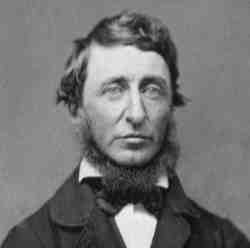
Henry David Thoreau was an American naturalist, essayist, poet, and philosopher. He was also an influential transcendentalist. He was born in Concord, Massachusetts, USA on 12th July 1817 and died on 6th May 1862, also in Concord aged 44.
Major Works
“Civil Disobedience” and “Resistance to Civil Government” (1849)
“Walden; or, Life in the Woods” (1854)
“Echoes of Harper’s Ferry” (1860)
Biography Timeline
1817: Henry David Thoreau was born on 12th July in Concord, Massachusetts, USA. His father John Thoreau was a pencil maker and his mother was Cynthia (nee Dunbar). His paternal grandfather had been born on the British Isle of Jersey and his maternal grandfather, Asa Dunbar, had led the “Butter Rebellion” at Harvard College which was the first recorded student protest in the American colonies. He was christened David Henry but always styled himself with the names in reverse order.
1828: He starts his education at the Concord Academy.
1833: He goes to Harvard College where he lives in Hollis Hall and studies classics, philosophy, mathematics, and science.
1835: He takes leave of absence from Harvard and teaches at a school in Canton, Massachusetts. There he contracts tuberculosis which is to reoccur throughout his life.
1836: He writes the poem “Nature”.
1837: He officially graduates from Harvard but according to legend refuses to pay the fee for his Harvard master’s diploma. He teaches at the Concord public school but resigns after a few weeks as he opposed the giving of corporal punishment. He meets Ralph Waldo Emerson through a mutual friend. Emerson suggests Thoreau should contribute essays and poems to “The Dial” a quarterly periodical and lobbies the editor Margaret Fuller on his behalf.
1838: He opens Concord Academy, a private school, with his elder brother John.
1839: John and he travel by boat on the Concord and Merrimack rivers which supplies material for Thoreau’s first book, “A Week on the Concord and Merrimack Rivers”.
1840: In July “Aulus Persius Flaccus”, about the Roman poet and satirist, is his first essay published the “The Dial”. During this period, he follows transcendentalism as advocated by Emerson, Fuller and Alcott.
1841: On 18th April he moves in with the Emerson family. He acts as children’s tutor, assistant to Emerson and general odd job man.
1842: His brother John dies in his arms after contracting tetanus and lockjaw after cutting himself shaving. The school they had established is forced to close. His essay “Natural History of Massachusetts” is published.
1843: He moves to Staten Island, New York for seven months ostensibly to tutor William Emerson’s nephew but in reality, to make it as a writer in New York. Homesick and lacking in paid literary employment he goes back to Concord. He publishes “A Walk to Wachusett” and “A Winter Walk”.
1844: Back in Concord Thoreau works in his family’s pencil factory where they are now using the Conte process. He continues writing whilst working there. In April he and his friend Edward Hoar accidentally start a fire that destroys 300 acres of Walden Woods.
1845: He begins a two-year experiment in simple living by building a small cabin on land owned by Emerson in the forest around the shores of Walden Pond. Whilst there, he writes his only large piece of literary criticism entitled “Thomas Carlyle and his Works”.
1846: On 24th or 25th July Thoreau accidentally bumps into the local tax collector, Sam Staples, who asked him to pay six years of poll taxes. He refuses due to his opposition to the Mexican-American War and slavery and thus has to spend one night in jail. Someone, probably his aunt, pays the tax and he is released. This story is related in his essay “Civil Disobedience”. He makes a brief trip to Mount Katahdin in Maine during the year.
1847: He is asked to move back into the Emerson house to help Emerson’s wife Lidian while her husband is away in England.
1848: In January and February he gives lectures at the Concord Lyceum on “The Rights and Duties of the Individual in relation to Government” and explains his tax resistance. “Katahdin and the Maine Woods” is published. In July Thoreau moves out of the Emerson’s house and moves to nearby Belknap Street.
1849: His sister Helen dies of tuberculosis. He self-publishes “A Week on the Concord and Merrimack Rivers” about their trip to the White Mountains as a tribute to his brother John but fewer then 300 copies are sold. He starts work as a surveyor in order to pay off his debts. Elizabeth Peabody publishes his essay “Resistance to Civil Government” in her publication “Aesthetic Papers” in May.
1850: He moves to 255 Main Street where he is to live for the rest of his life. In the summer he travels to Cape Cod and Quebec.
1851: He becomes engaged in the “Underground Railroad”, a network of secret routes and safe-houses in the USA, due to his annoyance at the passing of the Fugitive Slave Act. He becomes more and more interested in natural history and is an admirer of Charles Darwin’s “Voyage of the Beagle”. He begins to keep detailed notes on the countryside around him.
1853: Parts of “A Yankee in Canada” are published.
1854: “Walden, or Life in the Woods” is published. He travels to Philadelphia and New York City. “Slavery in Massachusetts” is published.
1856: He surveys the Eagleswood Community near Perth Amboy, New Jersey.
1857: He travels to Cape Cod and Maine Woods. “Chesuncook” is published.
1858: He travels to the White Mountains in New Hampshire.
1859: His father dies. Thoreau delivers a lecture in Concord on 30th October, “A Plea for Captain John Brown”.
1860: “A Plea for Captain John Brown” is published in his essay “Echoes of Harper’s Ferry”. He reads Darwin’s “Origin of Species” and publishes “The Succession of Forest Trees”. He contracts bronchitis after counting tree rings one night during a rain storm. His health never fully recovers.
1861: He travels to Minnesota to try and regain his health. Back in Concord, he spends months working on his journal and compiling lists and charts about seasonal variations. He works on his books “The Maine Woods and Cape Cod” and “Faith in a Seed and Wild Fruits”. He travels to Detroit, Chicago and the Great Lakes region and visits Niagara Falls.
Henry David Thoreau died on 6th May 1862 of tuberculosis. Emerson wrote the eulogy at the funeral and Thoreau was buried in the Dunbar family plot. He and his family’s remains were later moved to Sleepy Hollow Cemetery in Concord, Massachusetts.
Influences
Henry Thoreau was influenced by the works of the Ancients, men like Homer, Aristotle, Virgil and Plotinus. He was also familiar with philosophers such as Rene Descartes, John Locke and Jean-Jacques Rousseau. He discussed his own scientific findings with leading naturalists of the day and read the latest work of Alexander von Humboldt and Charles Darwin with admiration. He also read widely amongst the Romantics such as Samuel Taylor Coleridge in England and the works of Johann Wolfgang von Goethe and the German Idealists.
In America his biggest influence was the philosopher and transcendentalist Ralph Waldo Emerson whom he met at Harvard University and introduced him to thought from around the world as well as his own ideas. After working in a pencil factory he was asked to become a live-in handyman by Emerson who was by then already a famous philosopher and men of letters and who encouraged him to write. His most famous work “Walden or Life in the Woods” published in 1854 was written whilst living in a cabin built on land owned by Emerson. Other people whom he was influenced by were the American Nathaniel Hawthorne and the British thinker Thomas Carlyle.
In his own day he was known as an essayist and a naturalist and his famous essay “Civil Disobedience” of 1846 was written after a night when he was held in Concord jail for nonpayment of the poll tax. He never had much faith in governments and said that government is unlikely to act on the will of the people and that it is liable to be abused and perverted before the people can act through it.
Thoreau believe disliked organised religion but nevertheless was deeply religious and believed that God was all around people and didn’t need to be found in church. He was drawn to Hinduism as a supplementary way of conceptualising God and a person’s relationship to the world around them. His most most famous quote was “You must live in the present, launch yourself on every wave, find your eternity in each moment”.
Although his political essays have become famous, they had little impact during his lifetime and his works on natural science were not published until the late twentieth century. He was seen at the time purely as a naturalist and the only two complete books that were published in his lifetime, “Walden” and “A Week on the Concord and Merrimack Rivers” both dealt with nature.
After his death critics and the public continued either to dislike or ignore him until 1893 onwards when a definitive set of Thoreau’s works by the Riverside Press led to the rise of what has been termed a “Thoreau cult”. In Britain Henry Stephens Salt wrote a biography of him in 1890, popularising his ideas in Britain which were picked up by other writers such as George Bernard Shaw and the socialists Edward Carpenter and Robert Blatchford.
Nathaniel Hawthorne himself had mixed feelings about Thoreau. He noted that he was a keen observer of nature but that he repudiated all regular modes of getting a living, and seems inclined to lead a sort of Indian life among civilized men”. The poet John Greenleaf Whittier went further detesting what he called the heathenish message of “Walden”, claiming that Thoreau wished man to “lower himself to the level of a Woodchuck”. In Britain the English novelist George Eliot wrote in the “Westminster Review” that such critics were uninspired and narrow-minded.
Thoreau’s idea of civil disobedience has been adopted by several twentieth-century leaders. In particular Mahatma Gandhi who first read “Walden” in 1906 whilst in prison in Johannesburg, South Africa for the crime of non-violently protesting discrimination against the Indian population in the Transvaal. He called Thoreau “one of the greatest and most moral men America has produced”. Likewise, Martin Luther King stated in his autobiography that his first encounter with the idea of nonviolent resistance was reading “On Civil Disobedience” in 1944 whilst at college. His ideas have resonated with anarchist movements in the USA and in Spain, France, and Portugal.
There have been many writers influenced by his work including Leo Tolstoy, Marcel Proust, William Butler Yeats, the American Novelist Sinclair Lewis and Ernest Hemingway. People as diverse as the architect Frank Lloyd Wright and the psychologist B.F. Skinner were also influenced. Skinner wrote that he carried a copy of “Walden” around with him in his youth and wrote “Walden Two” about a fictional utopian community of 1,000 people. In music he was an inspiration to Charles Ives who wrote the “Concord Piano Sonata” in 1915.
Today he is one of the most read and influential American authors with a worldwide readership under translation and “Walden” is a set work in American college literature courses. Links, however tenuous, have been made from his writings to the environmental movement, the national park system, the civil rights movement, the creation of India, the hippie revolution and the British labour party and he is often quoted by liberals, anarchists, libertarians, socialists and conservatives alike.
Further Information
List of works by Thoreau.