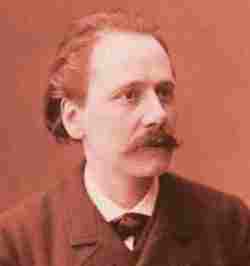
Jules Massenet was a French composer of the Romantic era best known for his operas. He was born on 12th May 1842 in Montaud, France and dies on 13th August 1912 aged 70.
Major Works
Incidental music “Les Érinnyes” (The Furies) (1873)
“Le Roi de Lahore” (1877)
“Manon” (1884)
“Werther” (1892)
“Méditation” from the opera “Thais” (1894)
Biography Timeline
1842: Jules-Émile-Frédéric Massenet is born on 12th May in Montaud, France (now a part of the city of Saint-Etienne). His father was Alexis Massenet an ironmaster. His mother was Eléonore- Adelaïde, née Royer de Marancour, who was a talented pianist who taught him how to play. He was the youngest of four children and was educated at the Lycee Saint-Louis school in Paris.
1848: The Massenet family move to Paris.
1853: He enters the Paris Conservatoire aged only eleven studying piano with François Laurent whilst still attending his school.
1855: His father’s health is poor and he moves the family on medical advice to Chambery in the south of France. Jules, however, returns to the Conservatoire in October and lodges with relations in Montmartre.
1859: He wins the Conservatoire’s first prize for piano students. To support himself he has to take on private students and also acts as a percussionist and pianist in the theatre where he meets Richard Wagner.
1861: He begins composition lessons at the Conservatoire under the opera composer Ambroise Thomas. His first piece of music to be published is the “Grande Fantasie de Concert” for piano based on the opera “Pardon de Ploermel” (The Pilgrimage of Ploërmel) by Giacomo Meyerbeer.
1862: He begins work on his first oratorio.
1863: He wins the Prix de Rome with his cantata “David Rizzio” which pays for him to have two years study in Italy. He enjoys his time in Rome and makes friends with several artists even though he does not gain much formal musical education. Whilst there he meets Franz Liszt, who introduces him to Louise-Constance de Gressy, a young French woman traveling with her mother and he gives her piano lessons. They fall in love but he is too poor to propose marriage. His father dies.
1866: He returns to Paris having made a living by teaching the piano and publishing songs, and piano pieces in the popular style of the day. He is commissioned to write an opera for the Opera-Comique by Amboise Thomas. He also composes a Requiem which is now lost. On 8th October he and Constance De Gressy marry.
1867: His first commissioned opera “La Grand’ Tante” (The Great Aunt) is performed.
1868: The couples only child, Juliette, is born.
1870: During the Franco-Prussian War he joins the French National Guard as a volunteer with his friend Georges Bizet. He is trapped during the Siege of Paris but manages to escape with his family before the Paris Commune begins and moves to Bayonne in the south.
1871: He becomes a founding member of the Société Nationale de Musique (National Music Society) whose aim is to support young French composers create a French style in contrast to the German music currently sweeping Europe.
1872: His opera “Don Cesar de Bazan” is a failure.
1873: His incidental music for the play “Les Érinnyes” (The Furies) by Leconte de Lisle is a great success, as is his oratorio “Marie Magdeleine” both of which are performed at the Theatre de l’Odeon in Paris. He is still earning the majority of his money through teaching however.
1875: His mother dies. He writes the oratorio “Eve”.
1876: He is made a Chevalier of the Legion d”Honneur.
1877: He writes the Grand Opera “Le Roi de Lahore” (The King of Lahore) which reflects the orientalism then in vogue and is based on the Mahabharata. It is first performed at the Palais Garnier. (Later known as the Paris Opera).
1878: He is appointed Professor of Counterpoint, Fugue and Composition at the Conservatoire where he will remain for the next eighteen years. “Le Roi de Lahore” becomes a huge success in eight Italian cities. He is elected to the Institut de France.
1880: He composes the oratorio “La Vierge” or Légende Sacrée)” (The Virgin) in four scenes which receives its premiere at the Opéra on 22nd May.
1881: The director the Opera refuses to perform “Hérodiade” (Herodias) judging it improper. It receives its premiere instead at the Theatre de la Monnaie in Brussels in December and is finally performed in Paris in 1884.
1884: The work which is considered his masterpiece, “Manon” is premiered at the Opera-Comique in January and goes on to tour Europe and the United States.
1885: His opera “Le Cid” is performed at the Paris Opera. Although he had been thinking for some time to write an opera based on “The Sorrows of Young Werther” by Johann Wolfgang von Goethe he starts working on it now.
1887: He completes“Werther” but it is turned down by the Opera-Comique. On 22nd May he meets the American soprano Sibyl Sanderson and is impressed by her voice and writes several roles for her over the next few years. Although the press characterise the pair as lovers it is thought the relationship was purely platonic.
1889: He composes “Esclarmonde” (Light of the World) which shows influences of Wagner.
1891: His next work “Le Mage” (The Magician) is a failure with audiences. He also writes the symphonic poem “Visions”.
1892: “Werther” finally gets its premiere in Vienna at the Hofoper on 16th February after the success of “Manon” and his ballet “Le Carillon” there.
1893: “Werther” is finally performed in Paris in January to enthusiastic applause at the Théâtre Lyrique and then tours Italy, Britain and the United States of America.
1894: He composes “Thaïs”, with its famous “Méditation” for violin and orchestra, which only receives a lukewarm reception at its first performance. He also produces “La Navarraise” (The Woman of Navarre).
1896: Ambroise Thomas dies in February leaving the post of Director of the Paris Conservatoire vacant. In May the government announce Massenet has refused it and it is therefore given to Theodore Dubois and that Massenet has resigned as Professor of Composition. It is believed he wanted the post of Director for life and this was refused.
1897: Having completed “Griselidis” he begins work on “Sapho” based on the novel by Alphonse Daudet and it is performed at the Opera-Comique in November.
1899: His performance of “Cendrillon” based on the Cinderella story is given in May 1899.
1900: He composes the oratorio “La Terre Promise” (The Promised Land).
1902: He composes the opera “Le Jongleur de Notre-Dame” (The Juggler of Our Lady).
1903: He finishes his Piano Concerto which he had first begun whilst still a student.
1905: He declines the directorship of the Conservatoire for a second time. He composes “Cherubino” based on the character from Mozart’s “The Marriage of Figaro”.
1910: He composes “Don Quichotte”, “Ariane” and “Therese” the last one being set during the French Revolution.
1912: He publishes his autobiography “Mes Souvenirs” (My Recollections).
Jules Massenet died from abdominal cancer on 13th August 1912 in Paris, France. He was buried at a private ceremony, with no music allowed at his own insistence, in the churchyard of Égreville.
Influences
The son of an ironmaster, Jules Massenet was musically talented and entered the Paris Conservatoire at very early age of 11. He studied composition with the opera composer Ambroise Thomas and in 1863 he met with his first success winning the Prix de Rome with his cantata “David Rizzio”.
His early influence was the music of Charles Gounod, so much so that he was known as “la Fille de Gounod” (Gounod’s daughter). He was inspired by flowing melodic lyricism and an affinity for mixing religious themes with passionate drama. Later he developed the full bloodied German Romanticism of Richard Wagner. He incorporated wagnerian musical devices such as continuous melodic flow and leitmotifs, though he his work was often lighter in tone and easier to sing.
Whilst in Rome as a Prix de Rome scholar, he met Franz Liszt who introduced him to the work of German masters from Johann Sebastian Bach onwards. His librettos were on inspired by great literature. Johann Wolfgang von Goethe in “Werther”, Pierre Corneille in “Le Cid” and Antoine François Prévost in “Manon”.
He appealed to nineteenth century Paris’s obsession with the exotic during the Belle Epoque. His historical settings and colourful instrumentation all added to the drama. He wrote more than forty stage works in a wide variety of styles, from opéra-comique to grander-scale settings as well as oratorios, cantatas and ballets and during his lifetime he was one of the most prolific and celebrated operatic composers writing twenty-four operas alone. He tried to keep up with current fashions moving from French Grand Opera, through Wagnerian drama right up to Verismo (Real-Life) works such as “La Nabarraise” (The Woman of Navarre). He also wrote over two hundred songs and a piano concerto.
By the time of his death in 1912 he was seen as old fashioned and his reputation had largely declined particularly outside of France. Many critics had begun to complain that he pandered too much to fickle Parisian tastes and watered his talents with a “weak and sugary” style and Fuller Maitland predicted that his work would all be forgotten after the composer’s death. Others disagreed. Sir Thomas Beecham stated “I would give the whole of Bach’s “Brandenburg Concertos” for Massenet’s “Manon” and would think I had vastly profited by the exchange”. By the 1990s, Massenet’s reputation had been considerably rehabilitated and a Massenet Festival was begun by Jean-Louis Pichon in his native town of Saint-Étienne.
As a teacher of composition at the Paris Conservatoire from 1878 he was highly influential on an entire generation of French composers. His students included Ernest Chausson, Gustave Charpentier, Gabriel Pierné and Florent Schmitt amongst their number. Although he did not teach them directly his approach to vocal writing and lyricism changed fashions in France and influenced later composers such as Claude Debussy and Francis Poiulenc. Internationally he was a direct influence on Italian Verismo giants such as Giacomo Puccini and the Italian Giovane Scuola of the late nineteenth and early twentieth centuries.
Further Information
List of compositions by Massenet.